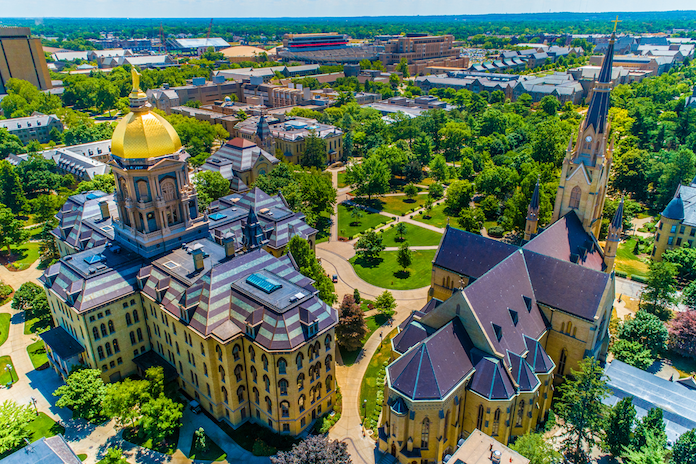
Founded in 1842, the University of Notre Dame, located in South Bend, Indiana, is a private research university steeped in its mission as a Catholic university ”to provide a forum where, through free inquiry and open discussion, the various lines of Catholic thought may intersect with all the forms of knowledge found in the arts, sciences, professions, and every other area of human scholarship and creativity.” Notre Dame has an undergraduate population of just under 9000 students and ranks #20 according to U.S. News & World Report 2026 Best Colleges in a four-way tie with Carnegie Mellon University, the University of Michigan–Ann Arbor, and Washington University in St Louis. It also ranks #10 in Best Undergraduate Teaching.
Notre Dame by the Numbers
According to Notre Dame’s student newspaper, The Observer, the Class of 2030 admissions rate held steady at its record low of 9%. The university also saw an increase in the number of applications in the most recent admission cycle: 36,102—701 more than last year. According to The Observer, Notre Dame’s acceptance rate has fallen by more than half since 2016.
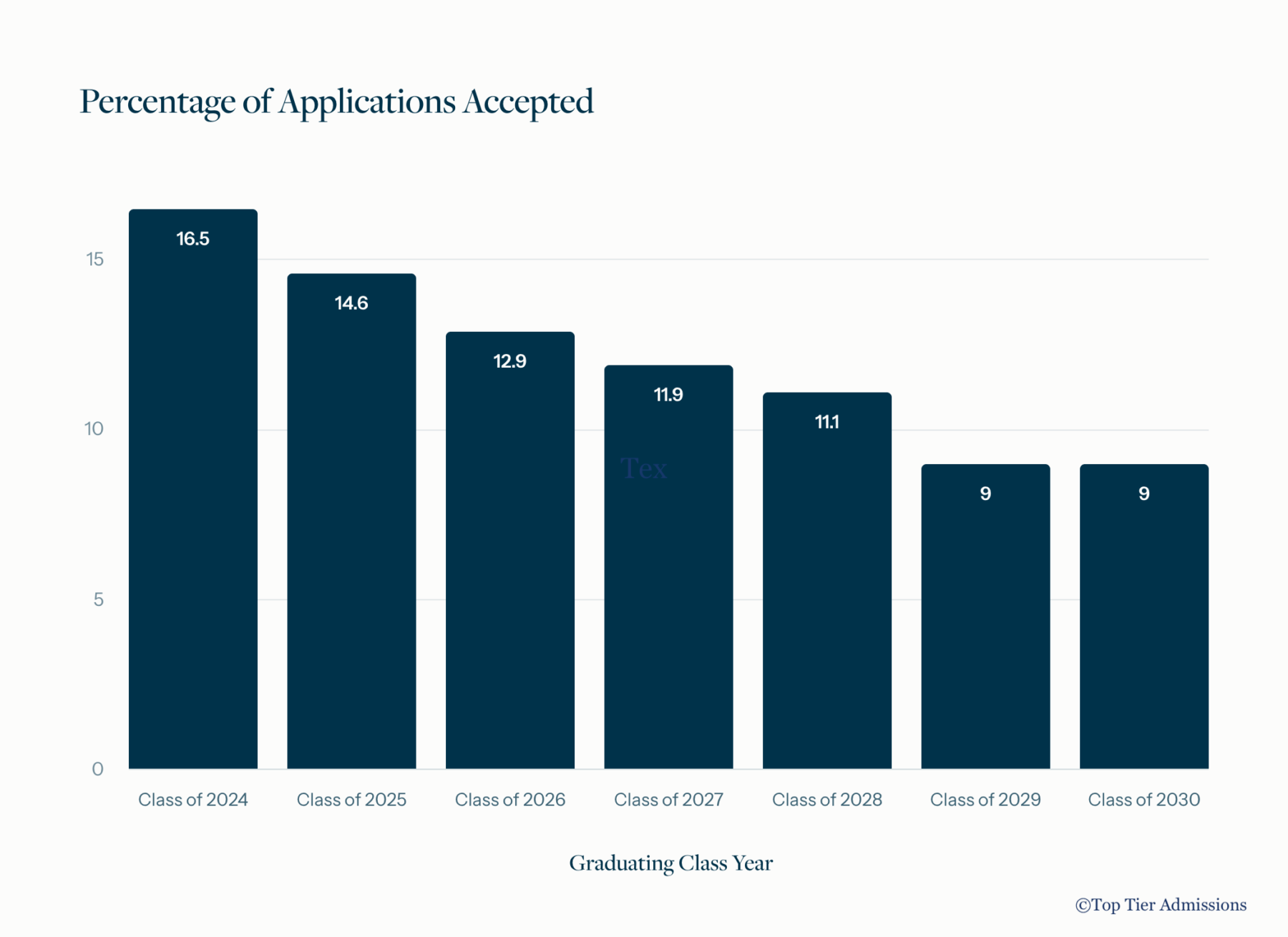
Although Notre Dame stopped reporting decimal places in its acceptance rate percentages, the sustained hyper-selectivity of the University of Notre Dame’s Class of 2030 underscores a broader national paradigm shift, wherein top-tier applicants are increasingly drawn to institutions that offer a potent combination of elite academic rankings and distinct institutional identities. Considered one of 20 public and private universities deemed the New Ivies, which represent 20 public and private universities throughout the United States, Notre Dame has emerged as a compelling alternative to the eight Ivy Leagues institutions and four Ivy-plus schools: Stanford, MIT, Duke, and the University of Chicago. Like its “New Ivy” counterparts, Notre Dame has seen an influx of applications from high-achieving, motivated students at a time when the Ivy and Ivy-plus colleges and universities are falling under increased scrutiny for their admission policies and responses to student protests.
What Restrictive Early Action Means at Notre Dame
Notre Dame’s commitment to financial aid underscores the university’s commitment to accessibility for all admitted students. According to the university’s Admissions webpage, Notre Dame meets 100% of student need without loans—and promises zero tuition to families who make less than $150,000/year.
Informative also is the university’s choice to offer Restrictive Early Action—an application pathway that allows students to apply on November 1 and receive an admission decision in mid-December without having to commit to an offer until May. Without forcing an early commitment, Notre Dame allows students the flexibility to compare offers. Restrictive Early Action, however, does impose certain limits: students applying REA to Notre Dame may not apply to any other institutions under a binding Early Decision I program. This policy ensures that Notre Dame will not lose admitted applicants in the early round—while still providing the university an early read on their applicant pool.
Notre Dame’s admission language is telling: the university specifically encourages students for whom Notre Dame is their first or one of their top choices to apply Restrictive Early Action. The message here? If you want to maximize your chances of admission, apply early. The numbers support that message: Notre Dame received 13,711 undergraduate early applications to the Class of 2030. The school accepted 1,617, for a rate of 12 percent—a statistically significant advantage compared to the 9% overall admission rate.
Living Its Mission
Despite the increase in selectivity, Notre Dame remains true to its mission as a Catholic university devoted to scholarship, faith, and a “desire to serve the common good.” In 2029, Notre Dame enrolled a student body consistent with its stated purposes: in addition to its significant commitment to financial aid, the university enrolled 81% students who identified as Catholic and another 20% of Pell Grant recipients or first-generation students. Although full demographic information has not yet been released for the Class of 2030, The Observer reports that the incoming freshman class will include students representing all 50 states, the District of Columbia, five U.S. territories, and 183 countries.
These numbers represent Notre Dame’s ongoing commitment not simply to a faith-based education but also to its wide reach.
Prestige and Purpose
The University of Notre Dame’s Class of 2030 admissions cycle demonstrates that exceptional institutional selectivity and a steadfast commitment to foundational values are not mutually exclusive despite a defining shift in the landscape of higher education. The admissions data for the University of Notre Dame’s Class of 2030 also illustrates a defining shift in the landscape of elite higher education. By sustaining a record-low 9% acceptance rate amidst a growing pool of over 36,000 applicants, Notre Dame cements its status as a premier institution operating at the highest levels of national selectivity.
Explore Additional Resources
Are you thinking about applying to Notre Dame? Curious about admissions trends and strategies to improve your odds? Contact us to discuss our Application Boot Camp® or Private Counseling program—we look forward to supporting you!
- The New Ivies 2026: What Changed and What It Means for Applicants
- Get Into Notre Dame
- Should Your Student Apply Early Decision (and to Where)?
- What It Actually Takes to Get Into a Top College in 2026
- How to Choose a College Major
Stay Connected for More Expert Guidance
Want to stay in the loop? Follow us on Instagram @toptieradmissions and subscribe to our blog for expert advice and admissions insights.
Know someone else navigating the college process? Pass it along—they’ll thank you later!

She began her career at Kent School as an English teacher, coach, dormitory faculty member, and assistant athletic director, developing a deep understanding of students both inside and outside the classroom. After earning her master’s degree from Northwestern University, she joined Westminster School, where she ultimately served as Director of College Counseling, guiding students and families through academic planning and highly selective admissions.
Kate later held senior leadership roles at Pomfret School and for 12 years at The Winsor School, where she oversaw grades 5–12 academics, supervised college counseling, conducted mock interviews, and helped shape institutional strategy.
Having worked as a teacher, advisor, college counselor, academic dean, and associate head of school, Kate understands how admissions decisions are made — and how to position students thoughtfully and authentically. Today, she focuses on what she values most: partnering one-on-one with young people to help them tell their stories with confidence and purpose.
- NYU Supplemental Essays 2026-2027 - October 3, 2026
- University of Pennsylvania Supplemental Essays 2026-2027 - September 24, 2026
- University of Chicago Supplemental Essays 2026-2027 - September 18, 2026