Cornell is one of the hardest Ivies to decode because its admissions process is not organized around a single undergraduate admissions pool. Cornell’s famous motto, “any person…any study,” feels expansive, inclusive, and open-ended. And, in many ways, it is. But from an admissions standpoint, Cornell is highly structured: applicants apply directly to one of Cornell’s eight undergraduate colleges or schools, and that choice then determines how their application file is read.
Applying with a College-Specific Strategy
Applying to Cornell with a college-specific approach rather than a university-wide one is essential, and is where many otherwise strong applicants fall short. At Cornell, the college or school you choose determines which of the eight admissions offices evaluates your application and also shapes the admission officer’s expectations, the supplements you must write, the academic evidence you need to show, and the overarching story your application must tell.
When I worked as Assistant Director of Admissions for Cornell’s College of Arts & Sciences, I looked for the most compelling Arts & Sciences applicants, often turning directly to the college-specific portion of the application first, rather than evaluating applications from an overarching Cornell-wide perspective. And my colleagues in Engineering, CALS, Human Ecology, ILR, AAP, Brooks, and the business programs were doing the same for their own academic communities. The strongest Cornell applications are those where the student’s transcript, activities, recommendations, intended major(s), and supplement all make great sense for that particular Cornell college or school and its majors. This is what Cornell calls “fit.” In practice it means that a convincing application with a lower GPA could easily outshine one with a higher GPA but weaker college-specific rationale.
“Which Cornell College Is Easiest To Get Into?”
As a college counselor, families often ask me – “Which Cornell college is easiest to get into?” Admit rates do vary somewhat by Cornell college and I share those college-specific admit rates here with the caveat that simply looking at the numbers for the greatest acceptance rate is a potential trap for the unwary.
Cornell Admit Rates by College
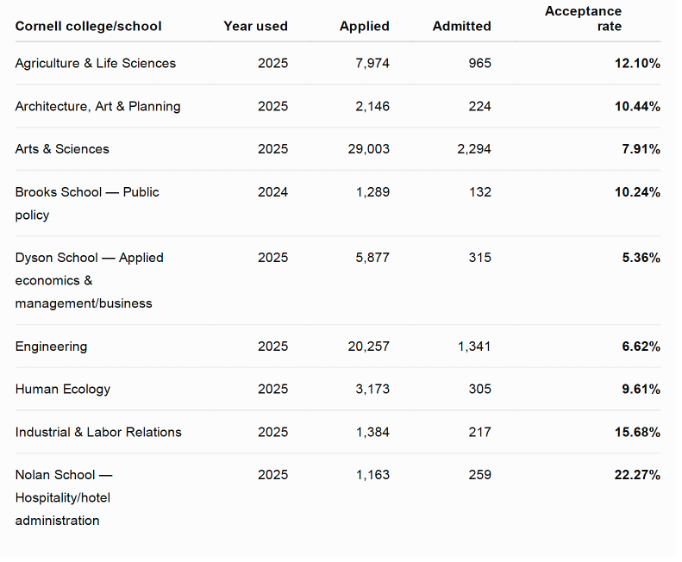
Cornell’s overall acceptance rate in 2025 was 8.7%. TTA students were admitted at a rate of 61%, more than seven times the university’s admit rate.
The most important take-home from this table is not which programs stand out as more or less competitive. Instead, the spread highlights how Cornell’s undergraduate admissions process is “siloed” and driven by college-specific priorities. An applicant to Engineering needs to make a very different case from an applicant to ILR. A Human Ecology reader is looking for different evidence than an Arts & Sciences reader. A Nolan applicant must tell a different story from a Dyson applicant.
This is also why this chart can be dangerous if you let admissions rates drive your application strategy. A student with authentic, well-developed hospitality, service, operations, travel, food, customer-experience, or hotel-related interests may be a great fit for Nolan. But a student with no meaningful hospitality or service-business story should not look at Nolan’s admit rate and conclude that it is an “easier” path into Cornell; it is instead the wrong Cornell for that student.
Cornell admissions officers are adept at spotting such mismatches. If your file reads like Engineering but you apply elsewhere because the admit rate looks more favorable, the mismatch weakens your application and the reader will pick up on that disconnect. Years ago, Cornell admissions officers “traded” applications between units, forwarding those that seemed mismatched or too weak for one college that might have resonated more strongly in another. Now, with application volumes as high as they are (Cornell received 72,523 applications in 2025), this practice has been discontinued. As a result, it is up to the applicant to make the correct decision about which college they are strongest for and wish to attend. The critical question applicants should be asking themselves is therefore: “Which Cornell college can I prove that I belong in the most?” There is no second chance for students who choose unwisely: you can only apply to one Cornell college.
How to Distinguish Between Cornell’s Colleges
College of Agriculture and Life Sciences. CALS is grounded in purpose-driven and applied science and requires direct entry to a specific major, so applicants must show how a specific CALS major fits the interests they have already developed and pursued. Students interested in fields like biology, environment, agriculture, food systems, communication, animal science, and applied life sciences typically find their home in CALS.
College of Architecture, Art, and Planning. AAP is pre-professional and highly self-selecting for architecture and art applicants. Successful AAP applicants typically have been working intentionally towards building their relevant portfolios for several years and have a robust body of work to share. AAP is the only Cornell college that still engages faculty in admissions decisions, and faculty both review application portfolios and interview students, reflecting the deep investment in choosing one of Cornell’s smallest college classes.
College of Arts & Sciences. This is the Cornell college I know most intimately from the admissions side. Although all students matriculate as “undeclared” and do not need declare their major until sophomore spring, A&S is not impressed by applicants who are vague about their academic interests. Instead, it is looking for intellectual range, depth, and curiosity. The student who wants to connect biology and economics, classics and government, computer science and linguistics, or another genuine interdisciplinary combination can make a strong case for A&S, where about 20% of students in the college double major.
Brooks School of Public Policy. Brooks is Cornell’s newest college-level unit and is for students who think in policy terms. That does not mean a generic interest in politics or current events; it means the student can point to public problems, institutions, systems, communities, data, governance, health, inequality, or sustainability and explain how they have engaged with thinking through a policy lens.
SC Johnson College of Business: Dyson and Nolan. The business application requires special consideration because Dyson and Nolan are very different pathways. Dyson is the home for applied economics and management; Nolan is the home for hotel administration and hospitality/service-business management. Dyson applicants need to make an analytical, economic, managerial, entrepreneurial, or agribusiness case. Nolan applicants need a genuine hospitality, service, operations, or customer-experience story.
Duffield College of Engineering. All engineering applicants need to bring a problem-solving identity along with high-level math and science preparation and STEM extracurriculars. The best Engineering applications show why engineering is the student’s chosen way of acting on the world, then make a Cornell-specific case for the projects, curriculum, and community they want to join.
College of Human Ecology. This college is applied, interdisciplinary, and human-centered. A strong CHE applicant usually has a challenge in mind – in a community, career, industry, health setting, family system, design context, or social structure – and can explain how a CHE major, and the breadth of a CHE education, will help them address it. This is another place where families sometimes see a slightly higher admit rate and mistakenly imagine a shortcut. CHE wants students whose academic and extracurricular record already shows a human-centered problem they are genuinely prepared to pursue in the major they apply to within CHE.
School of Industrial and Labor Relations. ILR is an applied social science school focused on work, labor, organizations, policy, law, business, and institutions. Strong applicants often care about workplace issues, inequality, unions, management, conflict resolution, labor economics, employment law, or organizational change. The best applications show not only interest, but evidence that the student has already begun to engage seriously with questions of work, power, institutions, and people—and can explain why ILR is the right academic home for that work.
Not sure which Cornell college fits your student?
Same Major, Different Cornell College
Cornell becomes especially complicated when the same major can be pursued through more than one college. For example:
- Computer Science can be pursued through Engineering or Arts & Sciences.
- Both Biological Sciences and Environment and Sustainability can be pursued through CALS or Arts & Sciences.
- Biological Engineering and Environmental Engineering can both be pursued through CALS or Engineering.
In these cases, the major requirements, faculty, and research opportunities are the same, but the surrounding college-level course distribution requirements differ. A computer science student with a fundamentally engineering-driven story may belong in Engineering. A computer science student whose academic life is grounded in language, cognition, political theory, economics, or another liberal arts pairing will have a stronger Arts & Sciences case. A biology student who wants to pair biology with economics fits A&S; a biology student who wants communication or applied life sciences fits CALS since Cornell students can only double-major within their home college.
This is one of the few places where admit-rate data can become legitimately strategic. If a student can make an authentic, well-evidenced case for more than one Cornell college, then the admit-rate difference can be one factor in the decision. But it should never be the driving factor. A convincing answer to “why is this my natural academic home?” is even more essential for students applying to a major accessed by multiple schools.
Internal Transfer Is not an Application Strategy
Cornell does allow internal transfers between colleges, and approximately 10% of students find that their interests evolve as undergraduates and then switch their college. College is for exploring and many students do discover new interests along the way that set them on new academic paths. That is healthy and normal. But applying to one Cornell college with a preexisting plan to leave it is a different matter and a big mistake.
When I led information sessions for prospective Arts & Sciences applicants, invariably someone in each group asked, “How hard is it to transfer into Engineering?” during the Q&A. This question always frustrated me and immediately raised red flags as it highlighted, even before applying, that A&S was not the academic home they wanted.
If you know you want Engineering, apply to Engineering. If you know you want ILR, apply to ILR. If you know you want Human Ecology, CALS, Brooks, Dyson, Nolan, AAP, or Arts & Sciences, build the application for that college or school from the start. Otherwise, even if you get in you will spend your first year completing requirements for a college you do not intend to stay in, missing prerequisite sequences for the program you actually want, and building advising relationships in the wrong academic home.
The Bottom Line
The strongest Cornell applications make a specific argument, not for Cornell, but for the specific college or school and its majors as the academic home within Cornell where the academic record, interests, preparation, and future plans all make sense.
Use the admit-rate table that I’ve calculated directly from Cornell’s Office of Institutional Research & Planning data above as context. Respect the differences among Cornell’s colleges and schools. Then, choose the Cornell that your application can honestly prove you are ready to enter.
Cornell rewards the applicant who chooses the right college from the start. Connect With Our Team
FAQ
How many undergraduate colleges and schools does Cornell have?
Cornell has six Colleges (each with multiple majors) plus two Schools (each with a single major) that admit undergraduates. Each has its own admissions office and separate supplemental essay. Applicants can apply to only one.
What is the difference between Cornell’s contract and endowed colleges?
Cornell is a unique amalgam of private endowed colleges and public New York State contract colleges or schools, all under the same Cornell University umbrella. NYS contract colleges are partly funded by New York State, which means that official NY state residents have an admissions advantage and, if admitted, pay reduced in-state tuition.
Cornell Contract (State-Supported Undergraduate Colleges)
- College of Agriculture and Life Sciences (CALS)
- College of Human Ecology (CHE)
- School of Industrial and Labor Relations (ILR)
- Charles H. Dyson School of Applied Economics and Management
- Jeb E. Brooks School of Public Policy
Which Cornell college is easiest to get into?
Statistically, Nolan has the highest admit rate, followed by ILR. But that does not make either program the easiest path for most applicants. A higher admit rate only helps if the student’s academic and extracurricular record is genuinely aligned.
Which Cornell college is hardest to get into?
Dyson currently has the lowest admit rate, followed by Engineering and Arts & Sciences. And Engineering’s already selective rate is compounded by a self-selecting group of high achieving STEM applicants. But “hardest” also depends on the applicant’s fit. A student with the wrong academic story will be a weak applicant anywhere.
Should I choose a Cornell college based on acceptance rate?
No. The admit rate becomes strategically relevant only when the student can make an authentic case for more than one Cornell college offering the same or similar academic path.
Can I transfer between Cornell colleges after enrolling?
Internal transfer is possible, and approximately 10% of Cornell students apply to transfer to a different college within Cornell, but it is not a wise back-door admissions plan. Apply to the college or school that you actually want to call your academic home.
Stay Connected for More Expert Guidance
Want to stay in the loop? Follow us on Instagram @toptieradmissions and subscribe to our blog for expert advice and admissions insights.
Know someone else navigating the college process? Pass it along—they’ll thank you later!

After attending Castilleja School in Palo Alto, California, Heidi graduated cum laude with an Honors thesis from Dartmouth College as a double major in Classical Archaeology and Comparative Literature. At the University of Pennsylvania, Heidi was a Williams Fellow in the graduate program of Art and Archaeology of the Mediterranean World. She has conducted archaeological field work in Sardinia, Cyprus, Greece, and Turkey.