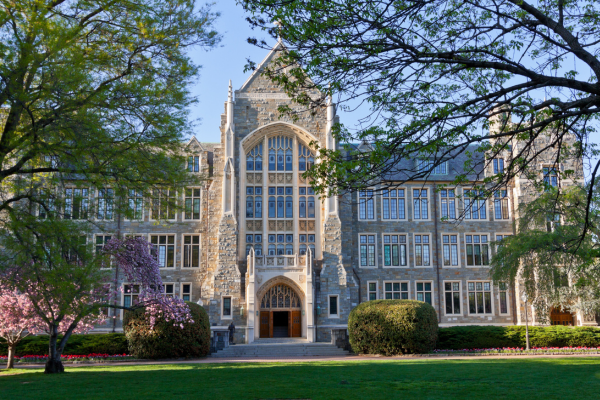
Georgetown University is a leading research institution situated on just over 100 acres in the historic Georgetown district of Washington, D.C. Recognized as the oldest Catholic and Jesuit institution of higher education in the United States, the university fosters an inclusive environment that embraces all faiths and perspectives. Hallmarks of the Georgetown experience include an education for both the “heart and mind,” service, a global mindset, and the proximity of “D.C. at your door.” The university enrolls approximately 8,000 students in over 50 majors across its undergraduate schools. Georgetown ranks #24 in a tie with Emory University, according to U.S. News & World Report 2026 Best Colleges.
Georgetown Acceptance Rate
According to The Hoya, Georgetown’s student newspaper—first published in 1920—Georgetown admitted 13% of applicants to the Class of 2030, roughly one percentage point higher than last year. Georgetown’s 26,900 applications reflect the university’s continued popularity for high-achieving students seeking a mid-size research university with access to a large city. Its community, campus, and rich selection of undergraduate opportunities, plus the promise of engagement with students from all over the world, also make Georgetown a popular destination.
Although the university has not yet released more specific data on how many students it accepted or the demographics of its admitted class, the numbers reported by The Hoya for the Class of 2030 reflect an increase in the total applications received.
| Year (Entering Class) | Number of Applications | Number of Students Admitted | Acceptance Rate |
| 2026 | 26,900 | Not available | 13.0% |
| 2025 | 26,131 | 3211 | 12.3% |
| 2024 | 25,485 | 3,241 | 12.7% |
| 2023 | 26,638 | 3,217 | 12.1% |
| 2022 | 27,629 | 3,282 | 11.9% |
| 2021 | 21,190 | 3,286 | 15.5% |
Like many selective undergraduate institutions during and immediately after the COVID-19 pandemic, Georgetown University waived the standardized testing requirement for applicants who were unable to access testing; however, those able to test were still required to submit their results. This change in policy, though brief, likely explains the surge in application numbers and the dramatic reduction in acceptance rate for those entering in 2022. Georgetown was the first among its elite peer institutions to reinstate the standardized testing requirement and has maintained it ever since. According to a University News article published on March 27, 2025, a recent analysis from the National Bureau of Economic Research affirmed Georgetown’s decision to require standardized tests, citing the results that “making test scores optional disproportionately harms students from poorly-resourced high schools.” Consistent with its commitment to a diversity of experiences and perspectives, Georgetown remains steadfast in its standardized testing requirement for the foreseeable future.
New Policies Announced
In that same article, Georgetown announced two admissions policies that will have a direct impact on both application numbers and enrollment—and, likely, selectivity. After a two-year study, Georgetown decided to uphold its commitment to legacy admissions. The institution will continue to give “extra care and attention” to relatives of faculty, staff or alumni. Why does this matter? The commitment to legacy admissions, as well as hooks such as athletic recruitment and donor ties, reduces the statistical chances of acceptance for “unhooked students,” whose applications are read without these added considerations.
The most significant change to Georgetown’s admissions policy, however, is the university’s decision to begin accepting the Common App, in addition to its current application, in August 2026 for the class entering in fall 2027. Georgetown attributes this change to its ongoing commitment to removing admission barriers for students from a wider variety of backgrounds who may not have the guidance or means to access Georgetown’s proprietary application. Because more than a thousand colleges and universities use the Common App, interested students will have a much easier time applying.
What implications does this hold for current high school students hoping to secure a place in Georgetown’s Class of 2031? On the one hand, they will find the admissions process more streamlined for multiple applications. On the other hand, it’s reasonable to expect that applications to Georgetown will once again surge, as they did when the standardized test requirement was removed following the pandemic. When colleges remove admissions barriers, more students elect to apply, which inevitably drives down the overall acceptance rate. Although it is too early to know the actual impact of Georgetown’s decision, we can expect some measure of unpredictability in the upcoming admissions cycle.
Final Thoughts
Despite the anticipated effects of Georgetown’s decision to accept the Common App and its reinforced commitment to legacy admissions, securing a place at Georgetown has always been competitive. Students must demonstrate significant course rigor, high academic performance, and a compelling demonstration of their commitment to the greater good. To distinguish themselves, they must also show evidence of deep curiosity and scholarship and their potential to contribute meaningfully to their college community and beyond.
Explore Additional Resources
Are you thinking about applying to Georgetown? Curious about admissions trends and strategies to improve your odds? Contact us to discuss our Personal Application Boot Camp® or Private Counseling program—we look forward to supporting you!
- Navigating the Georgetown Application
- Get Into Georgetown
- What It Actually Takes to Get Into a Top College in 2026
- How to Choose a College Major
- What Is College Fit? How to Choose a University That Matches You
Stay Connected for More Expert Guidance
Want to stay in the loop? Follow us on Instagram @toptieradmissions and subscribe to our blog for expert advice and admissions insights.
Know someone else navigating the college process? Pass it along—they’ll thank you later!

She began her career at Kent School as an English teacher, coach, dormitory faculty member, and assistant athletic director, developing a deep understanding of students both inside and outside the classroom. After earning her master’s degree from Northwestern University, she joined Westminster School, where she ultimately served as Director of College Counseling, guiding students and families through academic planning and highly selective admissions.
Kate later held senior leadership roles at Pomfret School and for 12 years at The Winsor School, where she oversaw grades 5–12 academics, supervised college counseling, conducted mock interviews, and helped shape institutional strategy.
Having worked as a teacher, advisor, college counselor, academic dean, and associate head of school, Kate understands how admissions decisions are made — and how to position students thoughtfully and authentically. Today, she focuses on what she values most: partnering one-on-one with young people to help them tell their stories with confidence and purpose.
- Caltech Supplemental Essays 2026-2027 - October 19, 2026
- Test-Optional vs. Test-Blind: Decoding College Testing Policies - October 15, 2026
- NYU Supplemental Essays 2026-2027 - October 3, 2026