This application season, we’re watching to see how a few things will play out: the reintroduction of the SAT/ACT requirement at several top schools, the drop in enrollments of Black and Latino students, the California ban on legacy admissions, and the predicted “enrollment cliff.” All four will have interesting implications for this application cycle and beyond.
COLLEGE ADMISSIONS TRENDS
Testing Requirements — The Ever-Shifting Landscape
In the last several months, Brown University, Dartmouth College, Harvard University, and Yale University have all returned to requiring standardized testing as part of the admissions process, beginning with applicants to the Class of 2029. They join Georgetown University and MIT, two schools that quickly reinstated testing requirements post-pandemic. Two large state university systems —Florida and Georgia — also require standardized testing. Looking ahead, Caltech, Stanford University, Cornell University, and the University of Texas at Austin will require testing beginning with applications submitted in the fall of 2025 for the Class of 2030.

SAT Tutoring
Expert one-on-one guidance to boost your score.
Among the factors driving the change are data from researchers at Dartmouth showing that scores are a better predictor of how students will fare in college (and much better predictors than high school grades) and, when used as part of a holistic admissions process, can be especially useful in identifying high-potential students from under-resourced schools and communities. To put it more bluntly, the very students that top colleges sought to admit – those “diamonds in the rough” whose standardized test scores far outshone their peers in their schools and communities were being missed since many low-income students, in particular, were choosing not to submit scores.
We’ve written before on the prevalence of significant grade inflation at high schools across the country. When 60% of students in some high schools have an A- average or higher, there’s no way grades alone can distinguish the very best from among this high-achieving group. Standardized testing – SATs, ACTs, and APs – provide useful, standardized data with which to compare students who, based on grades alone, are indistinguishable.
In the wake of the pandemic-era test-optional admissions policies, the applicant pools at top colleges ballooned as students nationwide decided to toss their application “hats” into many rings because, “why not?” Now, with testing requirements reinstated at some top schools, we expect to see some reduction in the numbers of applicants. It’s also a pretty safe bet that applicant pools at top schools who are still test-optional (including Columbia University and Princeton University, among others) will see larger shares of high-scoring students in their applicant pools, making it harder for most students to gain admission without top scores.

Essay Guidance
Get our expert guidance on your college essays.
Student Body Diversity Takes a Hit at Many Top Schools
The Class of 2028 was the first to be admitted since the Supreme Court outlawed the use of race in admissions. Just as quickly as new students settled into their dorm rooms and began their classes, colleges released profiles of students enrolling in the Class of 2028. For many colleges and universities, the numbers showed a dramatic drop in the diversity of the enrolling class; for others, the change was less dramatic.
The share of Black students enrolling in Amherst’s first-year class dropped by 8 percentage points, from 11% to 3%. At Brown, the numbers of Black and Latino first-year students dropped by 40% and 29%, respectively. Northeastern saw the enrollment of Black first-year students drop by 35%. Columbia saw the share of Black students in the first-year class drop from 20% to 12%. The percent of the class that identifies as Black or African American at Harvard dropped from 18% to 14% this year whereas the percent identifying as Hispanic/Latino grew from 14% to 16%. At MIT, only 16% of the Class of 2028 identifies as Black, Hispanic, Native American or Pacific Islander, down from 25% in recent years. Yale reported that for the Class of 2028, the share of Asian American students decreased by 6% compared to last year’s class, while Black and Latino enrollment remained largely the same.
Whether through new partnerships with QuestBridge’s National College Match Program (as Cornell just announced) and STARS (Small Town and Rural Students) or redoubling outreach to communities with a higher percentage of underrepresented students of color and more campus visitation/fly-in programs, we expect to see a continued focus on recruiting a diverse pool of applicants, especially socioeconomically. Using tools like the College Board’s Landscape and the Opportunity Atlas, admissions officers will gain important context on the schools and communities from which their applicants come.

Application Review Program
Do you have a compelling and strategic application package that will rise above the rest?
Warning: Another Enrollment Cliff Approaching!
As reported in the Chronicle of Higher Education last February, “the consensus view is that America will hit a peak of around 3.5 million high-school graduates sometime near 2025.” After that, we can expect the numbers of high school graduates going on to college to shrink by 15%.
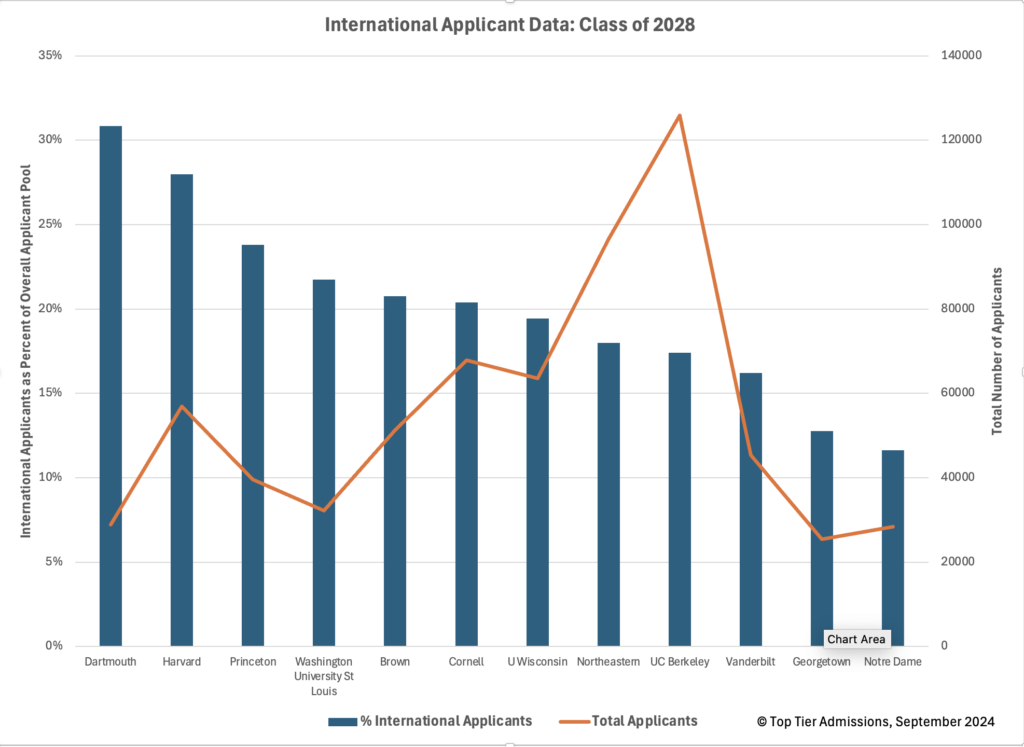
How might this enrollment cliff impact top colleges? Has it already? Diving into the most recent Common Data Set (academic year 2023-24) revealed that international applicants make up a pretty significant slice of the applicant pool at several of the nation’s most selective colleges and universities. Looking forward, colleges might continue to mitigate the effects of the domestic enrollment decline by strategically diversifying their applicant pools and recruiting more international students. Take a look:
There has been more pressure this year on the traditional model of college enrollment (18-year-olds heading off for four years of college) due to the cost of higher education, now further out of reach for most Americans. All but the most well-endowed colleges and universities simply don’t have the resources to steeply discount the cost of education. Added the demographic and financial pressures are increased political attention, eroding trust in higher education, and public skepticism about the real value of higher education. That said, as Dr. Michele Hernandez noted in “Where Do Billionaires Go to College?” there remains a noteworthy correlation between top colleges and financial success. We’d gamble that student interest and attendance at top colleges like the Ivies and Ivy Plus schools will not wane due to the cost of education. When the return on investment is worth the out-of-pocket expense of college, it makes the mountains of debt slightly more palatable (for those who can afford it.)
COLLEGE ADMISSIONS: THE YEAR AHEAD
As this year’s application cycle unfolds, we’ll be reading the tea leaves and share further insights and our expert analysis!
If you enjoyed this post, follow us on Instagram @toptieradmissions for more tips and subscribe to our blog for expert insights & college admissions news!

In addition, Maria is proud of her long-term volunteer work with Opera North (Lebanon, NH) in fundraising, marketing and audience engagement. She is an avid masters rower with the Upper Valley Rowing Foundation (Hanover, NH) and also serves as a member of its board of directors.