The 2026 college admissions cycle has seen acceptance rates plummet to unprecedented lows, particularly among top-tier institutions. As former Dean of Admissions at Dartmouth, here’s how I read between the lines of these numbers — and what it means for your family.
Is Anybody Getting In?
The overall acceptance rates at a range of the nation’s top universities for the 2026 admissions cycle (Class of 2030) showcase an era of hyper-selectivity. For comparative purposes, data from the Class of 2029 cycle is also included when no information is available for the current cycle:
| University | Overall Admit Rate |
| Caltech | 2.6% (Class of 2029) |
| Harvard University | 3.2% (calculated) |
| Stanford University | 3.6% (Class of 2029) |
| Vanderbilt University | 4.1% (calculated) |
| Columbia University | 4.23% |
| Yale University | 4.24% |
| Princeton University | 4.4% (Class of 2029) |
| MIT | 4.6% |
| University of Chicago | 4.6% (Class of 2029) |
| Duke University | 4.7% |
| Brown University | 5.35% |
| University of Pennsylvania | 5.4% |
| Dartmouth College | 5.8% |
| Johns Hopkins University | 6.1% (Class of 2029) |
| Northwestern University | 7% |
| Cornell University | 8.4% (Class of 2029) |
| University of Notre Dame | 9% |
| University of Southern California | 9.2% |
| Washington University St Louis | 12% (Class of 2029) |
Why Are Admit Rates Dropping?
Diving deeper into the data, I see four factors leading to today’s ever-lower admit rates:
1. Applications Submitted Per Student
The primary engine behind falling acceptance rates is not a massive spike in the number of students going to college, but rather a massive spike in the number of applications each student sends. Data from the Common Application shows that over 1.4 million students applied to colleges using the platform and the total number of applications submitted grew by 5% over last year to 9.42 million. Importantly, the average number of applications submitted per student via the Common Application jumped 3% this year, from 6.41 to 6 59 applications per student.
The average of 6.59 is merely a baseline. Looking beneath the surface a recent Common App trend report, First Year Applications Per Applicant, reveals that the pool of “power submitters”—students applying to 10, 15, or the platform’s maximum of 20 colleges—has grown exponentially. A decade ago, the vast majority of applicants submitted fewer than 5 applications. Today, applying to a single-digit number of schools is increasingly rare for students targeting selective institutions, as they use sheer volume as a hedge against unpredictable outcomes.
As students watch acceptance rates drop year after year, this ‘lottery ticket’ mentality leads to panic. Anxious applicants respond to hyper-selectivity by applying to even more schools to hedge their bets—often expanding their lists from 5 or 6 colleges to 12, 15, or even 20. This behavior creates a self-fulfilling prophecy: student anxiety drives higher application volumes, higher application volumes drive acceptance rates down, and lower acceptance rates drive further student anxiety for the next cycle.
2. Record-breaking Application Volume
Ever-lower admit rates start from record application volume. Admissions for the Class of 2030 was marked by continued record-setting volume at some schools. Yale University reported one of the most significant climbs, with 54,919 applicants, a 9.4% increase that university officials attributed to expanded outreach and enhanced financial aid. Brown University also reached a historic peak, receiving over 47,000 applications, which represented a 12% jump from the previous year. Fueling the surge were applications from first-generation students and students from rural communities, the result of intentional outreach by admissions staff. UVA experienced an unprecedented 27% increase in applications submitted. This year’s total of 82,118 represents the largest single-year jump in the last five years, largely due to the 13 percent increase in out-of-state applications for the regular decision application cycle. There’s no doubt that the lack of a UVA-specific supplement contributed to their record-breaking results.
Some more record-breakers this cycle include:
- Boston College: up 5.6% to a record-high 41,898 applicants for the Class of 2030.
- Columbia University: up 1.3%, making this year’s applicant pool the largest in Columbia history, with 61,031 applications.
- Duke University: up nearly 6% over last year to nearly 62,000 applicants, a record-high.
- Emory University: up about 13% to 43,269 applicants.
- Georgia Tech: nearly 68,000 applicants — a 2% increase from the prior year and a record-breaking total.
- Tufts: hit a new high of more than 36,000 first-year applicants, up 8% over last year.
- Vanderbilt: received over 56,000 applications, up 12%, and the largest pool in school’s history.
The Common App highlights that this volume surge is not exclusively driven by affluent students over-applying and that’s noted in several news releases this season. Colleges are quick to note that their increases in application volume are due, in no small part, successful outreach efforts to students from underrepresented backgrounds, rural and small towns, and low-income households.
3. Increased Use of Early Decision
In selective college admissions, the Early Decision (ED) option has transitioned from a niche preference for the decisive to a cornerstone of institutional enrollment management. By offering a binding commitment, colleges can lock in a significant portion of their incoming class – often 40% to 60% — before the Regular Decision cycle even begins. The use of ED provides universities with a yield ‘floor’, guaranteeing that every student admitted during the ED round will attend and effectively driving their yield rate for this cohort toward 100%.
Take a look at top schools that admitted 50% or more of their Class of 2029 through ED (or a combination of ED1 and ED2):
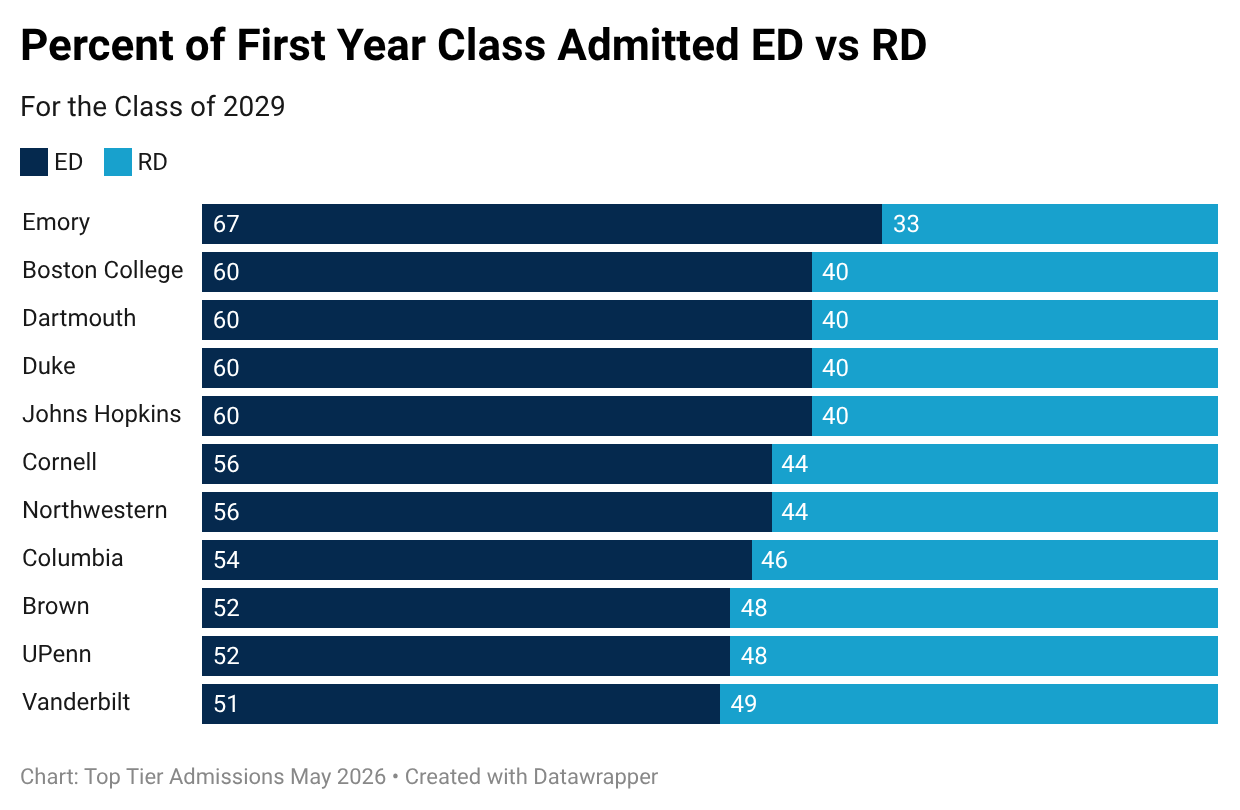
Strategically, this front-loading allows admissions officers to be ‘choosier’ during the RD round; since the foundation for the incoming class is set, they can afford to reject or waitlist a higher volume of qualified applicants, which systematically lowers the overall admit rate.
Looking Ahead
Looking ahead, I see an admissions landscape that is becoming more stratified and strategically complex than ever before.
Applications Will Likely Surge at WashU and Georgetown
Washington University in St. Louis (WashU) adding an Early Action (EA) option for the Class of 2030 will lead to increased application volume and is a calculated move that goes far beyond simply offering “more choice.” Historically, WashU has been one of the most aggressive users of Early Decision, filling upwards of 60% of its class through binding rounds to protect its yield. The addition of a non-binding EA round, alongside the formal reinstatement of “demonstrated interest” as an admissions factor, points to a sophisticated strategy.
WashU has long struggled with being a “backup” or “target” for Ivy League applicants. By offering EA, they can now capture high-achieving students who are unwilling to commit to a binding ED contract in November or don’t want to gamble on REA/SCEA to Harvard, Stanford, Princeton, or Yale. This may be especially true for a diverse set of high achieving students from middle- or lower-income families who want to compare financial aid offers. By adding an EA option, WashU may also be trying to tempt students to forgo REA/SCEA/ED altogether and instead, take a broader early strategy that could include EAs to schools like Michigan, UVA, UNC and Georgia Tech, along with WashU. An approach like this positions WashU as the premier private anchor in a non-restrictive early strategy.
Adding an EA round allows the admissions office to build a large, high-quality dataset by mid-December. Paired with the renewed emphasis on demonstrated interest, applying EA to WashU is the second strongest signal a student can send (after applying ED). Remember – a strong student applying EA effectively says they don’t want the binding ED or restrictive EA options. The EA application allows WashU to see who is truly interested versus who is just using the Common App to “collect” an admission. This helps them more accurately determine how many students to waitlist or reject in the Regular Decision round to keep their overall acceptance rate artificially low and prestigious.
Georgetown University’s decision to adopt the Common Application for a three-year pilot program beginning with the Class of 2031 (the 2026-2027 cycle) is one of the most significant shifts in elite admissions in recent years. Historically, Georgetown has been a “holdout,” requiring its own separate, bespoke application—a strategy that acted as a natural filter for the most dedicated applicants. By joining the world’s most ubiquitous application platform, Georgetown aims to cast a much wider net to ensure application volume remains high even as the national pool of students shrinks.
Georgetown’s separate application was often viewed as a “barrier to entry” for students from under-resourced high schools or first-generation backgrounds who may not have the counseling support to manage multiple application systems. Transitioning to the Common App is intended to reach students who previously skipped Georgetown because of the “extra hassle.” This will naturally increase the number of applications from low-income and minority students, as well as students across the country and around the world who rely heavily on the Common App’s convenience.
In the competitive landscape of the top tier universities, raw selectivity (acceptance rate) is a key metric for prestige. Georgetown’s current acceptance rate for the Class of 2030 is 13%—significantly higher than peers like Duke (~5%) or Harvard (~3.65%). Joining the Common Application will significantly increase the number of application Georgetown receives. Assuming Georgetown can accurately predict yield within the larger pool, this will naturally lead to increased selectivity and overall admit rates closer to its peer institutions.
The Last Word: Positioning Your Student for Success
If these numbers feel overwhelming, please know that you aren’t alone in that feeling. The 2026 cycle has been a “perfect storm” of rising application volumes and strategic shifts by elite universities. But as we’ve seen, much of this “hyper-selectivity” is driven by institutional math—like the expanded use of Early Decision to lock in classes early or the move to the Common App to intentionally boost applicant pools.
My goal is to help your family look past the “lottery ticket” mentality that leads to so much burnout. Success in this landscape isn’t about applying to 20 schools; it’s about understanding the nuances of things like “demonstrated interest” and choosing the right early strategy—whether that’s an EA anchor like WashU or a bespoke approach for a school like Georgetown.
My colleagues and I at Top Tier Admissions have guided many students through these record-low cycles, and they continue to find their “perfect fit” homes. You don’t have to navigate this complex map by yourself. Let’s sit down, take a deep breath, and start building a strategy that puts your student—not the statistics—first.
Frequently Asked Questions
Q: Why are college acceptance rates dropping every year?
A: Rates are dropping because students are submitting more applications than ever—often 10 to 20 each—which creates a cycle of hyper-selectivity and lower admit rates.
Q: What is the average Ivy League acceptance rate for the Class of 2030?
A: It’s 5.1%, but bear in mind that we are estimating admit rates for some Ivies and won’t have final confirmation until the 2026-27 school year.
Q: Does applying early decision improve your chances of admission?
A: Yes. Applying Early Decision is a powerful tool because colleges often lock in 40% to 60% of their incoming class through these binding commitments before the Regular Decision cycle even begins.
Q: How many colleges should I apply to given low acceptance rates?
A: You don’t need to be a ‘power-submitter”. A strategic, high-impact list tailored to you is more effective than simply treating applications like “lottery tickets”
Q: What can students do to improve their odds of admission to selective schools?
A: We suggest a three-part strategy. First, utilize the binding Early Decision option if your dream school offers it and you are squarely in range. Second, target Early Action wisely. Applying EA serves as the second strongest signal of interest and allows students to stand out before the Regular Decision pool becomes oversaturated. Finally, prioritize demonstrated interest at colleges and universities that use this in their decision making.
Stay Connected For More Expert Guidance
Want to stay in the loop? Follow us on Instagram @toptieradmissions and subscribe to our blog for expert advice and admissions insights.
Know someone else navigating the college process? Pass it along—they’ll thank you later!

In addition, Maria is proud of her long-term volunteer work with Opera North (Lebanon, NH) in fundraising, marketing and audience engagement. She is an avid masters rower with the Upper Valley Rowing Foundation (Hanover, NH) and also serves as a member of its board of directors.