
The early admissions season, which spans from mid-October to mid-February, is proving once again to be a volatile landscape for applicants. While transparency remains a challenge as several elite private universities continue to withhold real-time data, the publicly available numbers for the Class of 2030 reveal a clear theme: the test score requirement is a primary driver of application volume.
Last year at this time, we saw a “mixed bag” of results. This year, the bag is being sorted by those schools that have reinstated mandatory testing requirements and those that remain test-optional. Here is what we know so far and what these trends portend for the Regular Decision pool and current juniors.
Key Early Application Trends for the Class of 2030
Mandatory Testing vs. Test-Optional
The most striking trend this season is the impact of reinstated testing requirements. Last year, UPenn saw a 12% surge in applications while remaining test-optional. This year, following their return to mandatory testing, ED applications plummeted to approximately 7,800, a sharp 18% decline from last year’s record 9,500 early applications.
In contrast, schools that have maintained their testing requirements for longer, like MIT, saw more stability. MIT’s Early Action pool dipped only slightly (1.4%) to 11,883, but the competition remains fierce with a 5.5% admit rate. Meanwhile, Notre Dame—which remains test-optional—saw its Restrictive Early Action pool swell by 6% to a record 13,711 applicants, resulting in a record-low 11.8% acceptance rate.
SAT Tutoring
Expert one-on-one guidance to boost your score.
Early Application Results: Class of 2030 at a Glance
| School | Early Volume | Admit Rate | Key Takeaways |
|---|---|---|---|
| Brown | 5,406 (ED) | 16.5% | ED apps up 7% over last year (~400 apps); admit rate dropped from 17.9% last year. |
| Columbia | 5,497( ED) | TBA | A 6.4% decrease in volume compared to the Class of 2029. |
| Duke | 6,159 (ED) | 13.8% | 7% volume drop; admit rate slightly higher than last year. |
| Northwestern | ~5,600 (ED | TBA | ~7% drop in ED volume over last year; over 50% of NU’s class was admitted ED. |
| Notre Dame | 13,711 (REA) | 12% | REA apps up 6% over last year (~800 apps); only 19% of REA apps were deferred. |
| UPenn | ~7,800 (ED) | TBA | ~17% drop in ED apps over last year; testing requirement reinstated this year. |
| UVA | 5,108 (ED) | 24% | 62.5% of the 1,225 ED admits were Virginians. |
| Yale | 7,140 (SCEA) | 10.9% | Admitted 779; 18% of the pool was deferred. |
Macro Trends: The Common App November 2025 Report
The Common Application’s latest data offers a bird’s-eye view of the shifting demographics and behaviors of the modern applicant. While specific elite schools may see volume fluctuations due to testing policies, the Common Application as a whole continues to see growth on its platform. By November 1, 962,284 first-year applicants had submitted 4,716,352 applications—a 5% increase in applicants and a 10% rise in total applications compared to the same point last year. Students applied to an average of 4.90 colleges, up slightly from 4.68, continuing the steady upward trend in application volume and reach.
Some items we note:
- Mirroring the policy shifts at top-tier schools, there was an 11% increase in students submitting SAT or ACT scores across the platform. The “test-optional” era is clearly receding in favor of “test-preferred” or mandatory environments.
- While domestic applicant numbers grew by 5%, with the Southwest (15%) being the fastest-growing region, international applications saw a surprising 9% decline. This is a notable reversal from the double-digit growth in international applicants seen in recent years and an early warning indication that current U.S. immigration policies might be impacting the higher education plans of students worldwide.
- The ongoing access and outreach efforts across many colleges and universities impact the overall applicant diversity. Black/African American applicants grew by 16% and first-generation applicants increased by 12%. Additionally, the growth rate among applicants from rural areas was greater than the rate among those from metropolitan areas.
College Private Counseling
Unlock your full potential.
Class of 2030 Early Application Trends: What This Means for the Road Ahead
As we look toward the Regular Decision round, the “tea leaves” suggest that students are becoming more strategic—or perhaps more cautious. The drop in volume at schools like UPenn this year (and schools like Yale, Brown, and Dartmouth last year) suggests that mandatory testing is acting as a natural filter, discouraging “aspirational” applications from students without competitive scores. The decline in international student applications may create a “selectivity cushion” for domestic students, even at some of the most hyper-competitive colleges and universities. Because international students often pay full tuition and represent a significant portion of the applicant pool at many universities, a persistent decline may force these schools to accept a higher percentage of domestic applicants to meet enrollment and budgetary goals. In fact, a look at Common Data Sets for a range of colleges and universities shows us that international applicants can make up a significant proportion of their applicant pools. Nearly a third of applicants at Dartmouth and Harvard, for instance, are international citizens. At Duke, Tufts, Cornell, Princeton, Columbia, UPenn, Brown, Rice, and Emory, a quarter or more of applicants are not U.S. citizens or permanent residents.
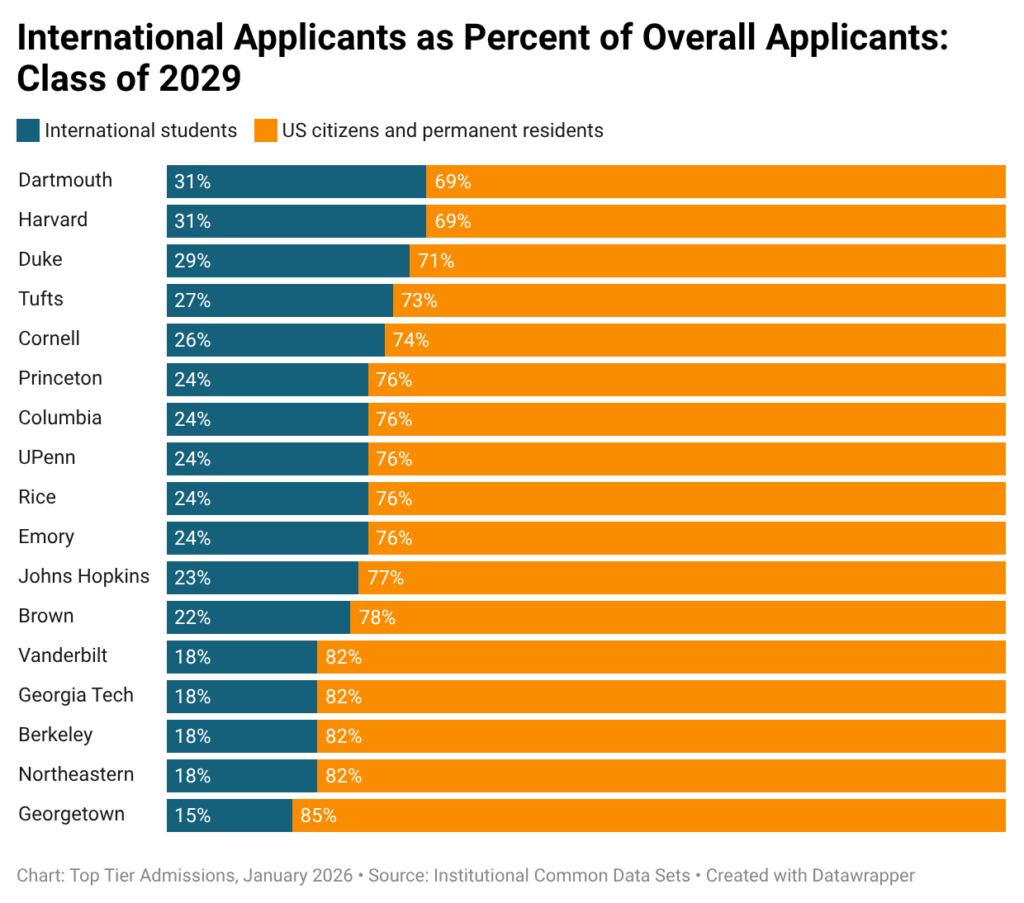
For the first time in years, U.S. citizens might find the math of admissions shifting slightly in their favor during this admissions season. Fewer international applicants (without an offset in increased applications from U.S. citizens) will result in decreases in overall applicant volume and upticks in rates of admission.
As more data becomes available, we will continue to update our analysis to help families navigate this increasingly complex environment.
Want to stay in the loop? Follow us on Instagram @toptieradmissions and subscribe to our blog for expert advice and admissions insights.
Know someone else navigating the college process? Pass it along — they’ll thank you later!