

If “factors that matter most in college admissions” were the question posed to contestants on “Family Feud,” surely the top answer would be “high school transcript.” Scan the websites of any selective college and you’ll see that colleges care deeply about the combination of grades and rigor of courses. Plenty of research at the national level – and anecdotal evidence – points to the fact that students who do well in challenging, college-level courses while in high school (whether labeled as AP, IB, honors, etc.) are prepared for success in college. Certainly, one’s grades in high school do offer evidence of natural ability, work ethic, and engagement in learning. But, without any national standards upon which grades are based, there can be quite a bit of variability in grading standards in similar courses across high schools in the same town let alone across the country and around the world.
ADMISSIONS OFFICER’S FIRST READ SORTS THE POOL
Admissions offices that practice holistic admissions – so pretty much every top public and private university – focus significant attention on a student’s record of tangible achievement (historically, grades, rigor of program, and testing) informed by an understanding of each applicant’s educational circumstances and available opportunities. The more selective the college or university, the more that review also includes an analysis of the applicant’s relative standing in his or her senior class, their rank. Remember, the goal is to identify the most accomplished students – especially in the first read process. Increasingly, given the current hyper-inflated applicant pools, this read is more cursory, looking to quickly sort the pool into those likely to be compelling applicants and those not. These reads often include a quick look at the transcript and school profile to answer a pretty basic question – not just are the applicants qualified to do the work but are they among the most distinguished in their class.
NO RANK, NO PROBLEM
Many high school transcripts include a grade point average; if not, admissions officers will calculate an unweighted GPA on a 4.0 scale (or increasingly, applicants self-report a GPA on their Common Applications). When parents of today’s applicants were in high school, almost every high school ranked students based on GPA and shared that information with colleges as part of the secondary school. You see the vestiges of that in metrics that admissions offices report to this day: the percent of admitted students who are valedictorians or in the top 10 percent of their class. If you read the fine print on the Common Data Set, you’ll see the denominator for those percentages are the number of applicants from high school that actually report rank. Last year, among students applying for admission to Harvard, only 39 percent actually submitted a high school rank. So, if Harvard received roughly 40,000 application last year, only 15,600 had an official rank.
So, does GPA provide admissions officers enough information to help them differentiate among applicants? No – as noted earlier, there is no national standardization of grades, so it’s hard to equate an A in Honors English at a small school in rural Maine with an A in Honors English at a large and diverse school in Los Angeles. Admissions officers instead rely on years of experience, records of past applicants, and the high school profile in their deliberations.

ACT Tutoring
Hit your target score with our renowned ACT tutors.
RAMPANT GRADE INFLATION
Rampant grade inflation complicates the review process. Take, for example, a particularly large public high school in a well-heeled community in the Northeast, nationally recognized for excellence. Roughly a decade ago, grades of A+ were extremely hard to come by: .2 percent of total grades given in English were A+, for instance, and 1.5 percent of total grades given in Social Studies were A+. Admissions officers could pretty much identify which applicants from this high school were at the very top of the class, as well as those in the top decile and quintile.

Fast-forward to the present and we can see that 9.1 percent of English grades are A+ and a whopping 16.4 percent of Social Studies grades are A+. In fact, 50 percent of grades given in Social Studies were A or higher last year; 10 years ago, that was less than 20 percent. A decade ago, only 12 percent of grades in English were A or higher; today, over 30 percent of grades are A or higher. Grade inflation also seeps into math and science courses – theoretically, much less subjective when it comes to grading. The number of math grades at A or higher grew by 11 percent; for science, that number grew by about 7 percent.
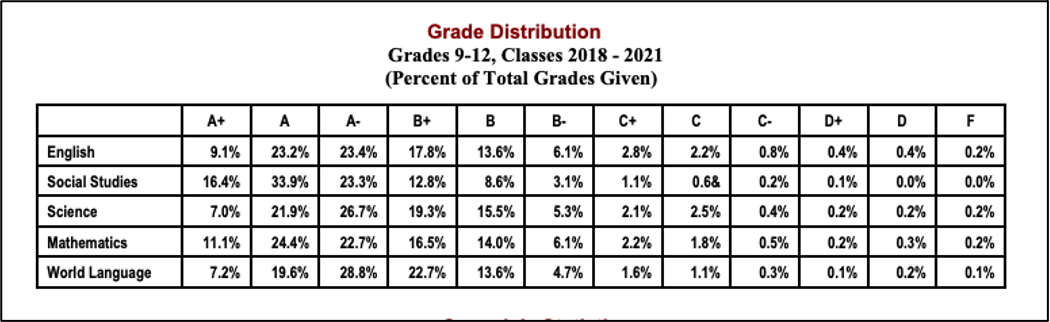
Are today’s students at this particular high school significantly stronger than those who attended a decade ago? Interestingly, these same profiles also include average standardized test scores. A decade ago, 6 percent of graduating seniors at this high school were named National Merit Semifinalists. Last year, only 4 percent were. Ten years ago, the mean AP score was 4.36 (268 students took the exams); last year, the mean AP score was 4.1 (302 students took the exams). Now, there are other factors that could influence the variations we see in mean SAT and AP data: the pandemic obviously disrupted learning and testing last year. But wouldn’t it stand to reason that if today’s students perform at significantly higher levels in the classroom, you would see that reflected in testing as well?
An article in USA Today in August 2021, citing data from the U.S. Department of Education noted that “[nearly] half of American high school students – 47% in the class of 2016 – are graduating with grades ranging from A-plus to A-minus. According to the Department of Education, the average high school grade point average was 2.68 in 1990. By 2016, it had risen to 3.38, with the biggest inflation occurring in private independent schools. If we are running with the premise that all students earn a grade between 1-100, nearly half are within just a few points of each other. Is this right?”

SAT Tutoring
Expert one-on-one guidance to boost your score.
STANDARDIZED TESTING MATTERS
Although the pandemic has necessitated a major shift in the process of selecting students, the fact remains that standardized testing – for all its well-documented flaws and limitations – still provides admissions officers with additional data points to help them quickly sort through inflated applicant pools with large numbers of students from the same high schools whose grades are, as the USA Today author noted, within a few points of each other. That’s why, even in the current test-optional paradigm, test scores (perhaps AP scores even more than the SAT or ACT) continue to matter. How else could NYU or USC, each with applicant pools over 100,000, or for that matter, even schools like Colgate with double the applicants for the Class of 2025, efficiently tackle the volume of applications that need to be read and decided upon in the course of a few months?

AP Exam Tutoring
Our tutors offer customized tutoring designed to fit the needs of each student.
All this to say, grades and scores have always been and continue to be KING in college admissions, regardless of test optional policies. The more data points a student has to differentiate themselves from these inflated pools of applicants, they better off they are.

In addition, Maria is proud of her long-term volunteer work with Opera North (Lebanon, NH) in fundraising, marketing and audience engagement. She is an avid masters rower with the Upper Valley Rowing Foundation (Hanover, NH) and also serves as a member of its board of directors.

2 replies on “Grade Inflation and Standardized Testing”
Spot on and totally agree!
We live in south Florida and my son goes to an ‘extremely’ rigorous private school. His school considers all of their classes honors (and honestly they should) although they do not score them as such and they do not report weighed GPA’s either. He will have taken 8 AP classes (real AP classes such as Linear Algerbra with differentials, AP Cal A/B, AP cal B/C, AP mico, AP macro, AP European history, I don’t remember the rest of the AP classes, but they are the harder classes and not the known easier ones, ie Art, etc) and scored 4’s and 5’s on all of them. A 1500 on the SAT (not super scored) and 33 ACT single sitting. He applied to university with a 3.57 gpa unweighted, while his counterparts and friends from other public and private schools reported gpa’s of 3.8-4.4. I can personally tell you that the rigor and intensity of the classes at the other schools were not even close to the demands at his and the grading criterias were so much more lax and forgiving. Therefore, until we have standardized classes ‘and’ grading standards across the country, and know that we are comparing apples to apples, you are absolutely correct in that AP and SAT scores (flaws and shortcomings and all), are the only really way to fairly differential students. Great article and well said.
Thank you!