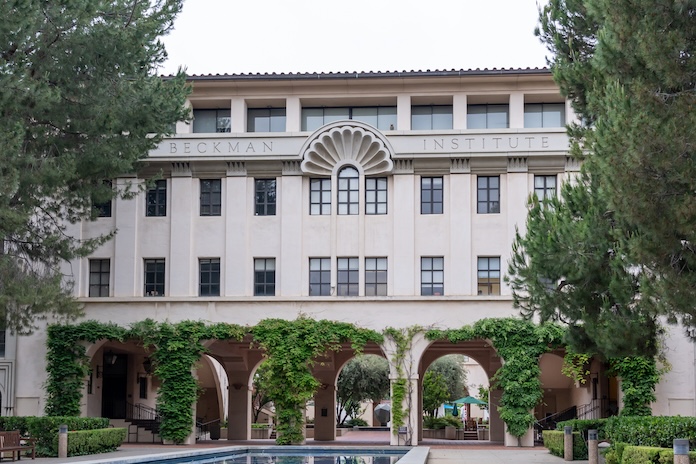
The California Institute of Technology (Caltech) enrolls just under 1,000 undergraduate students and has a 3:1 student-to-faculty ratio. Because it’s so small, every student plays an active role in the community: in classrooms, makerspaces, residence halls, extracurricular activities, lunch tables and project teams. It also means that your application will be read holistically and in depth. In fact, Caltech professors read the files of every competitive applicant. According to the admissions website, every admitted student has at least one positive review from a professor in the area they wish to study. This unique approach to file-reading ensures that the depth of a student’s knowledge is interpreted by an expert: “So don’t worry that your science won’t make sense to a lay-person because our faculty with PhDs conducting research that will change the world will understand what you’re saying. We promise.”
In inviting undergraduate students to apply, Caltech is clear in its mission to enroll some of the brightest STEM minds in the world. Unapologetically committed to STEM education, the Institute references its “unusually demanding pace” and its rigorous core curriculum. Although there is no single Caltech profile, the institute asks applicants to consider carefully whether or not they would thrive in an environment built on relentless inquiry.
Caltech Supplemental Essays: What’s Required
In addition to the personal essay required on the Common App, Caltech requires 1 optional and 5 supplemental essays designed to identify those students who will flourish at Caltech. The admissions office offers a piece of advice that is as helpful as it is informative: “Literally, there is no way to write about too much STEM in your supplemental questions. So lean all the way in on the STEMiest of STEMmy topics (yep, those are made-up words but totally appropriate).”
The admissions committee is looking for “unusual promise, intellectual vitality, strong character, a sense of joy in discovery, and a meaningful relationship with scientific inquiry.” Your supplement responses should address these priorities. And remember, the more you reference your own ‘STEMiness,’ the better!
How Caltech Evaluates Applicants
Caltech uses three transparent categories to describe what the admissions committee is trying to understand about you as an applicant:
- Capacity for Caltech Rigor is not about surviving the Caltech curriculum. It is about demonstrating the readiness to grow, contribute, and thrive within it.
- Scholarly Character helps us understand both how a student will engage with challenges and how they contribute to the learning of others.
- Scientific Drive is more than participation in STEM extracurriculars for résumé building…We are interested in the depth of a student’s engagement, the choices they made within the opportunities available to them, and the evidence that science and engineering remain a meaningful source of curiosity, motivation, and drive.
How to Approach the Caltech Supplements
Big-Picture Strategy
- Be specific. Remember, professors will read your responses if you are a competitive applicant, so you can name actual concepts, methods, tools, and scientific approaches.
- Show process over accomplishment. Notice how often these prompts say how: how you learn, how you work through difficulty, what you’d defend about your process.
- Think of your responses as parts of a whole. Combined, your answers should form a complete picture of who you are as a three-dimensional person.
Common Mistakes to Avoid
- Listing achievements. You will do that on the application. Use these essays to reveal the thinking and learning behind your accomplishments.
- Overexplaining the science. Technical detail is welcome, but it should serve the story. Remember, a world-class professor with deep science knowledge is your reader.
- Writing what you think Caltech wants. Authenticity and specificity stand out.
- Making every essay about success. Struggle, dead ends, and open-mindedness are critical to scientific inquiry.
- Extraneous descriptions. With such tight caps, every word and sentence must earn their place.
A Strong Drafting Process
- Brainstorm a list of personal moments of curiosity, struggle, collaboration, and creation before you begin. You will want to provide real-life examples in your responses.
- Do your homework about Caltech. Be able to address specific offerings in your answers.
- Write messy drafts first and worry about word-length second.
- Read each essay aloud to listen for awkward phrasing.
- Ask a friend or family member if the response sounds like you.
- Consult a teacher or mentor, ideally someone in STEM, about whether the technical content is accurate!
Caltech Supplemental Essay Prompts and Tips for 2026-2027
Note: Essay prompt wording is cited directly from the official Caltech admissions website.
Essay 1 (Required): STEM Academic Interest Question
Caltech has a rigorous core curriculum and students don’t declare a major until the end of their first year. However, some students arrive knowing which academic fields and areas already most excite them, or which novel fields and areas they most want to explore.
If you had to choose an area of interest or two today, what would you choose?
*Note that you are under no obligation to follow this choice if admitted.
Why did you choose your proposed area of interest? If you selected ‘other’, what topics are you interested in pursuing? (Min: 150 / Max: 200 words)
Top Tier Tip: Base your answer around the word “why” and provide examples of specific pursuits (e.g., courses, research, experiments, projects) that piqued your curiosity and inspired you to learn more.
Essay 2 (Required): Scholarly Character
How do you learn when there is no easy answer? Caltech’s learning environment asks students to work through difficulty, collaborate around hard ideas, and contribute to one another’s understanding. Use these responses to show us how you learn and grow.
Choose one of the following prompts: (Max: 200 words)
Option 1 — COLLABORATION: STEM as shared learning
- Tell us about a time your learning in STEM was shaped by another person or group — either because you needed help, offered help, changed your thinking through collaboration, or contributed to someone else’s understanding. What did that experience teach you about learning and working with others?
Option 2 — PROCESS: The thought behind the outcome
- Tell us about a time your approach to a STEM problem, concept, or project mattered as much as the outcome. How did you work through uncertainty or persist creatively in tackling the problem? What would you still defend about your process, regardless of the outcome?
Top Tier Tip: Choose the option where you have the better story, not the more impressive-sounding one. Include real uncertainty. Admitting you were stuck, wrong, or confused shows humility and resilience. Failure is essential to experimentation and success!
Essays 3 and 4 (Required): Scientific Drive
How does STEM come alive in your life through learning, pursuing, or making? Caltech faculty review applications, so feel free to get technical in your response!
Choose two of the following prompts: (Two Essays, Max: 200 words each)
Option 1 — LEARNING: STEM as a never-ending rabbit hole
- Regardless of your STEM interest listed above, take this opportunity to nerd out and talk to us about whatever STEM rabbit hole you have found yourself falling into. Be as specific or broad as you would like.
Option 2 — PURSUING: STEM as sustained intellectual engagement
- Tell us about a STEM question, problem, idea, or project that has held your attention over time. What drew you to it, how have you pursued it, and what do you still want to understand?
Option 3 — MAKING: STEM as creation
- Tell us about something you created, tested, repaired, modeled, coded, built, or redesigned. What problem were you trying to solve and what did the process reveal to you?
Top Tier Tip: Don’t let both essays be about school coursework. At least one should show curiosity that exists outside any assignment. Let your enthusiasm show.
Essay 5 (Required): Fun Question
Caltech students bring more than academic ability to the communities they join. What is something you would be excited to do, share, teach, make, start, or contribute as part of the Caltech community? (Min: 100 / Max: 150 words)
Top Tier Tip: Humor is welcome if it comes naturally! Be specific and concrete: a particular workshop you’d run, a club you’d start, a tradition you’d bring.
Essay 6 (Optional): Academic Short Answer Question
Caltech cares about context. Is there anything about your academic preparation, coursework, school context, or learning experiences that would help us better understand your readiness for Caltech?
Top Tier Tip: If your record is strong and straightforward, skipping it is fine. Don’t write it just to fill space. Keep it factual and brief. Explain, don’t apologize or make excuses.
Frequently Asked Questions
What if I don’t have specific examples to answer these questions?
Use these supplements as a gut check against fit. The questions Caltech is asking reveal truths about the student experience that you need to consider before applying.
Will Caltech hold it against me if I do not know exactly what I want to study?
No. The prompt about fields of study is explicitly non-binding.
Why are there so many supplements?
Because Caltech has so few undergraduate students and a clear emphasis on STEM education, fit is critical. Taken together, these essays are the admissions committee’s way of ensuring that those they admit will thrive at Caltech and make meaningful contributions to the world.
I’m nervous about the “fun” question. Is there a “right” answer?
There is no right answer, but Caltech does want to see how you unwind despite an “unusually demanding” workload. Resilience matters. That said, if a STEMy, academic pursuit is your way of relaxing, that’s okay too!
I’m a terrible editor of my own work. How do I cut down my responses to meet the word limits?
This is where a trusted reader comes in. When you spend a long time writing a piece, you start to overlook extraneous words or details. Ask for honest feedback, and don’t take it personally when your reader slashes words, phrases, or even full sentences. If you are particularly proud of a sentence you need to cut, copy it and put it away for safekeeping.
Stay Connected for More Expert Guidance
Follow us on Instagram @toptieradmissions and subscribe for more expert advice and admissions insights.
Know someone else navigating the college admissions process? Pass it along, they’ll thank you later!

She began her career at Kent School as an English teacher, coach, dormitory faculty member, and assistant athletic director, developing a deep understanding of students both inside and outside the classroom. After earning her master’s degree from Northwestern University, she joined Westminster School, where she ultimately served as Director of College Counseling, guiding students and families through academic planning and highly selective admissions.
Kate later held senior leadership roles at Pomfret School and for 12 years at The Winsor School, where she oversaw grades 5–12 academics, supervised college counseling, conducted mock interviews, and helped shape institutional strategy.
Having worked as a teacher, advisor, college counselor, academic dean, and associate head of school, Kate understands how admissions decisions are made — and how to position students thoughtfully and authentically. Today, she focuses on what she values most: partnering one-on-one with young people to help them tell their stories with confidence and purpose.
- Caltech Supplemental Essays 2026-2027 - October 19, 2026
- Test-Optional vs. Test-Blind: Decoding College Testing Policies - October 15, 2026
- NYU Supplemental Essays 2026-2027 - October 3, 2026