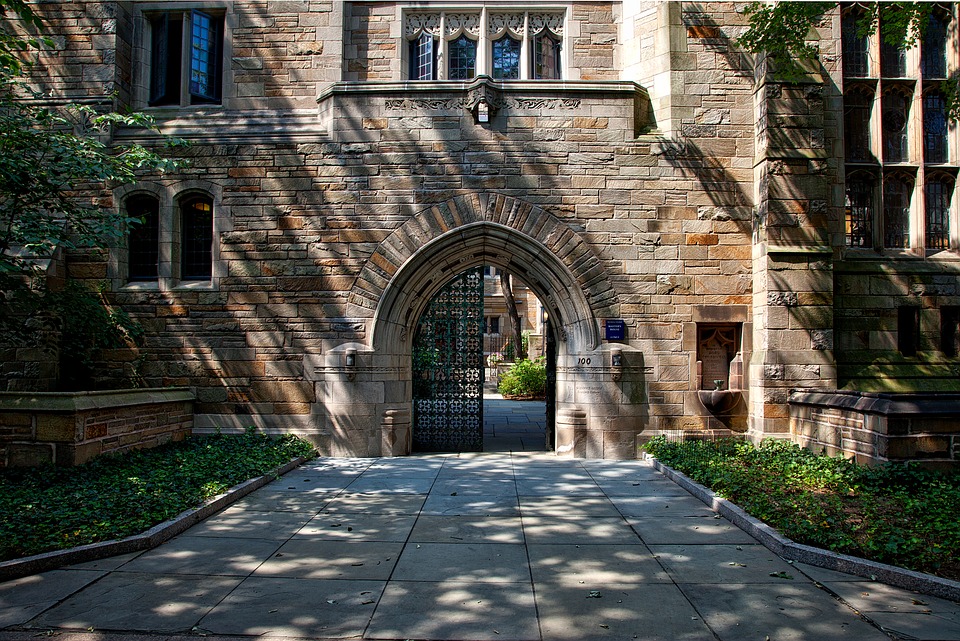
Yale University, an Ivy League institution in New Haven, Connecticut, admitted 779 of 7,140 Single-Choice Early Action applicants to the Class of 2030 for an acceptance rate of 10.9%, according to the Yale Daily News. This rate marks a slight increase from last year’s 10.8%, driven by a larger applicant pool and more admits—a sign of renewed interest following Yale’s smooth navigation of a turbulent year for peer institutions.
Yale University Early Acceptance Rate
Yale admits approximately 750 Early Action students each year, a number that has held steady across the last four cycles. The EA acceptance rate has likewise stabilized near 10–11% over six consecutive years, with one exception: the Class of 2028, when Yale’s former test-optional policy drew the second-largest early applicant pool in the university’s history, 7,856 applicants, and the fixed admit count depressed the EA rate to 9.0%. In February 2024, Yale replaced that policy with a test-flexible requirement, mandating SAT, ACT, AP, or IB scores. The new requirement reduced Early Action applications from 7,856 to 6,729 for the Class of 2029, but because Yale continued to admit approximately 750 students, the EA rate returned to 10.8%. This cycle, 7,140 students applied and 779 were admitted for an EA rate of 10.9%, a 6% application increase that brings the pool closer to its pre-2028 levels rather than signaling a new surge. For prospective applicants, the pattern is clear: the early acceptance rate is not the variable that changes. What determines your outcome is the strength of your application within a pool where roughly one in ten will be admitted.
College Private Counseling
Unlock your full potential.
One number worth noting: 70% of early applicants were denied outright, with just 18% deferred to the spring. Yale has maintained this pattern since the Class of 2025, preferring to give most applicants a clear answer in December rather than pushing large numbers into the Regular Decision pool. For deferred students, the silver lining is that the smaller deferral pool faces less internal competition in the spring round.
Dean of Undergraduate Admissions Jeremiah Quinlan noted that admitted students “impressed the admissions committee with their broad range of academic achievements, their significant contributions to countless communities, and their myriad talents.” Those talents will find no shortage of outlets: Yale’s 14 residential colleges create intimate communities of roughly 470 students within a research university of 6,600 undergraduates, and the 5:1 student-to-faculty ratio ensures access to scholars at the top of their fields. With more than 80 majors and particular depth in the social sciences, biological sciences, and humanities, plus a rephrased “Why Yale?” prompt that now asks applicants to reflect on how their interests, values, and experiences have drawn them to the university, Yale is signaling that fit and intentionality matter as much as credentials.
TTA Top Tip: Yale is the only Ivy League school offering a “test-flexible” policy—applicants may submit AP or IB scores instead of the SAT or ACT. But this option comes with a catch: students who choose this route must submit all AP or IB scores on record, not just their strongest. That makes the decision a strategic one, not simply a fallback. Among enrolled Class of 2029 students, 61% submitted SAT scores and 25% submitted ACT scores, indicating that most competitive applicants still lean on traditional testing. Understanding which pathway best represents your student’s academic profile—and how admissions officers evaluate each option—requires the kind of school-specific insight our counselors bring to every application.
At Top Tier Admissions, we are committed to making the college admissions process more transparent. Easy access to clear data helps families understand trends in college admissions to make more informed decisions. This year we’re once again collecting early acceptance rate data at selective schools and providing insight and analysis of our own.
Want To Read More?
Are you thinking about applying to Yale University? Curious about admissions trends and strategies to improve your odds? Contact us to discuss our Application Boot Camp® or Private Counseling program—we look forward to supporting you!
- Yale Acceptance Rate: Class of 2029
- Class of 2030 Early Application Trends: Reading the Tea Leaves
- Yale: Acceptance Rates & Statistics
- Average GPA and Class Rank at Top Colleges
- Ivy League Acceptance Rates & Profiles
- Regular Decision Notification Dates: Class of 2030
Want to stay in the loop? Follow us on Instagram @toptieradmissions and subscribe to our blog for expert advice and admissions insights.
Know someone else navigating the college process? Pass it along—they’ll thank you later!