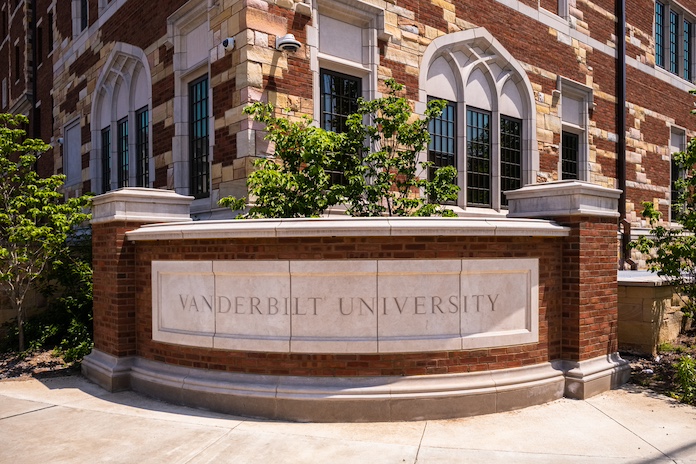
Vanderbilt University, a private research university in Nashville, Tennessee, is distinctive among elite institutions for housing four undergraduate schools under a single application. The university admitted just 2.8% of Regular Decision applicants to the Class of 2030, a record low, down from 3.3% the prior cycle, according to the Vanderbilt Hustler.
Vanderbilt Acceptance Rate: Class Of 2030 at a Glance
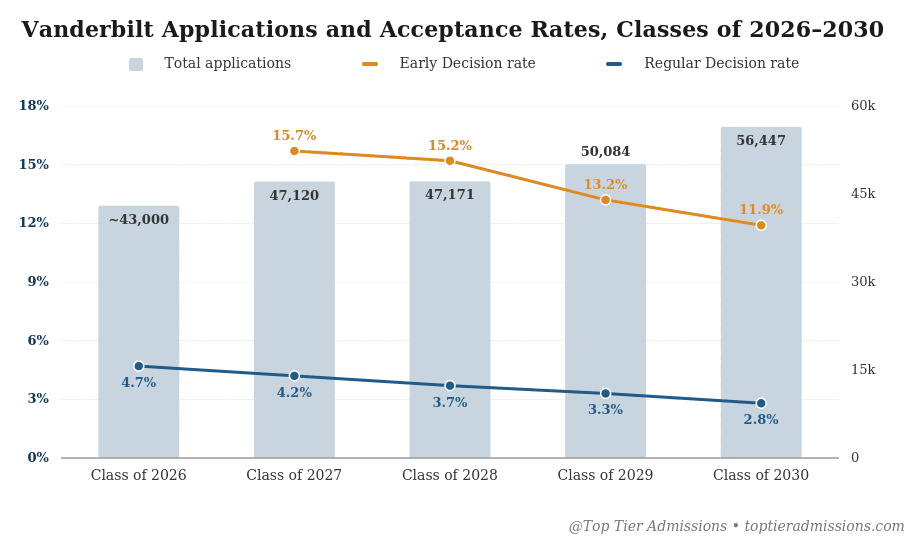
The Class of 2030 cycle widened the gap between Vanderbilt’s two admissions pathways. The Regular Decision rate fell to a record-low 2.8%, while the combined Early Decision rate held at 11.9%, leaving early applicants admitted at roughly four times the regular rate. Vanderbilt cautions that its final overall figure will not be official until the fall 2026 census, but the trajectory across both rounds points in one direction, as our chart of the past five cycles shows.
What’s Driving the Record-Low Regular Decision Rate
Our chart makes the mechanism plain: the record-low Regular Decision rate was driven by volume, not by tighter admit numbers. Vanderbilt received 48,720 Regular Decision applications for the Class of 2030, its largest pool ever and a 12% increase over the prior year, yet admitted 1,382 students, slightly fewer than the 1,411 it admitted the year before. As our analysis of the five-year trend shows, the Regular Decision rate has fallen every cycle, from 4.7% for the Class of 2026 to 2.8% today, while admit counts have steadily contracted as Vanderbilt’s yield has climbed. More applicants, fewer seats, lower rates, year after year.
College Essay Guidance + Common App Intensive Bundle
Combine our Common App Intensive and our College Essay Guidance Program for a complete application package!
Who Gets In: Academic Profile of Admitted Students
Vanderbilt remains test-optional through students entering in fall 2027. Among Regular Decision admits to the Class of 2030, 95.6% ranked in the top tenth of their graduating class—a figure that underscores how little statistical daylight separates admitted from denied applicants at the top of the pool. The admitted cohort also reaches broadly, drawn from all 50 states and 65 countries, signaling that Vanderbilt builds its class from a genuinely national and international applicant base rather than a regional one. With academic credentials clustered so tightly, the essays, short answers, and demonstrated engagement carry decisive weight—and for applicants who do submit scores, competitive results still tend to land near the top of Vanderbilt’s published ranges.
The Four-School Structure and Why Your Choice Matters
That four-school structure shapes the application itself: students apply directly to one school, and the choice signals fit. The College of Arts and Science anchors the liberal arts and sciences across the humanities, social sciences, and natural sciences; the School of Engineering offers ABET-accredited programs from biomedical to computer science; Peabody College of Education and Human Development houses Vanderbilt’s nationally ranked education and human-development programs; and the Blair School of Music delivers conservatory-caliber training as one of the few exclusively undergraduate music schools in the country. Because admission is to a specific school rather than the university at large, a student’s choice should reflect a genuine academic match. For a fuller view of how the early round unfolded this cycle, see our Vanderbilt early acceptance rate analysis.
Early Decision Strategy: The Most Powerful Lever for Applicants
TTA Top Tip: The clearest strategic signal in this cycle is the gap between the two pathways: Early Decision applicants are admitted at roughly four times the Regular Decision rate. Because Vanderbilt fills about half of each class through its two binding Early Decision rounds, a well-prepared ED I or ED II application is the single most powerful lever a committed applicant can pull. The school-specific choice compounds that advantage: a student drawn to public policy, for instance, might find a stronger fit in Peabody’s Human and Organizational Development program than in a traditional Arts and Science track, and demonstrating that intentionality is exactly what Vanderbilt rewards. If Vanderbilt is your student’s clear first choice, build the academic narrative and school selection early enough to apply binding in the fall.
Expert Insight: How to Frame Your Application
“While the College of Arts and Science does not admit students into a particular major, it is still to an applicant’s benefit to articulate a clear narrative centered on their academic and intellectual interests. And for students applying to the other three undergraduate schools, demonstrated interest, fit, and relevant experience for their program(s) of choice is incredibly important in application review and selection.”
Sam Joustra, TTA Head of Student and Family Programming and former Assistant Director of Admissions at Vanderbilt University
At Top Tier Admissions, we are committed to making the college admissions process more transparent. Easy access to clear data helps families understand trends in college admissions to make more informed decisions. This year we’re once again collecting acceptance rate data at selective schools and providing insight and analysis of our own.
Explore Additional Resources
Are you thinking about applying to Vanderbilt University? Curious about admissions trends and strategies to improve your odds? Contact us to discuss our Application Boot Camp® or Private Counseling program — we look forward to supporting you!
- Get Into Vanderbilt University
- 2026 College Acceptance Rates: What’s Behind the Record Lows and What Families Should Know
- Vanderbilt Early Acceptance Rate
- College Acceptance Rates & Statistics
- Average GPA and Class Rank at Top Colleges
- When Does the Common App Open? What Rising Seniors Should Do Before August 1
- The New Ivies 2026: What Changed and What It Means for Applicants
Stay Connected For More Expert Guidance
Want to stay in the loop? Follow us on Instagram @toptieradmissions and subscribe to our blog for expert advice and admissions insights.
Know someone else navigating the college process? Pass it along — they’ll thank you later!
- Johns Hopkins Supplemental Essay 2026-2027 - October 9, 2026
- Get to Know College Admissions Expert, Kayte Hager - October 1, 2026
- U.S. News College Rankings 2027: MIT Is No. 1, Princeton Drops - September 22, 2026