
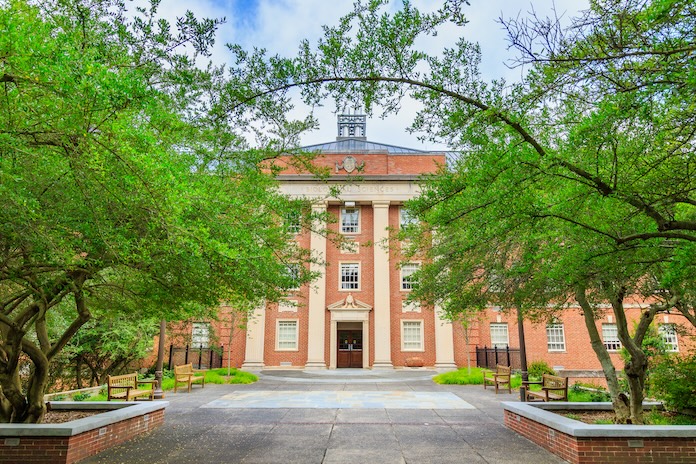
Duke University, located in Durham, North Carolina, is consistently ranked among the top 10 national universities and is widely regarded as one of the Southern Ivies. For the Class of 2030, Duke received a record-high 61,935 applications and admitted 2,930 students for an overall acceptance rate of 4.7%, holding near last year’s all-time low, according to The Duke Chronicle.
The defining feature of the cycle is the gap between the two rounds: an early acceptance rate in the low teens against a Regular Decision rate below 4%. Our table traces both pathways across five years.
Duke University Acceptance Rates by Round, Classes of 2026–2030
| Class | Total Apps | Total Admits | Overall Rate | ED Rate | RD Rate |
| 2030 | 61,935 | 2,930 | 4.7% | 13.8% | 3.7% |
| 2029 | 58,712 | 2,818 | 4.8% | 12.8% | 3.67% |
| 2028 | 54,194 | 2,790 | 5.1% | 12.9% | 4.1% |
| 2027 | 49,469 | 2,948 | 6.0% | 16.4% | 6.3% |
| 2026 | 50,002 | 2,309 | 4.6% | 21.3% | 4.3% |
How Duke’s Acceptance Rate Has Changed Over 5 Years
Read across five years, the overall rate tells a story of compression rather than steady decline. It sat at 4.6% for the Class of 2026, jumped to 6.0% for the Class of 2027 when Duke admitted a larger 2,948 students, then settled into a tight 4.7–5.1% band for the three cycles since. The Class of 2027 was the outlier, not the trend: with the admit pool otherwise anchored near 2,800–2,930, the rate has been driven almost entirely by application volume, which climbed from roughly 50,000 to nearly 62,000 over the span. This year sharpens that dynamic. Duke fielded about 2,000 more applications than the previous cycle, and nearly all of the growth came from Regular Decision—early applications actually fell by close to 500, but a surge to 55,776 Regular Decision applications more than offset the drop. Because Duke held its admit pool steady, that demand pushed the Regular Decision rate to its lowest point on record even as the early rate ticked up. The practical consequence is the widening distance between the two rounds: Duke fills roughly half its incoming class through the binding early pathway, leaving Regular Decision candidates competing for the remaining seats at a rate nearly four times more selective.
Why Duke Keeps Getting More Competitive
So, why do tens of thousands of strong students keep applying despite rates this thin? Because the payoff is distinctive. Duke pairs the resources of a top-ten research university with a residential, undergraduate-focused culture, an unusually strong link between its Trinity College of Arts & Sciences and its Pratt School of Engineering, and a 100% need-met financial aid commitment. The rising popularity of Southern colleges has only sharpened that draw—as families weigh Sun Belt weather, lower in-state cost in the Carolinas, and a perceived openness compared with the Northeast, Duke sits at the center of the migration. Several Ivy+ peers have seen application volume soften this cycle; Duke’s pool has only grown. The result is a Regular Decision round now as competitive as Brown and Dartmouth and given the regional tailwinds, no obvious reason to expect that pressure to ease next cycle.
This year’s numbers also reflect a quieter inflection inside Duke admissions. After nearly 33 years, Christoph Guttentag, the dean who authored the test-optional policy and the 2024 decision to stop assigning numerical ratings to essays and test scores retired, with associate dean Kathy Phillips taking over on an interim basis. The office simultaneously retired the Coalition Application and absorbed a roughly 50% cut to recruitment travel. None of those changes by itself moves the headline rates, but together they suggest the next cycle may see a slightly different applicant pool and a Regular Decision read with new judgment at the top. For the early-round results that set up this cycle, see our Duke early acceptance rate analysis.
TTA Top Tip: Beyond the ED math, the most consequential Duke-specific decision is the one many applicants treat as administrative: which school to apply to. Duke evaluates applicants for either the Trinity College of Arts & Sciences or the Pratt School of Engineering, and the choice is part of the read, not a checkbox. Pratt typically admits a smaller cohort and weighs demonstrated engineering preparation—advanced math through at least pre-calculus, ideally calculus; a meaningful physics record; and evidence of building, designing, or problem-solving outside the classroom—while Trinity is reading for intellectual range and a clear academic identity within the liberal arts. The mistake we see often is applicants hedging toward Pratt because they think it raises their odds, or naming Trinity without a coherent story about why. Pick the school that genuinely matches your record and ambitions, then write essays that argue for that choice with specifics: a faculty member, a lab or program, a Bass Connections project, a Pratt design course. Generic Duke enthusiasm reads as a missed signal; school-specific fit is what the application is actually asking you to demonstrate.
How to Strengthen Your Duke Application
At Top Tier Admissions, we are committed to making the college admissions process more transparent. Easy access to clear data helps families understand trends in college admissions to make more informed decisions. This year we’re once again collecting acceptance rate data at selective schools and providing insight and analysis of our own.
Explore Additional Resources
Are you thinking about applying to Duke University? Curious about admissions trends and strategies to improve your odds? Contact us to discuss our Application Boot Camp® or Private Counseling program — we look forward to supporting you!
- Get Into Duke University
- Duke Acceptance Rate: Early Trends
- The Rising Popularity of Southern Colleges
- What Are the “Southern Ivies”?
- 2026 College Acceptance Rates: What’s Behind the Record Lows and What Families Should Know
Stay Connected For More Expert Guidance
Want to stay in the loop? Follow us on Instagram @toptieradmissions and subscribe to our blog for expert advice and admissions insights.
Know someone else navigating the college process? Pass it along — they’ll thank you later!
- Johns Hopkins Supplemental Essay 2026-2027 - October 9, 2026
- Get to Know College Admissions Expert, Kayte Hager - October 1, 2026
- U.S. News College Rankings 2027: MIT Is No. 1, Princeton Drops - September 22, 2026