Brown University, an Ivy League institution in Providence, Rhode Island, is known for its Open Curriculum, the most flexible undergraduate program in the Ivy League, which allows its roughly 7,300 undergraduates to design their own course of study without distribution requirements. For the Class of 2030, the University admitted 2,564 of 47,937 applicants, according to the Brown Daily Herald, for an overall acceptance rate of 5.35%.
Brown Acceptance Rate: Class Of 2030
Brown’s 5.35% overall acceptance rate continues a pattern of stability as the acceptance rate has hovered between 5% and 6% for the past five cycles. The Regular Decision rate held steady at 3.94%, while the Early Decision round admitted 16.5% of applicants in December. That Early Decision (ED) to Regular Decision (RD) gap, more than four to one, is the defining feature of the data and focus of the charts below.
What the Acceptance Rate Trends Actually Tell Us
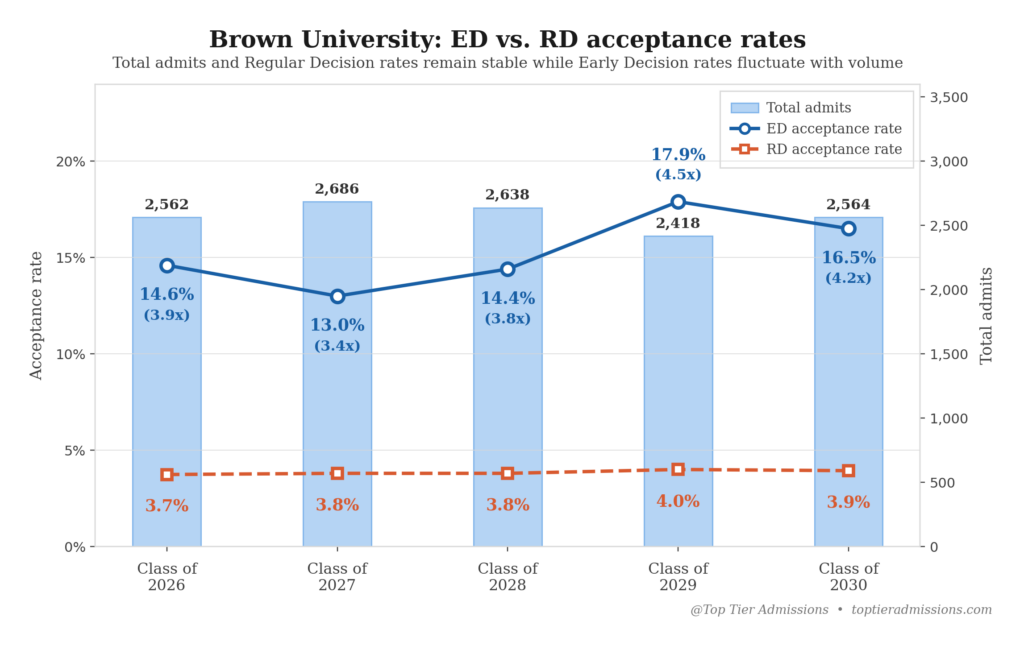
Our first chart tells a story of remarkable stability with one notable exception.
For five consecutive years, Brown has admitted roughly the same number of students. The blue bars barely move. Total admits have clustered between 2,418 and 2,686, and the RD acceptance rate has held within a whisker-thin corridor of 3.7%–4.0%. If you were hoping the regular decision window might quietly crack open a little wider, the data offers no such comfort.
The one element that refuses to sit still is the ED rate, swinging from 13.0% all the way to 17.9% across the same period. But that volatility isn’t a signal about Brown changing its standards. It’s a story about applicant behavior. When fewer students apply early, the rate climbs; when more pile in, it compresses. For the Class of 2030, applications rebounded 12% from the prior year—47,937 vs. 42,765—and the overall acceptance rate slid from 5.65% to 5.35%, even as Brown actually admitted more students in raw numbers.
The multiplier at each ED data point captures the bottom line: in every single year shown, applying early more than tripled your odds compared to applying in the regular round. The floor shifts. The ceiling shifts. But the advantage of going early has never disappeared.
Our second chart breaks those admits into their two components.
Early Decision vs. Regular Decision
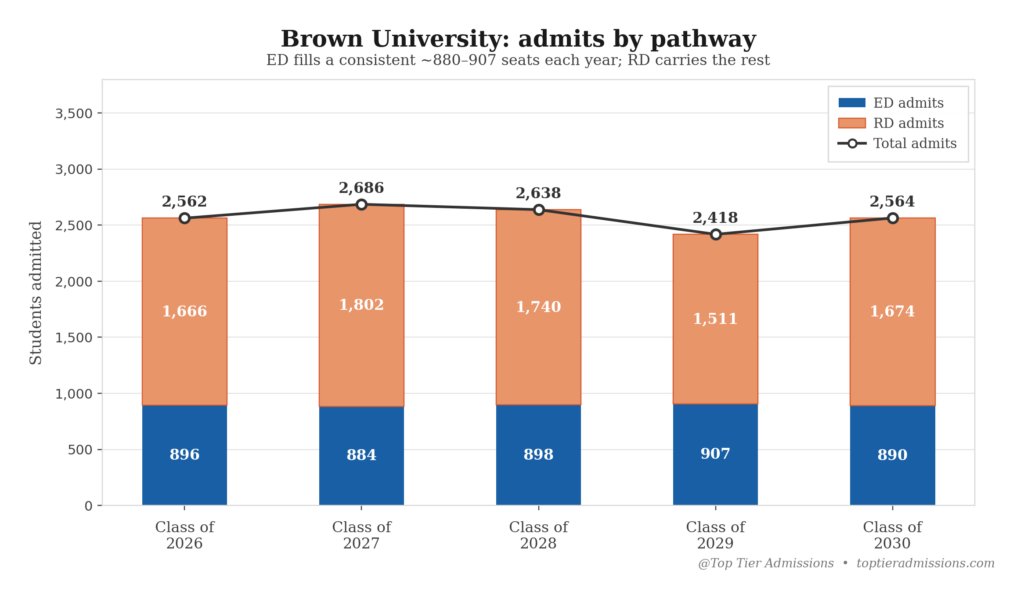
The blue base stays remarkably consistent with Brown admitting 884 to 907 ED students every year regardless of how many apply early. The orange portion absorbs the variation, and despite the 3.9% RD rate, Brown extended 1,674 Regular Decision offers for the Class of 2030—nearly twice the 890 ED offers. For families who cannot or choose not to apply early, the door is narrower but far from closed.
Beyond the Open Curriculum: Selective Programs Within Brown
The Open Curriculum is Brown’s signature, but it is the starting point of a broader academic identity, not the whole of it. Within the same application, students can pursue one of the most selective combined-degree programs in the country: the Program in Liberal Medical Education (PLME), an eight-year track guaranteeing admission to the Warren Alpert Medical School, accepted just 64 applicants overall to the Class of 2030; the Brown-RISD Dual Degree Program, which lets students integrate liberal arts at Brown with studio work at the Rhode Island School of Design, admitted 25. A 6:1 student-to-faculty ratio, classes where 69% have fewer than 20 students, and 100% of faculty teaching undergraduates create the environment in which curricular freedom operates.
Brown’s Academic Profile
Brown requires SAT or ACT scores now in its second year under the reinstated testing mandate,and its most recent Common Data Set reports a middle-50% SAT composite of 1510–1560 and a middle-50% ACT of 34–35 among enrolled students, with 89% in the top decile of their high school class. For additional context, see our Class of 2030 Brown Early Acceptance Rate post covering the Early Decision round.
Should You Apply Early Decision to Brown?
TTA Top Tip: The gap between Brown’s Early Decision rate (16.5%) and its Regular Decision rate (3.94%) is stark. ED applicants were admitted at more than four times the RD rate. For students who are in range and who know Brown is their top choice, applying ED is the single most consequential strategic lever available. And because Brown’s Open Curriculum rewards applicants who can articulate a self-directed intellectual path, that early commitment needs to be paired with essays that demonstrate genuine ownership of a course of study, not a generic case for the Ivy League.
What Brown Admissions Officers Are Really Looking For
“The Open Curriculum is not a shortcut. Brown admissions officers read every application with an eye to whether the student can actually thrive without a distribution requirement scaffolding their choices. That means a high school transcript that shows intellectual range, teacher recommendations that describe independent thinking, and essays that make a specific case for how this student would use Brown’s freedom. Applicants who treat the Open Curriculum as a talking point rather than a working philosophy rarely get in.”— Nellie Brennan Hall, TTA Senior Private Counselor and former Associate Director of Admissions at Brown University
How to Build a Competitive Brown Application
For rising seniors, this summer is one of the most consequential stretches of the entire admissions journey — and Application Boot Camp® is designed to make the most of it. Our team of admissions experts guides students through building a cohesive academic narrative and producing polished, strategically aligned essays before the Early Decision deadline so they head into senior year with confidence. Contact us to learn how your student can gain the August Edge.
Explore Additional Resources
At Top Tier Admissions, we are committed to making the college admissions process more transparent. Easy access to clear data helps families understand trends in college admissions to make more informed decisions. This year we’re once again collecting acceptance rate data at selective schools and providing insight and analysis of our own.
Are you thinking about applying to Brown University? Curious about admissions trends and strategies to improve your odds? Contact us to discuss our Application Boot Camp® or Private Counseling program—we look forward to supporting you!
- Brown University Admissions
- Brown University: Acceptance Rates & Statistics
- Get Into Brown: 5 Insider Tips
- Average GPA and Class Rank at Top Colleges
- Do AP Scores Matter for College Admissions?
- What To Do After You Commit to College
- The New Ivies 2026
Stay Connected For More Expert Guidance
Want to stay in the loop? Follow us on Instagram @toptieradmissions and subscribe to our blog for expert advice and admissions insights.
Know someone else navigating the college process? Pass it along—they’ll thank you later!
- Johns Hopkins Supplemental Essay 2026-2027 - October 9, 2026
- Get to Know College Admissions Expert, Kayte Hager - October 1, 2026
- U.S. News College Rankings 2027: MIT Is No. 1, Princeton Drops - September 22, 2026