
Over the last several months, a range of stories from The Free Press to The Wall Street Journal have proclaimed that students are ditching the Ivies for universities in the South. Setting aside the hyperbolic headlines, why are some Southern universities seeing surges in application volume? Economic factors — the cost of education and career opportunities post-graduation — likely are the main drivers here, but certainly their rising popularity has also been fueled by the ease of applying as more large public universities, like UT Austin, have joined the Common Application. Also not to be dismissed are high-profile athletic programs (videos of energetic student fans on ESPN’s Game Day are all over social media), perceptions of the political environment on campus, and yes, milder weather.
Keep in mind, too, the shift from students being hyper-focused on only the Ancient Eight, and expanding their range to the new list of “Ivy League” schools including:
THE APPEAL OF SOUTHERN COLLEGES
Let’s take a deeper dive into some additional key factors contributing to this shift and some of the institutions leading the charge.
Cost
Let’s start with data from the College Board and their Trends in College Pricing study. In 2024-25, the average published (sticker) tuition and fees for full-time undergraduate students are:
- Public four-year in-state: $11,610
- Public four-year out-of-state: $30,780
- Private nonprofit four-year: $43,350
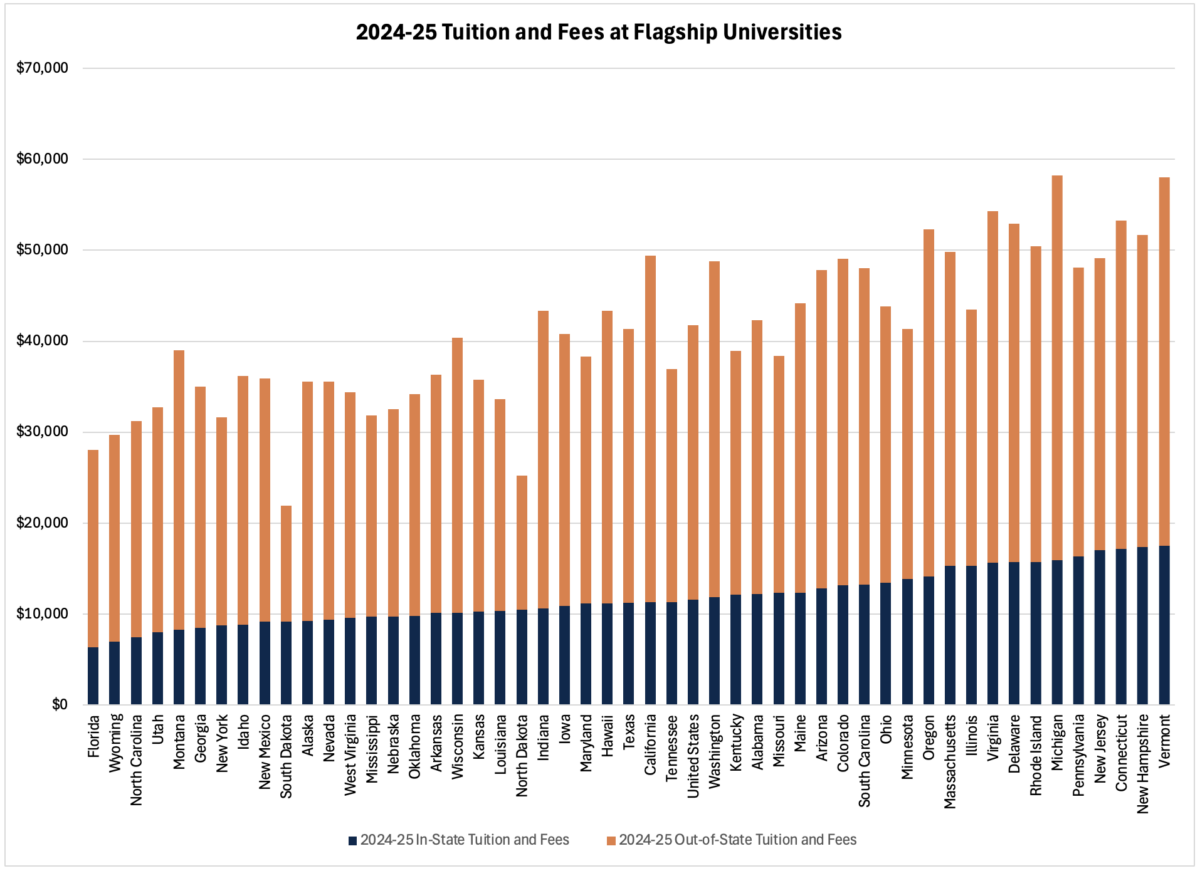
Importantly, as the College Board notes, published college prices vary widely, depending on where the institution is located. Take a look at the chart below showing the tuition and fees at flagship public universities (in-state and out-of-state). It’s clear that education costs more at schools in the Northeast than in other areas of the country. This economic reality may be a significant driver for many families.
Also important to note, however, is that with their significant endowments and commitment to need-based financial aid, top private universities have invested heavily in affordability. So, for students admitted to a highly selective and well-endowed private university who qualifies for need-based aid, the average tuition and fees paid by first-time full-year students drops quite a bit given the considerable grant aid per student. As an example, for more than 90 percent of American families, Harvard costs less than a public university.
Admissions Selectivity
Record low admit rates at top private universities and public universities like Michigan, UVA, UNC Chapel Hill, Berkeley, and UCLA have reshaped the admissions landscape for all students. Schools that may have at one time been considered “safeties,” like Northeastern and Tulane, aggressively chase low admit rates. Private schools in the south, notably Duke and Vanderbilt have admit rates in the low single digits and Vanderbilt’s applicant pool (50,488) nearly matched Harvard’s (54,008) last cycle.
In response, college seniors have turned their sights elsewhere, towards schools where their odds of admission are higher. For example, the schools cited by the Wall Street Journal as drawing students away from Harvard include:
- Clemson – 38% admit rate
- University of South Carolina – 60% admit rate
- University of Alabama in Tuscaloosa – 76% admit rate
- University of Tennessee Knoxville – 46% admit rate
- University of Mississippi in Oxford – 98% admit rate
It’s unlikely that these schools are drawing students away from Harvard but more likely, any bump in number of out-of-state students applying, is due in no small measure to the greater likelihood of getting in.
Common Application
A big reason for the increased numbers of out-of-state students applying to southern schools is also a likely a factor of ease of application. Today, over 1,000 schools are members of the Common Application, including 307 public universities. With minimal effort (and no written supplements), it’s easier than ever for today’s seniors to toss in a few more applications to public universities to balance out their college lists.

WHY ARE SOUTHERN COLLEGES GAINING POPULARITY?
Jeff Selingo, a prominent higher education expert, recently shared insights on LinkedIn about the growing trend of students flocking to Southern schools. In his post, he pointed out that these schools have long been known for strong programs in engineering, business, and healthcare, but now they’re gaining national attention for their academic rigor and post-graduate opportunities. In many cases, Southern colleges combine top-tier academic offerings with robust ties to local and regional industries, offering students a unique advantage as they transition from college to career.
Southern states such as Texas, Florida, Georgia, and Tennessee have seen a boom in population, tech industries, and corporate headquarters. Cities like Austin, Nashville, Miami, and Atlanta are not only vibrant hubs of innovation and culture but also offer students access to thriving job markets post-graduation.
WHAT ABOUT THE ESPN GAME DAY EFFECT?
Students eager to attend schools in the south with great football traditions have plenty of options from which to choose. Most SEC and ACC powerhouses have generous admit rates but a handful – Duke, Miami, Georgia Tech, Vanderbilt, Tulane, and UNC – have gotten increasingly selective as they attract increasingly large and diverse pools of applicants. Just for fun, let’s look at national football rankings (as of December 3rd) and overall admit rates for the Class of 2028:

If you are prioritizing football powerhouses, warm weather, a moderately competitive application process, and a lower cost of education, your sweet spots look to be the University of Georgia, Clemson, and the University of Tennessee. Students aiming for a more selective southern university with the hoopla of ESPN’s Game Day need look no further than Duke, Vanderbilt, Tulane, Georgia Tech, and Miami.
SHIFTING HIGHER EDUCATION LANDSCAPE
The rising popularity of Southern colleges is not just a passing trend; it’s a sign of a significant shift in the broader higher education landscape. From the strategic expansion of Vanderbilt University into New York City to the booming tech industries in cities like Austin and Atlanta, Southern universities are emerging as competitive alternatives to the traditional Ivy League schools. As more students flock to these campuses for both academic excellence and the promise of post-graduation success, it’s clear that the South is becoming an increasingly influential player in the world of higher education.
If you enjoyed this post, follow us on Instagram @toptieradmissions for more tips and subscribe to our blog for expert insights & college admissions news!

In addition, Maria is proud of her long-term volunteer work with Opera North (Lebanon, NH) in fundraising, marketing and audience engagement. She is an avid masters rower with the Upper Valley Rowing Foundation (Hanover, NH) and also serves as a member of its board of directors.