Get Into UCLA
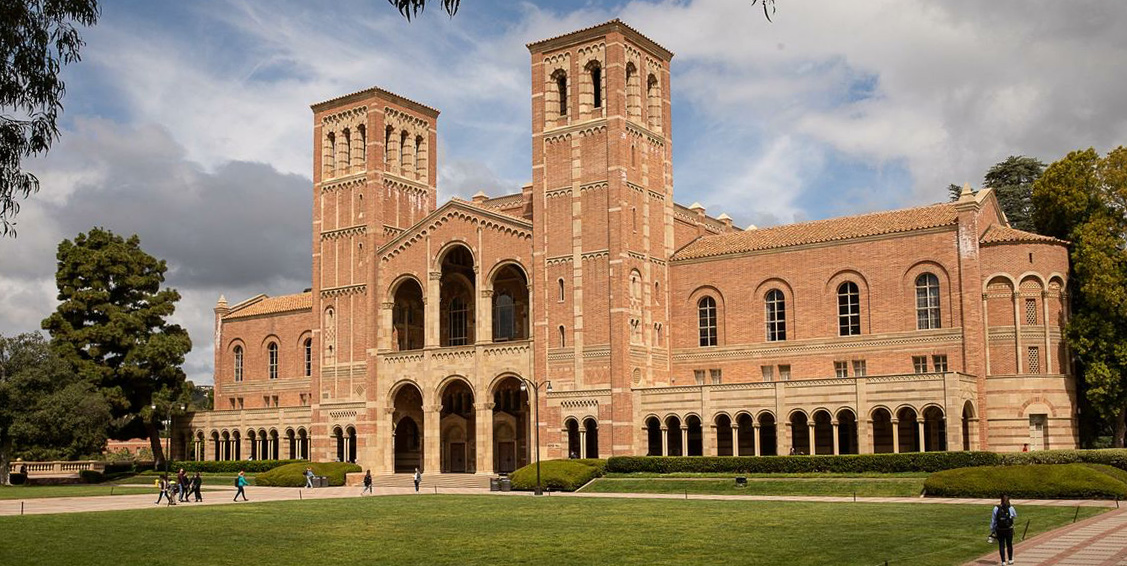
University of California—Los Angeles is a public university founded in 1919. UCLA is currently ranked #17 (tied with rice and Vanderbilt) on the U.S. News & World Report’s list of national universities and #2 among U.S. public universities. UCLA is situated on an urban campus of 419 acres and has an undergraduate enrollment of 32,423.
Undergraduates at UCLA can choose from 125+ majors and 90+ minors offered by the College and professional schools. Thanks to the 10-week quarter system, students are able to sample a wide array of subjects and classes from more than 109 academic departments, including instruction in 40 different languages.
Although UCLA has a large student body, two out of three classes have less than 30 students. All students must complete the campus-wide general education curriculum, which is overseen by the Division of Undergraduate Education. This includes academic experiences like Freshman Clusters, Writing II and Entrepreneurship programs. Students must also choose from over 200 Fiat Lux (Let There Be Light) seminars, which focus on an in-depth topic for 10-20 students.
UCLA includes six undergraduate colleges, seven professional schools, and four professional health science schools:
FEATURED SERVICES
3 popular Top Tier solutions recommended for you!

Top Tier’s students had GREAT results in both the early and regular rounds. Check out our successes!
- The College of Letters and Science
- The majority of the UCLA student body belongs to the College of Letters and Science, which encompasses the social sciences, the humanities, the physical and life sciences, and undergraduate education. Within the College of Letters and Science, students can select courses within a number of academic divisions: the Social Sciences Division (ex. African American studies, political science, anthropology, communication studies), the Humanities Division (ex. art history, philosophy, literature, history), the Division of Physical Sciences (ex. astronomy, mathematics, geophysics, chemistry), and the Division of Life Sciences (ex. ecology, genetics, cell biology or psychology).
- The majority of the UCLA student body belongs to the College of Letters and Science, which encompasses the social sciences, the humanities, the physical and life sciences, and undergraduate education. Within the College of Letters and Science, students can select courses within a number of academic divisions: the Social Sciences Division (ex. African American studies, political science, anthropology, communication studies), the Humanities Division (ex. art history, philosophy, literature, history), the Division of Physical Sciences (ex. astronomy, mathematics, geophysics, chemistry), and the Division of Life Sciences (ex. ecology, genetics, cell biology or psychology).
- The School of the Arts and Architecture
Students in the schools of the Arts and Architecture can earn degrees in four departments: architecture & urban design, art, design media arts, and world arts and cultures/dance. There are frequent opportunities for students to partner with institutions such as the Hammer Museum, the Fowler Museum at UCLA and the Center for the Art of Performance at UCLA.
- The Henry Samueli School of Engineering and Applied Science
UCLA Engineering is consistently ranked among the top 10 engineering schools at public universities nationwide and offers nine different undergraduate programs including computer science, aerospace engineering, and mechanical engineering. The school also includes eight externally funded interdisciplinary research centers, which focus on a wide range of topics including space exploration, wireless sensor systems, and nanotechnology.
- The Herb Alpert School of Music
The Herb Albert School of Music includes three departments: Ethnomusicology, Music, and Musicology. Within these larger departments/programs, students can pursue more specific degrees, including conducting and music education. UCLA also offers two unique programs: Global Jazz Studies (which pairs music performance, studio instruction with African American Studies) and Music Industry, a more practical program to prepare students for careers in the music business.
- The Luskin School of Public Affairs
Through the Luskin School, undergraduate students can earn a B.A. in public affairs, an interdisciplinary program that draws on resources in Public Policy, Social Welfare, and Urban Planning. There are also three minors available: the minor in Public Affairs, the minor in Urban and Regional Studies, and the minor in Gerontology, which focuses on human aging and the impact of an aging society. Students pursuing this degree are required to complete am experiential learning opportunity with an internship, seminar, and capstone project. Many students choose to complete this capstone off campus through the UCLA Global Internship Program, the UCLA Quarter in Washington, or the UC in Sacramento (UCCS) programs.
- School of Theater, Film and Television
The UCLA School of Theater, Film and Television focuses on film and digital entertainment, performing arts, costume design and research. Students can take advantage of top-notch resources on campus like the UCLA Film and Television Archive, the second largest moving image archive in the United States, and the digital incubator and think tank, which studies the impact of technology on traditional media industries.
- School of Nursing
The UCLA School of Nursing is ranked among the top 25 nursing schools in the nation and offers a Bachelor of Science in nursing, a prelicensure program for undergraduate study.
UCLA Campus Life
The UCLA school year begins with the annual Bruin Bash –a festival with top performers organized by the Campus Events Commission. When it comes to activities, there’s really something for everyone: students can join over 1000 clubs and organizations on campus.
Incoming UCLA freshmen are guaranteed four years of housing, and 100 percent of freshmen choose to live on campus, which fosters a close community. Campus housing (the majority of students live in triple rooms) is conveniently located within walking distance to most libraries, classrooms, and dining halls. Students may also opt to live in living-learning communities including “Chicanx/Latinx,” “Global Health,” “sustainability,” and “Creative Collection.”
UCLA offers a number of exciting international extracurricular opportunities like the UCLA Global Citizens Fellowship, a summer grant that gives undergrads the chance to pursue a self-directed service project in international communities. UCLA is also a member of “Silk Road to the Future,” a project that brings American students to China to participate in cultural exchange and leadership programs as “peace ambassadors.” On campus, 15 percent of the undergraduate population is Greek affiliated and UCLA is home to more than 60 national land local fraternities and sororities. Many UCLA students also choose to get involved with UCLA Recreation and take advantage of resources like the Marina Aquatic Center (UCLA’s premier water-front rec facility), competitive sports, fitness classes, a rock wall, and other programs.
Applying to UCLA
UCLA is part of the larger “UC system” and adheres to the University of California application system and guidelines. As with all the UCs, there are no early action or early decision programs offered and freshman decisions are posted at the end of March.
The “personal insight questions” are a series of short-answer questions reviewed by both the Admissions and Scholarship offices. These questions are the same for every school in the UC system.
Students can choose four out of the following eight questions to answer:
- Describe an example of your leadership experience in which you have positively influenced others, helped resolve disputes or contributed to group efforts over time.
- Every person has a creative side, and it can be expressed in many ways: problem solving, original and innovative thinking, and artistically, to name a few. Describe how you express your creative side.
- What would you say is your greatest talent or skill? How have you developed and demonstrated that talent over time?
- Describe how you have taken advantage of a significant educational opportunity or worked to overcome an educational barrier you have faced.
- Describe the most significant challenge you have faced and the steps you have taken to overcome this challenge. How has this challenge affected your academic achievement?
- Think about an academic subject that inspires you. Describe how you have furthered this interest inside and/or outside of the classroom.
- What have you done to make your school or your community a better place?
- Beyond what has already been shared in your application, what do you believe makes you stand out as a strong candidate for admissions to the University of California?
Admissions Wrap Up for UCLA
Class of 2029
UCLA received 173,297 applications to the Class of 2029 for an acceptance rate of 9.2%.
Top Tier Admissions Can Help You Get Into UCLA:
Ready to Apply to UCLA? Try one of these Top Tier options!

Application Boot Camp®
Need strategic guidance from start to finish? Try Application Boot Camp®.

Personal Application Boot Camp®
Three days of one-on-one work with a Senior Counselor from the Application Boot Camp® team.

College Private Counseling
Develop an organized and effective application strategy that leverages your academic and extracurricular experience to stand out.