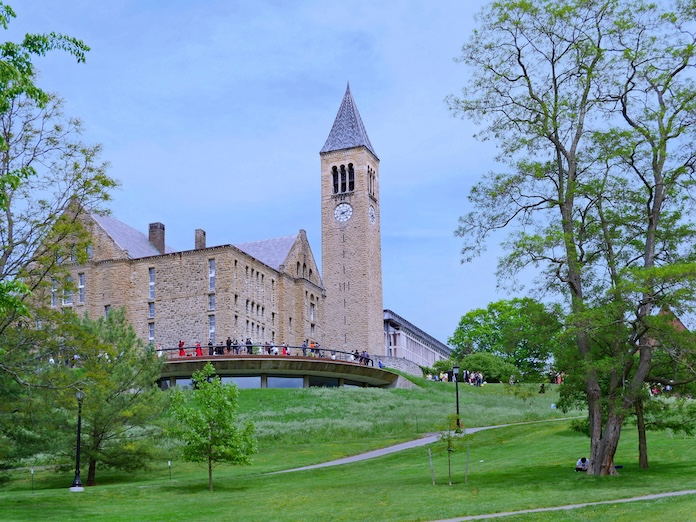
Cornell University, located in rural Ithaca, New York, approximately 220 miles northwest of New York City, is a private Ivy League research university founded in 1865. It is the largest land-grant university in New York state. Cornell’s eight undergraduate colleges and schools – the College of Agriculture and Life Sciences; the College of Architecture, Art and Planning; the College of Arts and Sciences; the Cornell David A. Duffield College of Engineering; the Cornell S.C. Johnson College of Business, the Jeb E. Brooks School of Public Policy; the College of Human Ecology; and the School of Industrial and Labor Relations–encompass more than 100 fields of study.
According to U.S. News & World Report 2026 Best Colleges, Cornell University ranks No. #12 in National Universities. It has a total undergraduate enrollment of approximately 16,000 students, making it the largest undergraduate population in the Ivy League. It also boasts the largest physical campus, spanning approximately 2,300 acres.
Cornell by the Numbers
Cornell does not provide the total number of applications received and the overall undergraduate acceptance rate for the Class of 2030 until it submits its updated Common Data Set figures. What we do know is that this year Cornell accepted 48 fewer undergraduate applicants than last year. According to an article published on March 26, 2026 by Cornell’s university newspaper, the Daily Sun, Cornell admitted 5,776 applicants overall, down from 5,824 for the Class of 2029. In the last seven years, however, the number of admitted applicants has held steady in the low-mid 5,000 range.
| Class Year | Early & Regular Decision Applications Received | Early & Regular Decision Applications Accepted *excluding admits from the waitlist | Early & Regular Decision Admissions Acceptance Rate |
| 2030 | NA | 5,776* | NA |
| 2029 | 72,523 | 5,824* | 8.00% |
| 2028 | 65,612 | 5,516 | 8.41% |
| 2027 | 67,846 | 5,358 | 7.34% |
| 2026 | 71,164 | 5,168 | 6.90% |
| 2025 | 67,380 | 5,852 | 8.71% |
| 2024 | 51,500 | 5,514 | 10.71% |
Over this six-year period, application volumes grew from 51,500 to 72,523. This represents a 40.8% increase in overall interest and competition, making a Cornell acceptance significantly harder to secure than it was at the turn of the decade.
The Return of Standardized Testing
According to the Daily Sun, applicants for the Class of 2030 were required to submit their SAT and/or ACT test scores for the first time since 2020. This policy reverses the test-optional and, in some colleges, test-blind approach, that Cornell adopted in response to the COVID-19 pandemic that caused many ACT and SAT test centers to cancel administrations.
According to an April 2024 article in the Daily Sun, a task force assembled to review Cornell’s testing requirements concluded that “Standardized test scores can give the admissions committees a better understanding of the students’ academic potential when contextualized to students’ backgrounds, including the high school they attend and their familial income, according to the task force…SAT scores [also] help inform how first-year students will handle academic rigor, especially in their first semester.” Cornell expected that making score-reporting optional would increase the diversity of applicants; instead, the task force found no measurable difference.
The surge in applications between the Class of 2024 (51,500) and the Class of 2025 (67,380) represented approximately a 31% jump, an increase of nearly 16,000 applications in a single cycle. This leap corresponds to the implementation of Cornell’s test-optional and test-blind policies, which removed a major barrier to entry for prospective applicants whose testing fell significantly below Cornell’s mid-50%. Since then, applicant numbers have hovered between approximately 65,000 and 71,000. For the Class of 2029, however, Cornell experienced another peak: 72,523—marking the highest application volume in Cornell’s history and proving that the university’s demand remains on the rise.
The Cornell Difference
The students admitted to the Class of 2030 at Cornell University hail from all 50 states and 102 countries; on their applications, they indicated intention to study approximately 80 majors across eight different colleges. These facts highlight the most fundamental difference between Cornell and every other member of the Ivy League: a structurally distinct and multifaceted undergraduate environment. By seamlessly integrating liberal arts with highly specialized, pre-professional disciplines, Cornell lives its founder’s mission: to offer instruction to “any person… in any study.”
Explore Additional Resources
Are you thinking about applying to Cornell? Curious about admissions trends and strategies to improve your odds? Contact us to discuss our Application Boot Camp® or Private Counseling program—we look forward to supporting you!
- Which Cornell College Should You Apply To? Insider Admissions Guide
- Dartmouth vs Cornell
- What It Actually Takes to Get Into a Top College in 2026
- How to Choose a College Major
- What to Do When Your AP Scores Come Out in 2026
Stay Connected for More Expert Guidance
Want to stay in the loop? Follow us on Instagram @toptieradmissions and subscribe to our blog for expert advice and admissions insights.
Know someone else navigating the college process? Pass it along—they’ll thank you later!

She began her career at Kent School as an English teacher, coach, dormitory faculty member, and assistant athletic director, developing a deep understanding of students both inside and outside the classroom. After earning her master’s degree from Northwestern University, she joined Westminster School, where she ultimately served as Director of College Counseling, guiding students and families through academic planning and highly selective admissions.
Kate later held senior leadership roles at Pomfret School and for 12 years at The Winsor School, where she oversaw grades 5–12 academics, supervised college counseling, conducted mock interviews, and helped shape institutional strategy.
Having worked as a teacher, advisor, college counselor, academic dean, and associate head of school, Kate understands how admissions decisions are made — and how to position students thoughtfully and authentically. Today, she focuses on what she values most: partnering one-on-one with young people to help them tell their stories with confidence and purpose.
- NYU Supplemental Essays 2026-2027 - October 3, 2026
- University of Pennsylvania Supplemental Essays 2026-2027 - September 24, 2026
- University of Chicago Supplemental Essays 2026-2027 - September 18, 2026