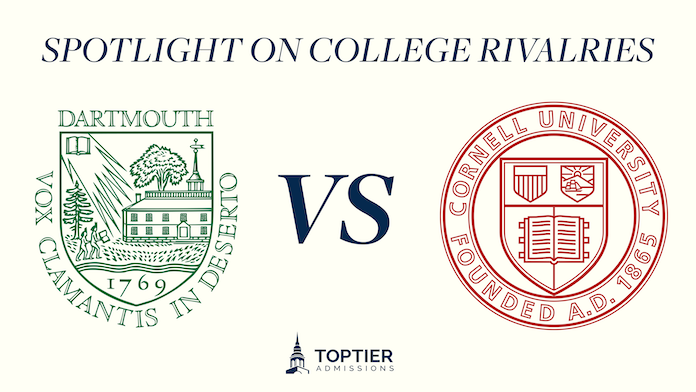
When deciding between two powerhouse Ivy League institutions like Dartmouth and Cornell, the choice isn’t just about prestige — it’s about finding the right fit for your academic goals, lifestyle, and future plans. In this blog, we’ll break down key factors like the cost of attendance, student body stats, and differences in the application process, helping you understand what sets each school apart. Whether you’re drawn to Dartmouth’s close-knit campus in rural New Hampshire or Cornell’s expansive offerings in Ithaca, New York, we’re here to help you weigh your options and decide which university feels like the right fit for you.
DARTMOUTH OR CORNELL? AN OVERVIEW
Dartmouth College — Hanover, New Hampshire
Dartmouth is the smallest Ivy League school with around 4,000 undergraduates. It’s known for its strong liberal arts focus, close-knit community, and emphasis on undergraduate teaching. The college operates on a unique “D-Plan” quarter system, which gives students more flexibility in designing their academic calendar and pursuing off-campus opportunities. Campus life centers around traditions, outdoor activities, and small class sizes that foster strong faculty-student relationships. Founded in 1769, it holds the honor of being the ninth-oldest institution of higher education in the United States. Roughly 60% of Dartmouth’s undergraduates are involved in Greek life and 25% participate in its Division I sports teams. Dartmouth was ranked #15 by the 2025 U.S. News and World Report.
Cornell University — Ithaca, New York
Founded in 1865, Cornell, by contrast, is one of the largest Ivies, with over 16,000 undergraduates across eight distinct colleges. It offers a broad range of academic programs, including specialized schools for engineering, agriculture, business, and hotel administration. While it has a vibrant campus community, its larger size can feel more decentralized compared to Dartmouth’s intimate setting. Cornell’s academic rigor is well-known, and the school provides abundant research, internship, and career resources. Cornell was ranked #11 by the 2025 U.S. News and World Report.
Students looking for a wider variety of majors and a more bustling campus might find Cornell a better fit, while those seeking a smaller, community-oriented college experience may be drawn to Dartmouth.
Application Boot Camp®
Need strategic guidance from start to finish?
COST OF ATTENDANCE
Cornell sets itself apart from other Ivy League colleges by offering a discounted rate to in-state students for some of its colleges. There is no in-state tuition rate for Cornell’s colleges of Architecture, Arts & Planning, Arts & Sciences, Engineering, and Hotel Administration. Per-year tuition is $71,266 for non-residents and/or those attending one of the previously mentioned colleges. New York residents attending one of Cornell’s state contracted colleges pay $48,010 a year.
Dartmouth maintains a consistent tuition price for both in-state and out-of-state students — $69,207 for the 2025-2026 academic year. Dartmouth’s admissions process is unique in that it is one of a few colleges that are need-blind for all applicants, including international students. Like other elite colleges, it meets 100% of demonstrated financial need. Cornell, on the other hand, is not need-blind for international students but will meet 100% of financial need for all admitted students.
STUDENT BODY STATS
As of Fall 2024, Cornell University had an undergraduate population of 16,128 and a graduate school population of 10,665. Of the undergraduates, 10% were international students and 53% were categorized as racial/ethnic minorities. 21% of undergraduate students received Pell grants. The student to faculty ratio is 9:1.
Meanwhile, Dartmouth College has a 7:1 student to faculty ratio with around 4,400 undergraduates and 2,300 graduate students. For the Class of 2028, 23% of students were Pell grant eligible and 31% came from low-income households. 45.6% were domestic students of color, 16% were international and 17% were the first in their family to attend college.
College Private Counseling
Unlock your full potential.
DARTMOUTH VS. CORNELL: THE APPLICATION
If you’re planning to apply to Dartmouth or Cornell, here’s what you need to know.
Dartmouth College was the first Ivy League to announce it would reinstate standardized testing requirements, effective for the Class of 2029. Cornell followed suit, with all 8 undergraduate colleges requiring standardized test scores effective Fall 2026.
Cornell has not yet released its acceptance rate for the Class of 2029, but Dartmouth has, accepting just 6.03% of applicants (although this is slightly higher than the Class of 2028’s 5.40% acceptance rate). Cornell’s Class of 2028 saw an 8.41% acceptance rate, making it marginally less selective than Dartmouth. Dartmouth enrolled 49% of the Class of 2028 through its ED round.
The Deadlines
Something Cornell and Dartmouth have in common is a shared admissions timeline. Binding Early Decision applications are due November 1st and applicants can expect to hear back in mid-December. Meanwhile, Regular Decision applications are due on January 2nd, with admissions decisions released on “Ivy Day,” typically during the last week of March.
The Academic Profile
For Dartmouth’s Class of 2028, 93% of accepted students were in the top decile of their high school class rank or standing, for those high schools that reported rank. The Class of 2024 is the most recent year in which applicants were required to submit scores to Dartmouth and they reported a mean ACT score of 33 and a mean SAT Math score of 750 and SAT Critical Reading of 733.
The Class of 2024 was also Cornell’s most recent test-required year, with the middle 50% of enrolled students reporting an ACT score of 34 and a total SAT score of 1490.
The Application Essays
Cornell introduced a new essay prompt following the Supreme Court ruling that overturned affirmative action. You can read this blog post for our full breakdown of Cornell’s supplemental essays. Remember, each of Cornell’s 8 colleges has its own requirements for admission and a distinctive set of majors — and their essay questions reflect those differences. Keep in mind that you can only apply to one, so choose wisely!
On the other hand, Dartmouth asks all applicants to respond to a series of questions (which we’ve broken down for you in this blog post). Dartmouth is specifically looking for applicants’ “sense of humor, your passion, your intellectual curiosity, your self-awareness, or social awareness, or some mix of these.” It’s critical that your essay responses help you stand out from the crowded and qualified applicant pools.
TTA EXPERT INSIGHT
“Unlike some Ivy League schools where undergrads compete with grad students for resources, Dartmouth is deeply undergraduate-centered. Professors often teach intro classes, not just grad seminars, and students build real relationships with faculty.
Dartmouth has a powerful and distinctive way of shaping not just scholars, but better human beings — people who are intellectually curious, socially responsible, and deeply connected to community and purpose.”
— Maria Laskaris, TTA Senior Private Counselor and former Dean of Admissions & Financial Aid at Dartmouth College
“Students considering the two rural Ivies—Cornell and Dartmouth—benefit from schools where student life is highly centered on campus. Although Cornell is much larger overall, students in Cornell’s liberal arts college, the College of Arts & Sciences, have a home college that is close to Dartmouth’s size while having access to the expansive resources and opportunities of Cornell’s other more pre-professional schools like the Dyson School of Applied Economics and Management and the Bowers College of Computing and Information Science.”
— Heidi Steinmetz Lovette, TTA Senior Private Counselor and former Assistant Director of Admissions at Cornell University
THE RIGHT FIT FOR YOU
At the end of the day, the right choice between Dartmouth and Cornell comes down to fit. If you thrive in a tight-knit, undergraduate-focused environment with a flexible schedule and love the outdoors, Dartmouth might be your perfect match. If you’re excited by academic variety, big-school energy, and access to specialized programs, Cornell could be the better match.
Both are world-class Ivy League institutions — so whether you find yourself hiking the trails of Hanover or exploring the gorges of Ithaca, you’ll be setting yourself up for an unforgettable college experience. At Top Tier Admissions, we’re here to help you make that call — and craft a standout application to get you there.
READ MORE FROM TOP TIER ADMISSIONS
- Cornell University Supplemental Essays (2024-25)
- Dartmouth College: Supplemental Essays (2024-25)
- Breaking News: Dartmouth College Reinstates the SAT
- Breaking News: Cornell Reinstates Standardized Testing
- Dartmouth: Class of 2028 Acceptance Rate
If you enjoyed this post, follow us on Instagram @toptieradmissions for more tips and subscribe to our blog for expert insights & college admissions news!

- University of Chicago: Supplemental Essays 2025-26 - August 29, 2025
- Boston College: Supplemental Essays 2025-2026 - August 15, 2025
- Cornell: Supplemental Essays 2025-2026 - August 1, 2025