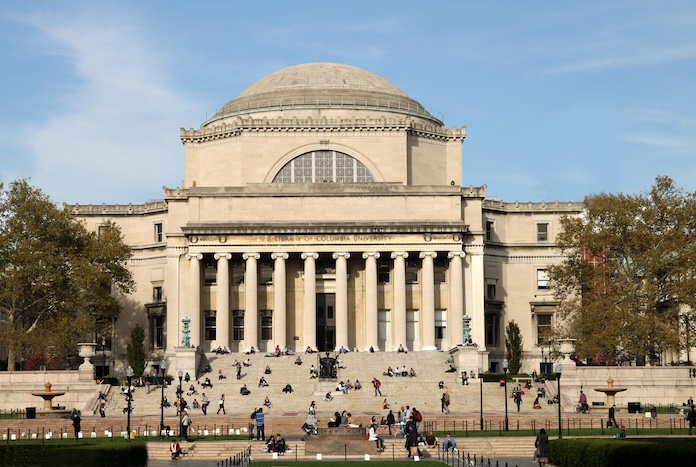
Columbia University, an Ivy League institution in New York City founded in 1754, is defined by its Core Curriculum—rigorous, discussion-based seminars in literature, philosophy, art, and science central to the Columbia College experience. The university admitted 2,581 students from 61,031 applicants to the Class of 2030 for an overall acceptance rate of 4.23%, down from 4.94% last cycle, according to the Columbia Spectator. The applicant pool was the largest in Columbia’s history, even as Early Decision applications declined for the second consecutive year.
The Class of 2030 marks a return to Columbia’s pre-2029 selectivity after an anomalous cycle in which the university offered roughly 600 more spots than usual.
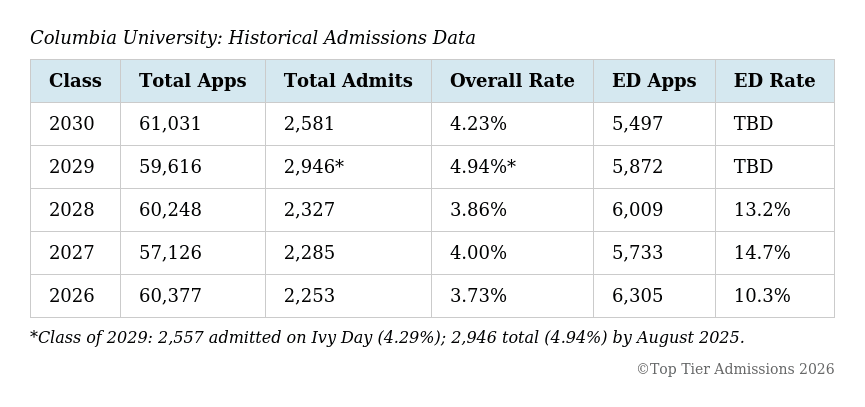
Across these five cycles, total admit counts have held between 2,253 and 2,581, with the Class of 2029 as the clear outlier at 2,946, for which Columbia had offered 2,557 combined Early Decision and Regular Decision spots by Ivy Day and then extended an additional 389 offers over the summer to reach that unusually high total. The university has since confirmed plans to continue some level of enrollment expansion, though the final scale and timeline have not been disclosed. Meanwhile, total applicant volume has continued to climb, reaching a new institutional high for the Class of 2030, yet Early Decision (ED) applications have fallen 8.5% over two cycles. Even so, the gap between the ED and Regular Decision (RD) acceptance rates has held firm: Early Decision applicants have been roughly five times more likely to gain admission than those applying Regular Decision.
Test-Optional, But Not Writing-Optional: What Columbia’s Supplement Really Demands
Despite remaining the only Ivy with a permanently test-optional policy, Columbia posted the lowest overall acceptance rate in the Ivy League this cycle. While 44% of enrolled students in the Class of 2029 still submitted SAT scores and 17% submitted ACT scores, every applicant—regardless of whether they submit test scores—must complete Columbia’s demanding writing supplement, one of the most extensive in the Ivy League. The admissions office describes these essays as “an essential part of our holistic and contextual review,” designed to surface “intellectual curiosity, habits of mind, love of learning and sense of self.” The writing supplement now requires six responses totaling roughly 850 words (one more than in the prior two cycles), including an essay tailored to the applicant’s chosen undergraduate college: Columbia College or the Fu Foundation School of Engineering and Applied Science (SEAS). Although both schools share intellectual commitments, their academic philosophies differ: Columbia College cultivates “habits of mind” through communal inquiry into “humanity’s most enduring questions,” while SEAS is guided by its “Engineering for Humanity” vision, orienting technical training toward the common good. The college-specific essay invites applicants to articulate fit with their chosen school, which calls for more than a stated preference for one subject or another.
TTA Top Tip: Columbia’s writing supplement has probed areas such as intellectual habits, lived experience, resilience, community engagement, and school-specific fit, with the newest prompt dedicated to navigating disagreement. The “Why Columbia?” prompt may appear straightforward, but it rewards applicants who go beyond surface-level enthusiasm and articulate a genuine, specific connection to what Columbia offers.
Expert Guidance for Every Step of the Columbia Application
TTA’s counselors bring deep expertise to every component of this supplement, helping students surface the intellectual curiosity, personal experiences, and habits of mind that resonate most with Columbia’s admissions readers. Our Application Boot Camp® helps families build a compelling application from the ground up — and our Private Counseling program provides personalized, end-to-end support throughout the entire process. Contact us to learn how we can support your family’s Columbia journey.
At Top Tier Admissions, we are committed to making the college admissions process more transparent. Easy access to clear data helps families understand trends in college admissions to make more informed decisions. This year we’re once again collecting acceptance rate data at selective schools and providing insight and analysis of our own.
Want To Read More?
Are you thinking about applying to Columbia University? Curious about admissions trends and strategies to improve your odds? Contact us to discuss our Application Boot Camp® or Private Counseling program—we look forward to supporting you!
- Get Into Columbia
- Barnard vs Columbia University: Same College, Different Campuses
- College Unfiltered: The Real College Student Experience on Campus
- Average GPA and Class Rank at Top Colleges
- Ivy League Acceptance Rates & Profiles
Want to stay in the loop? Follow us on Instagram @toptieradmissions and subscribe to our blog for expert advice and admissions insights.
Know someone else navigating the college process? Pass it along—they’ll thank you later!