
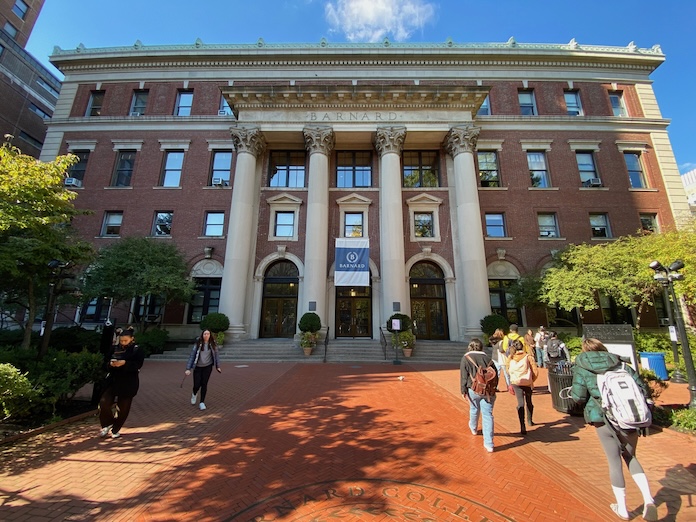
Columbia University and Barnard College share one of the most uniquely intertwined relationships in higher education. Columbia did not admit women until 1983, making it the last Ivy League school to do so, while Barnard, founded in 1889 as part of the Seven Sisters, is an independent women’s college with a long-standing affiliation with Columbia, located just across Broadway. Today, the two institutions remain deeply connected yet academically distinct. Students can cross-register for classes and share campus resources, but each school maintains its own degree requirements, academic culture, and signature educational experiences.
If you’re unsure how Barnard and Columbia fit together, or which might feel most like you, this guide breaks it all down clearly and simply.
BARNARD VS. COLUMBIA: A UNIQUE DYNAMIC
The unique dynamic between the two schools grew out of a more than century-long struggle for women’s access to higher education. In 1900, Barnard became formally affiliated with Columbia University under the traditional model of a women’s college, retaining its own board of trustees, faculty, dean, endowment, and campus. At the same time, Barnard and Columbia University shared academic instruction, library resources, and Columbia University degrees.
Even after Columbia University began admitting women as undergraduate students, Barnard remained an independent institution. The two schools renegotiated their relationship, but Barnard was never absorbed into the University and continues to operate as a distinct college with its own governance and academic identity.
College Private Counseling
Unlock your full potential.
THE MOST OBVIOUS DIFFERENCE
The biggest distinction between Barnard and Columbia University is simple: Barnard is a women’s college. It draws students who are interested in the unique community, focus, and academic environment that a women-centered education provides. While this experience isn’t for everyone, Barnard consistently attracts a highly accomplished and driven cohort each year.
At a women’s college, students benefit from classrooms composed entirely of women. Courses are often designed with women’s achievements in mind and frequently incorporate perspectives on gender, diversity, and critical theory. While Barnard students enjoy this specialized focus, they do not participate in Columbia’s Core Curriculum classes, which are part of the broader university experience.
Although Barnard’s academic environment is women-centered, the daily campus experience remains co-ed. Students interact with Columbia peers through clubs, electives, social activities, and the shared life of neighboring campuses, blending the benefits of a women’s college with the resources of a major university.
BARNARD VS. COLUMBIA: CURRICULUM
Barnard and Columbia University students share the unique advantage of being able to take courses on either campus. The main differences in their experiences lie in mentorship and curriculum structure.
Barnard students follow an open curriculum called Foundations. Their first year begins with a two-semester, discussion-based First-Year Experience seminar. In their sophomore year, students complete General Education Requirements, which combine Distributional Requirements with Barnard’s signature Modes of Thinking, including a distinctive technology component. This approach encourages students to explore a wide range of fields before declaring a major.
Throughout their time at Barnard, students choose electives, pursue a major from more than 50 areas of study, and complete a senior thesis or project, allowing them to demonstrate deep engagement with their discipline.
Columbia’s Core Curriculum is a major draw for prospective students. It consists of eight structured courses: Art Humanities, Contemporary Civilization, Frontiers of Science, Literature Humanities, Music Humanities, and University Writing. Students also take electives in areas such as the Global Core, foreign languages, science, and physical education.
For many applicants, these curricular structures play a key role in deciding between the schools. The Columbia Core offers a structured, time-tested framework that immerses students in a shared intellectual foundation. In contrast, Barnard’s Foundations curriculum provides similar exposure to a broad range of disciplines but in a more flexible, self-directed format, allowing students to explore their academic interests before committing to a major.
BARNARD VS. COLUMBIA: MENTORSHIP AND THE STUDENT EXPERIENCE
One of the most notable differences between Barnard and Columbia lies in their advising systems and student experience. Barnard attracts students who value smaller class sizes, close faculty relationships, and personalized mentorship. In 2024, Barnard’s undergraduate population was 3,269, compared with Columbia University’s 8,900 undergraduates across more than 20 schools, four of which are undergraduate. This significant difference in scale creates distinct experiences: Barnard offers a more intimate, community-driven environment, while Columbia provides the breadth and diversity of a larger research university.
The relationship between the schools is nuanced, and cross-campus academics add an extra layer of complexity. For example, a Barnard student majoring in computer science will take most of her major courses at Columbia, while art history students frequently enroll in classes at both schools. Barnard offers a standalone architecture degree, whereas Columbia students interested in architecture take those courses at Barnard. This interwoven structure gives students access to resources and faculty at both institutions while maintaining Barnard’s distinct academic identity.
When it comes to advising, Barnard students often build close, ongoing relationships with both their pre-major and major advisors. This level of personalized mentorship fosters academic growth, professional guidance, and a supportive environment where students can explore a wide range of interests before declaring a major. In contrast, the larger Columbia University experience can feel more generalized, though it offers broader networking opportunities and access to a wide array of programs and resources.
BIG PICTURE
Ultimately, Barnard College and Columbia University offer interconnected yet distinct experiences. Barnard provides a close-knit, women-centered liberal arts environment with personalized mentorship, while Columbia offers the scale, resources, and Core Curriculum of a major research university. Students at Barnard can take classes at Columbia, and vice versa, blending the benefits of both worlds, but each school maintains its own identity, culture, and academic framework. Choosing between them comes down to the kind of academic environment, community, and opportunities that best support a student’s goals, ambitions, and personal growth.
Want to stay in the loop? Follow us on Instagram @toptieradmissions and subscribe to our blog for expert advice and admissions insights.
Know someone else navigating the college process? Pass it along — they’ll thank you later!
- Johns Hopkins Supplemental Essay 2026-2027 - October 9, 2026
- Get to Know College Admissions Expert, Kayte Hager - October 1, 2026
- U.S. News College Rankings 2027: MIT Is No. 1, Princeton Drops - September 22, 2026