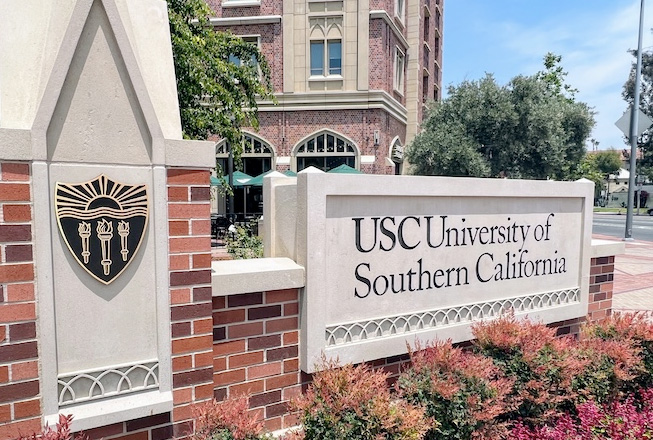
The University of Southern California, a private research university in Los Angeles ranked among the top 25 nationally, offers more than 150 majors across signature schools including Marshall (business), Viterbi (engineering), and Cinematic Arts. USC admitted 9,251 first-year students from a pool of 79,290 applicants to the Class of 2030—an overall acceptance rate of 11.7%, up from 11.2% last cycle, according to the Daily Trojan. The admitted class arrives with an average GPA of 3.92—the highest in USC history.
USC Acceptance Rate: Class of 2030
This is the highest acceptance rate USC has reported in four years, and well above 9.8% for the Class of 2028. The shift is volume-driven: applications fell roughly 5% from last cycle’s 83,500 to 79,290, while the number of admits held roughly steady at about 9,250. Fewer applicants for a similar number of admits produced the higher rate—not a softening of selectivity.
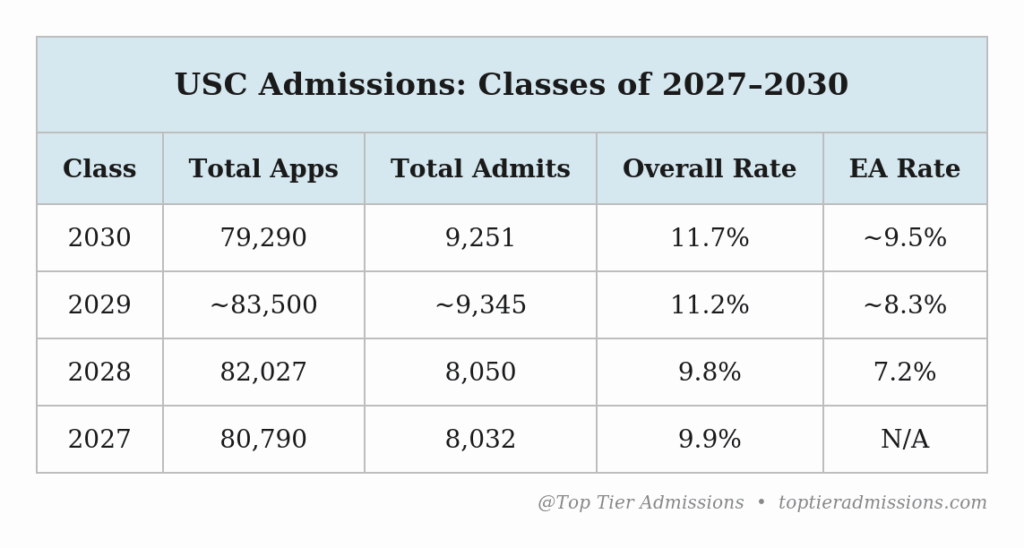
The Early Action acceptance rate this cycle was approximately 9.5%—the highest since USC introduced EA for the Class of 2027, but still below the overall rate. This inversion is one of USC’s most distinctive admissions features. At most selective schools, applying early offers a statistical advantage; at USC, the EA round draws an unusually concentrated pool because it doubles as the merit-scholarship deadline. The strongest, most credentialed applicants front-load into EA, producing a tougher pool and a lower admit rate. For Regular Decision applicants, this dynamic is meaningful: at USC, the RD round is generally more forgiving than EA, even as the absolute bar remains high.
USC remains test-optional, with the policy in place through the Class of 2031 cycle. According to USC’s most recent Common Data Set, 30% of enrolled first-year students submitted SAT scores and 12% submitted ACT scores—a combined submission rate of about 42% that runs well below peer institutions, where Yale reported 86% and the University of Michigan roughly 78% in the same cycle. USC weights rigor of secondary school record, academic GPA, application essays, and recommendations as “very important” factors—the highest ranking USC assigns. For RD applicants, this means the academic case carries the full weight, and applying without scores is a more viable path at USC than at most of its peers.
The Class of 2030 is also a turning point for USC’s admissions architecture. This cycle marked the first year of the Marshall School of Business Early Decision pilot, a binding pathway available only to applicants to undergraduate business and accounting programs. In February 2026, USC’s Provost announced that Early Decision will expand to nearly all undergraduate programs starting with the Class of 2031, with applicants in both the ED and EA rounds remaining eligible for USC’s merit scholarships. For families currently navigating the RD round, this signals that today’s USC admissions playbook—EA for merit, RD for flexibility—will look meaningfully different in one cycle. The performing arts schools (Kaufman, Thornton, and Dramatic Arts) will remain outside the ED option.
TTA Top Tip: USC’s three-round structure—EA, RD, and, beginning with the Class of 2031, binding Early Decision—rewards strategic timing more than at most peers. USC does not maintain a waitlist; applicants receive an admit or a deny with no second look. Both early rounds preserve eligibility for USC’s flagship merit awards (the Mork Family, Stamps, and Presidential Scholarships), which sharpens the strategic calculus for next cycle: an ED applicant gets the binding admission advantage without sacrificing merit consideration. With ED expanding, the RD round is likely to tighten as committed applicants migrate to the binding pathway. Families with rising juniors should map this calendar now. Contact us to discuss our Application Boot Camp® or Private Counseling program—we look forward to supporting your family’s college admissions journey.
At Top Tier Admissions, we are committed to making the college admissions process more transparent. Easy access to clear data helps families understand trends in college admissions to make more informed decisions. This year we’re once again collecting acceptance rate data at selective schools and providing insight and analysis of our own.
Want To Read More?
Are you thinking about applying to USC? Curious about admissions trends and strategies to improve your odds? Contact us to discuss our Application Boot Camp® or Private Counseling program—we look forward to supporting you!
- USC Acceptance Rate & Admissions
- USC: Class of 2028 Acceptance Rate
- USC Marshall Introduces Early Decision: What It Means for Applicants
- UCLA vs. USC
- Average GPA and Class Rank at Top Colleges
Want to stay in the loop? Follow us on Instagram @toptieradmissions and subscribe to our blog for expert advice and admissions insights.
Know someone else navigating the college process? Pass it along—they’ll thank you later!
- Johns Hopkins Supplemental Essay 2026-2027 - October 9, 2026
- Get to Know College Admissions Expert, Kayte Hager - October 1, 2026
- U.S. News College Rankings 2027: MIT Is No. 1, Princeton Drops - September 22, 2026