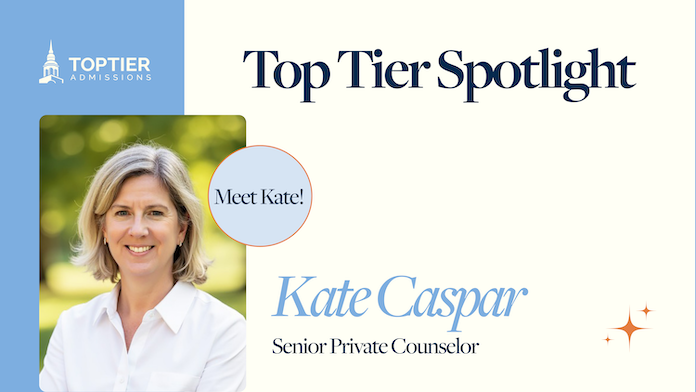
At Top Tier Admissions, our counselors bring decades of experience, deep knowledge of the admissions process, and a personal commitment to every student they work with. In our Counselor Spotlight series, we’re introducing you to the incredible individuals behind our high-touch, expert guidance. Learn more about their unique backgrounds, educational philosophies, and what inspires them to help students reach their college goals.
College Admissions: Counselor Spotlight
Meet Kate. A graduate of Stanford University, Kate brings nearly three decades of independent school experience to her work with students and families navigating the college admission process.
She began her career at Kent School as an English teacher, coach, dormitory faculty member, and assistant athletic director, developing a deep understanding of students both inside and outside the classroom. After earning her master’s degree from Northwestern University, she joined Westminster School, where she ultimately served as Director of College Counseling, guiding students and families through academic planning and highly selective admissions.
Kate later held senior leadership roles at Pomfret School and for 12 years at The Winsor School, where she oversaw grades 5–12 academics, supervised college counseling, conducted mock interviews, and helped shape institutional strategy.
Having worked as a teacher, advisor, college counselor, academic dean, and associate head of school, Kate understands how admissions decisions are made — and how to position students thoughtfully and authentically. Today, she focuses on what she values most: partnering one-on-one with young people to help them tell their stories with confidence and purpose.
With more than 30 years of experience in independent schools and college counseling—and a track record of helping students gain admission to highly selective institutions such as the NESCACs, as well as Ivies like Harvard and Brown—how have you seen the admissions landscape evolve, and how has that shaped the way you guide students today?
I began college counseling in 2003, a time when colleges and universities throughout the United States were rapidly growing more selective. A school would jump from a guidebook category like “selective” to “highly selective” in just one year. Some schools were still marketing themselves as “hidden gems.” Today, these gems still exist, but few are hidden, and highly selective institutions have become even more selective. Because of the unpredictable nature of the admission landscape, students now need more guidance than ever.
I have always believed that guiding students is a highly individualized process, and in that way my approach has always been the same: get to know the student well, work together to identify strengths and interests, and create a list of applications across a range of selectivity that match a student’s priorities and goals. More than ever, students need a trusted advisor who can help alleviate the pressures of the process with careful planning and a ready ear. Every student has unique talents; often they just need to discover them. It is my goal to help them find and lean into those talents over time.
As the landscape continues to evolve, careful planning has never been more important. Students and families crave insight much earlier than they ever did before so that they can enter the college search and application process in a more informed way. There are so many more options now–and so many more nuances to the application process–that families need ready support in understanding the landscape–not to mention all the acronyms out there!
Top Tier Futures
Strategic Consultation & Action Plan
You’ve worked closely with students across the full arc of their development, including in earlier grades. How do you approach guiding younger students in a way that sets a strong foundation for future success?
Adolescence is essentially about identity formation; as such, it is a profound time of growth. Although there are identifiable developmental stages, each student charts a course through middle and high school differently. Younger students, in particular, differ wildly in the way they navigate friendships, interact with their parents, guardians, or siblings, and develop academically. They also approach communication differently. Although some are more reticent than others, they crave trusted adults in their lives to talk through their experiences. They want guidance–even when they eschew it–and they want to feel like they belong.
Younger students need much more support when it comes to exploring their interests in meaningful ways. They also need much more practice in self-advocating than older students typically do. Getting them comfortable talking with adults, trying new things, and discovering their own measures of happiness and success–these are all incredibly important goals when working with younger students. I love to harness their energy and enthusiasm for self-exploration and to help them generate authentic excitement for all of the opportunities to come. The earlier we urge students toward intrinsic motivation and authentic connections to community, the more prepared they will be to make meaningful decisions.
College Private Counseling
Unlock your full potential.
You bring deep experience from highly selective independent and boarding schools, including Winsor, Westminster, and Pomfret. How does that background inform the way you advise students navigating competitive academic environments and aiming for selective colleges?
I have worked for three decades with highly motivated students who find great success in high school because they are curious, intellectual, and genuinely enthusiastic about learning. They are readers and debaters, artists and athletes. They love research and writing and excel across a wide range of academic disciplines. In addition to administrating at these schools, I taught high school English courses every year and thus experienced first-hand the insatiable thirst many of these students have to engage with big ideas and hone their skills. It is no surprise to me that these students wish to attend a college with like-minded peers; understandably, they want vast opportunities and the resources to dive deeply into subject areas.
High-achieving students that aim for selective schools often feel greater stress in the college process because they are used to a direct correlation between excellence and results. The college admissions process does not necessarily reward students in that same way. Even the very top students may not see the results they hope for. Working with these students, it is therefore imperative to celebrate their achievements and support their ambitions while also helping them develop resilience and decision-making skills.
I have always approached the college process as just one part of a student’s academic journey. I focus on planning and purpose but never at the expense of deep conversations about all of the lessons learned along the way.
As a Stanford graduate and former student-athlete, how has your own experience shaped the way you work with students—particularly those balancing rigorous academics with extracurricular or athletic commitments?
I still remember my first week at Stanford. I met more medaled Olympians than exist in some small countries. I was surrounded by patent-holders, entrepreneurs, and published writers. It is not uncommon for students at highly selective colleges and universities to experience some form of imposter syndrome. For me, lacrosse became my niche, a place where I could stand out and depend on people with the same athletic drive. I found great success academically in part because I had a “side gig” that provided me with a healthy, balanced perspective and a way to structure my time. The same was true for me in high school.
Most of the students I have worked with enjoy deep commitments either inside or outside of school that extend beyond the classroom. Some hold jobs. Others engage in research, community activities, club sports, and fine arts competitions. And most get involved in some way or another with student organizations at their school. All of these are valuable opportunities for students to stretch and grow and try new things. And what students learn about time-management and leadership from extracurricular commitments is invaluable. What I have learned from guiding these students, and from my own experience balancing athletics with academics, is how important it is to prioritize quality over quantity. I work with students to help them identify those opportunities that most excite them and to commit their time to those. This approach does not mean they should forgo other pursuits, but I want them to choose their commitments carefully and not over-extend themselves at a time when life demands so much of them.
You’re known for building strong, trust-based relationships with students and families. What does that look like in practice—and what continues to energize you about this work after so many years?
I approach all of the work that I do with students and families as an educator. Fundamental to my philosophy is that true learning can only take place in the context of a trusted relationship with an adult. Students learn best when they know that the adult they are working with is as invested in their success as they themselves are. To that end, building a relationship with a student and family must begin with trust.
Adolescents are savvy, and they can smell inauthenticity from a mile away. The first step in building any relationship with them is to ensure that they feel seen and heard. Even students reluctant to open up initially will warm to a conversation with a genuine listener who celebrates them for who they are and who truly believes in their capacity to grow. These relationship-building conversations become safe spaces for students to reflect and make choices–and that is where the real learning begins.
Likewise, families need to trust that their child is in the capable hands of an experienced adult, and that trust is born when they see that their child is known. The success of that relationship also depends on good communication and a willingness to partner in support of their child.
I first started working with young people in 1995, and I have never looked back. I love guiding adolescents because they approach the world with so much wonder. Even when they stop asking “why” 100 times a day (probably 10 of which occur just on the walk from the front door to the mailbox), their curiosity remains. Sometimes their inquisitiveness is insatiable and they cannot resist making connections (every middle school teacher learns how to manage a barrage of “that reminds me of…!” comments); other times they are shyly curious–all eyes and ears. As they grow, they learn to turn their questions into answers and into more questions again. And all this growth is happening in a swirl of emotion and uncertainty. Working with young people means that not one day is the same as the next. What is more exciting than that?
I think we sometimes forget that parents go through stages, too. Those frenzied early years of parenting turn all too quickly into frosty conversations with their once-doting teenagers. Then the empty nest looms (something I will experience in September), and all that self-doubt kicks in: Is my child ready to be on her own? Did I give her a proper moral compass? Will she eat vegetables? At the end of the day, we all want our children to be happy. We want them to get what they want. We want their hard work to be recognized. Parents need guidance too, especially in a process that is different from the one they encountered. I love talking with families about their own experiences and their profound investment in their child’s happiness and wellbeing.
Stay Connected for More Expert Guidance
Want to stay in the loop? Follow us on Instagram @toptieradmissions and subscribe to our blog for expert advice and admissions insights.
Know someone else navigating the college process? Pass it along — they’ll thank you later!