At Top Tier Admissions, our counselors bring decades of experience, deep knowledge of the admissions process, and a personal commitment to every student they work with. In our Counselor Spotlight series, we’re introducing you to the incredible individuals behind our high-touch, expert guidance. Learn more about their unique backgrounds, educational philosophies, and what inspires them to help students reach their college goals.
College Admissions: Counselor Spotlight
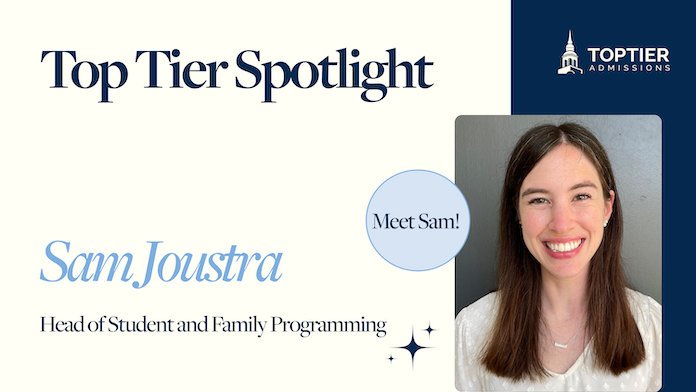
Meet Sam. As the lead counselor for Top Tier Admissions’ renowned Application Boot Camp®, she works directly with students and families during one of the most intensive and impactful stages of the college admissions process. In her role as Head of Student and Family Programming, Sam brings deep, firsthand insight from her experience as a former Admissions Officer at the University of Michigan and former Assistant Director of Admissions at Vanderbilt University. Holding a Master of Education in Higher Education Administration from Vanderbilt, she is also a nationally recognized thought leader who has presented at the National Association for College Admission Counseling (NACAC) Annual Conference. Sam combines strategic admissions expertise with a warm, student-centered approach to help applicants navigate highly selective admissions with clarity, confidence, and purpose.
You’ve worked on both sides of the admissions desk—from Michigan and Vanderbilt to counseling families directly. How has that dual perspective shaped the way you guide students and parents today?
I knew it was important for my eventual work in college counseling that I had firsthand experience making admissions decisions. Having reviewed tens of thousands of college applications and essays, I know what is important in the application process–and what might matter less than students and families think. Especially in committee review, the storytelling and personal qualities in a student’s application speak volumes when it comes to understanding what kind of learner, friend, and community member a student will be on campus. It’s these qualitative pieces that really shine through in an application and help a student stand out. It’s so much more important to focus on the “why” behind the “what.” For example, when it comes to activities and involvements, a student’s awards, accomplishments, and titles alone are not enough to impress an admissions reader; they don’t jump off the page without deep and earnest reflection on growth, impact, and connection to sense of self.
In your role as Head of Student & Family Programming, you lead some of our most immersive experiences—Application Boot Camp®, the College Planning Retreat, and live workshops nationwide. What do you think students and parents gain from being together, in person or virtually, for this immersive work?
I think this work is most successful (and enjoyable!) when the entire family is working together. And that includes college counselors- we are all coaches and mentors on the student’s team, equally invested in our students’ success. It’s important for students and parents alike to be well-informed and to keep communication lines open. There is so much chatter in this space, and truths about college applications and selection can become muddied. I want to help families cut through the noise and focus on what’s really important for them–and that will look different for each student. Having a space to ask questions, address concerns, and absorb expert insight can help families feel more empowered on this journey.
Application Boot Camp®
Need strategic guidance from start to finish?
What do you wish more parents understood earlier about how admissions decisions are actually made? And what’s one myth you find yourself debunking most often?
I love to debunk the myth that in order to be appealing to a college, students have to be well-rounded. I think it can be enlightening for students and parents alike to hear that colleges are not necessarily looking for well-rounded students; they’re looking to build a well-rounded class. Hopefully, knowing this also releases students from any pressure they might feel to have to be involved in every single activity or to love every single academic subject. You don’t have to be an expert in everything- in fact, you aren’t expected to be an expert on anything. However, colleges do expect you to have thought about the things that light you up, and to have investigated ways to make connections across those interests and explore them more deeply. For that reason, what a college is looking for from one applicant can be completely different from what they are looking for from another applicant. This is why it’s so important for students to focus on their own journeys, rather than trying to emulate someone else or try to fit into a mold of what they think a school is looking for. College campuses would not be the incredibly dynamic and diverse communities they are if they were looking for the same thing from every student.
Families often describe you as calm, kind, and deeply invested. What does building trust with a student look like for you? And how do you help students stay grounded and confident during high-pressure moments in the process?
Building trust with a student is the cornerstone of my work with them. This starts with listening intently to what they’re looking for, and meeting them where they are. I want to be an advocate and a cheerleader for my students. I want them to feel that they have another trusted adult who’s in their corner. I want to validate their interests and curiosities while helping open them up to new ideas and ways of putting the pieces together. There is no one-size-fits-all type of counseling because every student has different wants and needs. I constantly remind my students that the most important factor in this entire process is not their GPA or their test score–their mental health and wellbeing- if that’s not being nurtured, then nothing else matters. Rather than try to do everything, I find that students are most successful when they are able to find balance in their lives at the intersection of challenging but fulfilling academics, meaningful community impact, making connections across intellectual curiosities, and pursuing hobbies that they enjoy for the pure, intrinsic love of them. Those are the things that make you a whole person- and that make this entire process more authentic and enjoyable.
What’s one small mindset shift that can make the college process feel healthier for both students and parents?
Though it can be a difficult truth to hear, your college admissions decision is not just about you. I think it’s important to remember that there are parts of this process that are out of a student’s control- things like institutional priorities, departmental directives, programs a school wants to grow or limit, geographic representation, and so much more. It is often impossible to know what those factors are, and so you couldn’t possibly try to predict them. Instead, let’s spend our time and energy focused on the things you can control–the decisions a student makes around their courses, how they choose to spend their free time, and more. I want students to get to a place where they feel that, no matter what those college decisions are, they are confident and proud of the self they put forward in their applications.
When a student finishes one of our programs, what do you most hope they’re walking away with?
I want students to feel more confident in themselves and in their voice. It’s easy for the college decision to feel like the end goal–it is, after all, the culminating moment that they have worked so hard for throughout high school. But I hope that students feel that all the reflection and self work they do throughout their application journey is so much more than just a means to an end. Getting into college is not the end of the road; it’s the beginning. College is an incredibly exciting chapter in life. It’s absolutely normal to have some nerves and trepidation about embarking on that next chapter, but I want students to feel excited as they think about all the ways the world will open up to them- the different perspectives and ideas they’ll confront; trusted friends and mentors they’ll connect with; new ways of learning; and risks they’ll get to take as they learn about themselves just as much as about the world around them.
Want to stay in the loop? Follow us on Instagram @toptieradmissions and subscribe to our blog for expert advice and admissions insights.
Know someone else navigating the college process? Pass it along — they’ll thank you later!