
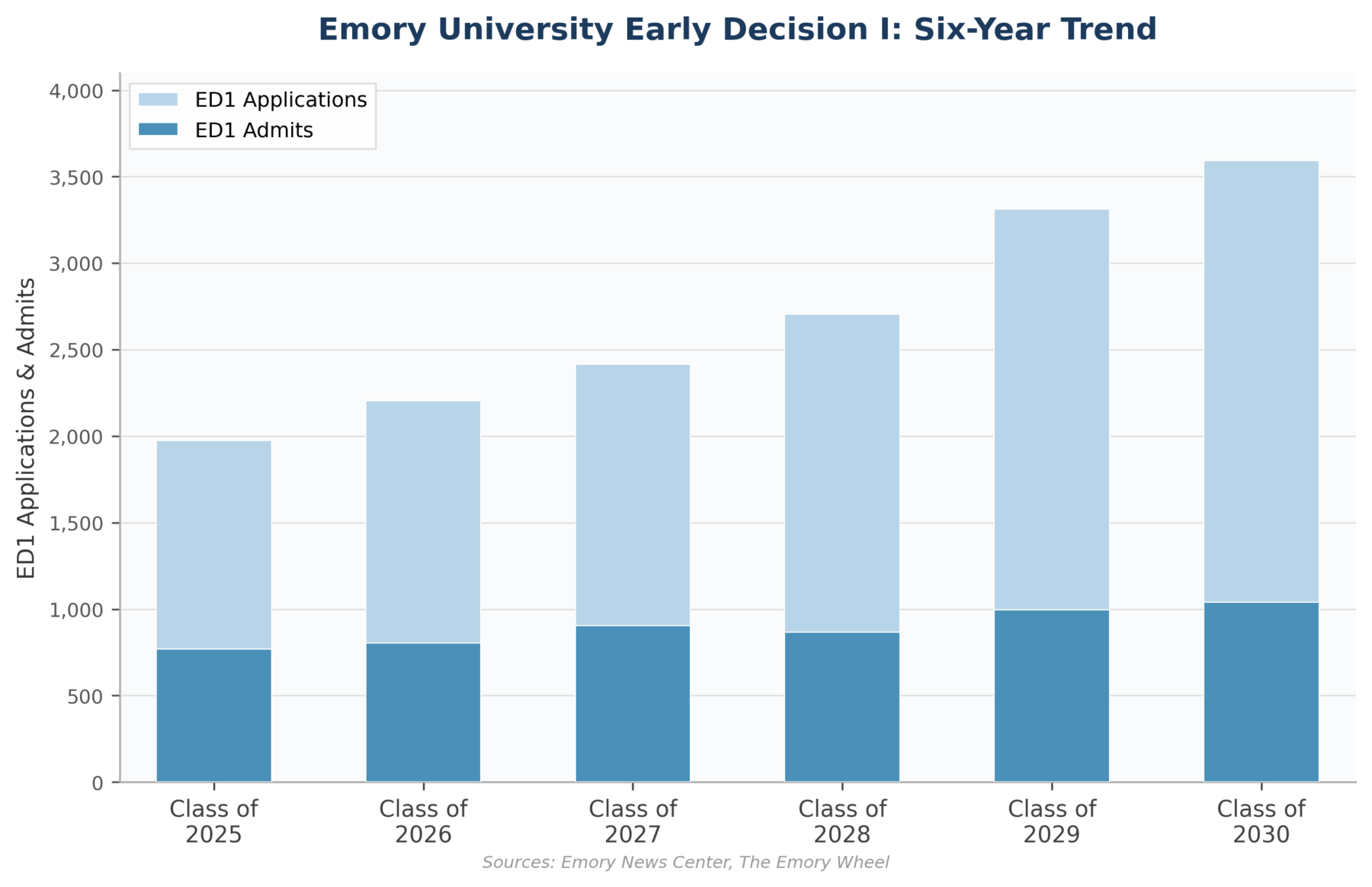
Emory University, a top-25 research university in Atlanta, Georgia, received a record 3,593 Early Decision I applications to the Class of 2030 and admitted 1,041 students for an early acceptance rate of 29%, according to the Emory Wheel. The 8.5% jump in applications extends a six-year streak of consecutive growth that has nearly doubled the ED1 applicant pool since the Class of 2025—and pushed the acceptance rate down ten points over the same period.
Emory University Early Acceptance Rate
ED1 applications have grown from 1,975 to 3,593 over six cycles—an 82% increase—while admits have risen modestly from 769 to 1,041. That widening gap between the two bars in the chart below is the story: Emory is admitting more students each year, but application growth has far outpaced the increase in available spots, compressing the acceptance rate from 39% to 29%. The university attributes much of this year’s surge to the Emory Advantage Plus program, announced in September 2025, which grants free tuition to all domestic undergraduate students from families earning $200,000 or less—a move that broadened the applicant pool across income levels nationwide.
“The talent base of applicants is bigger and broader than we’ve ever seen,” said John F. Latting, associate vice provost for enrollment and dean of admission, in a university press release, pointing to the Emory Advantage Plus expansion as a driving factor behind the record applicant pool.
Emory is distinctive among research universities for its dual-campus structure. First-year students begin at either Emory College of Arts and Sciences—the main campus in Atlanta, shared with graduate and professional schools—or Oxford College, the original 1836 campus roughly 36 miles east in Oxford, Georgia. Oxford enrolls only first- and second-year students in a smaller, liberal arts–focused setting with classes capped at about 30 students and no upperclassmen; all Oxford students transfer to the Atlanta campus as juniors to complete their degrees. On the Atlanta side, the campus sits adjacent to the U.S. Centers for Disease Control and Prevention—a partnership that dates to 1947, when Emory donated 15 acres for the CDC’s headquarters. Emory has received more than $180 million in CDC research funding over the past decade, and undergraduates benefit from that proximity through research internships, lab placements, and faculty with joint appointments across both institutions. Combined with Emory University Hospital, the Rollins School of Public Health, and the Winship Cancer Institute, the Atlanta campus offers pre-med and STEM-oriented students a density of clinical and research opportunities typically reserved for graduate students at peer institutions. Of the 1,041 students admitted this cycle, 845 were accepted to Emory College, 417 to Oxford, and 221 to both—giving those students the choice of where to begin.
College Private Counseling
Unlock your full potential.
Emory remains test-optional, but the profile of admitted students suggests the bar is high across the board. Among enrolled first-years in the Class of 2029, 43% submitted SAT scores and 20% submitted ACT scores—and those who did posted a middle-50% SAT range of 1480–1540 with ACT composites between 32 and 35, according to Emory’s Common Data Set. Eighty percent of enrolled students ranked in the top tenth of their high school class, and the average unweighted GPA was 3.84. For families weighing whether to submit scores, the data points in one direction: competitive applicants continue to view strong test results as an advantage, even when submission is optional.
TTA Top Tip:
Emory’s dual-campus structure creates a unique strategic opportunity—and a potential pitfall—for applicants. Applying to both Emory College and Oxford College in a single application can signal flexibility and genuine interest, but admissions readers expect you to articulate a specific, compelling reason for each choice. A generic “I’d be happy at either campus” won’t suffice. If Oxford’s intimate liberal arts setting and small seminar classes appeal to you, explain why that environment fits your learning style; if Emory College’s proximity to the CDC, Emory University Hospital, and Atlanta’s research corridor aligns with your pre-med or public health ambitions, make that case concretely. Our counselors help families navigate these campus-specific decisions—including how to position the dual-campus application, which supplemental essay angles resonate with Emory’s readers, and when ED1 versus ED2 timing makes strategic sense.
For a broader look at how peer institutions fared this cycle, see TTA’s Class of 2030 early application trends overview.
At Top Tier Admissions, we are committed to making the college admissions process more transparent. Easy access to clear data helps families understand trends in college admissions to make more informed decisions. This year we’re once again collecting early acceptance rate data at selective schools and providing insight and analysis of our own.
Want To Read More?
Are you thinking about applying to Emory University? Curious about admissions trends and strategies to improve your odds? Contact us to discuss our Application Boot Camp® or Private Counseling program—we look forward to supporting you!
- Class of 2030 Early Application Trends: Reading the Tea Leaves
- Emory University: Early Acceptance Rate (Class of 2028)
- Emory Acceptance Rate: How to Get into Emory (Class of 2027)
- Average GPA and Class Rank at Top Colleges
- Why Spring Is the Most Strategic Season in College Admissions
Want to stay in the loop? Follow us on Instagram @toptieradmissions and subscribe to our blog for expert advice and admissions insights.
Know someone else navigating the college process? Pass it along—they’ll thank you later!
- Johns Hopkins Supplemental Essay 2026-2027 - October 9, 2026
- Get to Know College Admissions Expert, Kayte Hager - October 1, 2026
- U.S. News College Rankings 2027: MIT Is No. 1, Princeton Drops - September 22, 2026