As families gear up for another college admissions cycle, one key question continues to dominate: Should we apply Early Decision or stick with Regular Decision?
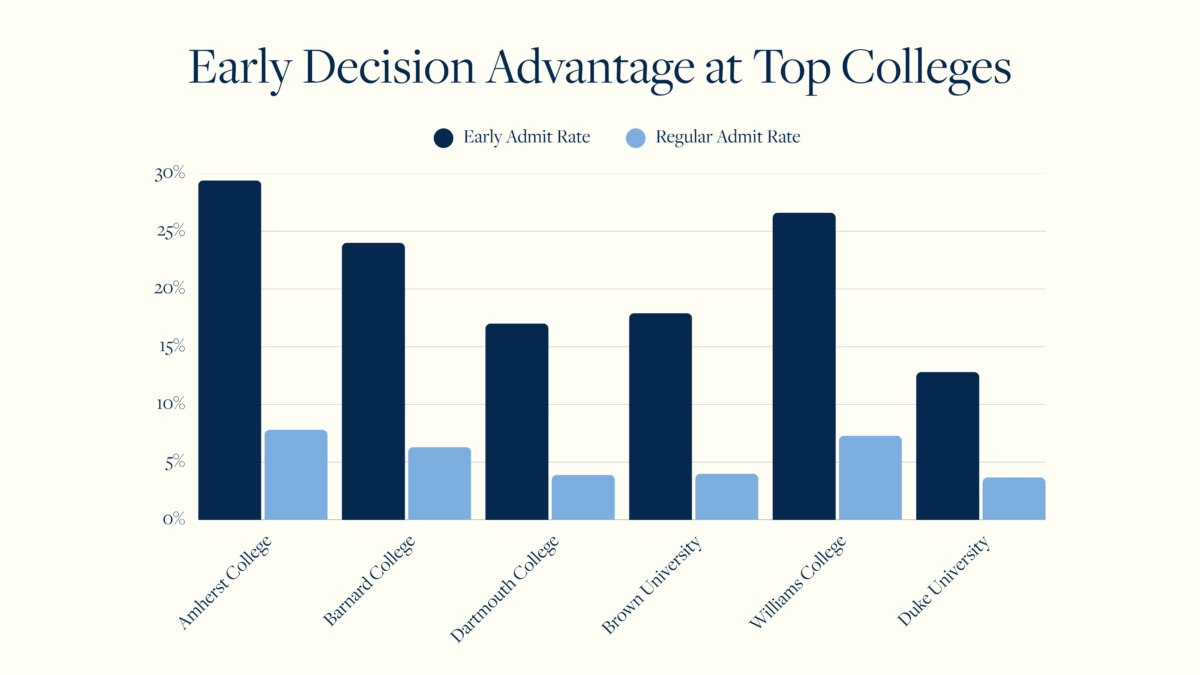
With acceptance rates dropping each year—especially at selective institutions—making the right strategic choice can offer a major advantage. Our team at Top Tier Admissions analyzed the most recent data from 60+ colleges and uncovered a clear yet familiar trend: applying early can drastically increase your odds of admission.
Why does this matter? The gap between Early and Regular admission acceptance rates isn’t just a few percentage points—it’s often massive. Let’s break down what we found, what it means, and how families should approach Early Decision, Early Action, and Regular Decision this fall.
KEY TAKEAWAYS FROM THE DATA
1. Applying Early Makes a Huge Difference at Many Selective Schools
Here’s just a snapshot of the admissions lift students received in the Early rounds:
| School | Advantage |
| Amherst College | ✳️ 3.8x more likely |
| Barnard College | ✳️ 3.8x more likely |
| Dartmouth College | ✳️ 4.3x more likely |
| Brown University | ✳️ 4.5x more likely |
| Williams College | ✳️ 3.6x more likely |
| Duke University | ✳️ 3.5x more likely |
Even less selective schools showed a marked early advantage:
- American University: 79.8% (ED) vs. 61% (RD)
- Tulane University: 59.4% (ED) vs. 11% (EA + RD)
- University of Richmond: 33.8% (ED) vs. 17.7% (RD)
2. But Not All “Early” Rounds Are Equal
- ED1 vs. ED2: Some schools (like Emory and Rice) show a steep drop from ED1 to ED2, suggesting that applying in the first round yields the strongest results.
- Early Action vs. Early Decision: At schools like Harvard and Yale, where early rounds are restrictive but non-binding, there’s still a significant boost—but not the same level of advantage as binding ED rounds.
3. Some Exceptions Prove the Rule
- Georgetown University: RD acceptance (12.4%) was actually slightly higher than REA (11%) this year.
- Brandeis University: Early and Regular acceptance rates were nearly identical (42.2% vs. 40%).
- USC: RD (12.5%) edged out EA (8.3%).
College Private Counseling
Unlock your full potential.
WHAT THIS MEANS FOR YOU
If you’re a strong academic fit and have a clear first-choice school: Apply Early Decision.
The data shows it’s your best bet—by far—for maximizing your admissions chances.
If you need to compare financial aid offers, consider Early Action or build a smart Early Decision II strategy.
ED1 is binding, but ED2 (available at schools like Emory, Vanderbilt, and Middlebury) can serve as a second-chance boost.
Don’t waste your Early application on a reach school if your profile isn’t competitive.
Top-tier schools like MIT, Caltech, and Stanford still hover below a 4% admit rate even in early rounds. Make sure your academic niche, test scores, and extracurriculars align with their admitted pool.
HOW WE GUIDE OUR FAMILIES
At Top Tier Admissions, we use this data to:
- Build strategic college lists by analyzing a student’s profile alongside institutional priorities.
- Identify “early opportunity” schools where the ED bump is especially strong.
- Ensure students are academically and emotionally prepared to commit to a school through binding ED.
- Help families evaluate the financial implications of ED vs. EA vs. RD.
Want to increase your odds of admission? Reach out today—because when it comes to college admissions, timing really is everything.
Want to stay in the loop? Follow us on Instagram @toptieradmissions and subscribe to our blog for expert advice and admissions insights.
Know someone else navigating the college process? Pass it along
- Johns Hopkins Supplemental Essay 2026-2027 - October 9, 2026
- Get to Know College Admissions Expert, Kayte Hager - October 1, 2026
- U.S. News College Rankings 2027: MIT Is No. 1, Princeton Drops - September 22, 2026