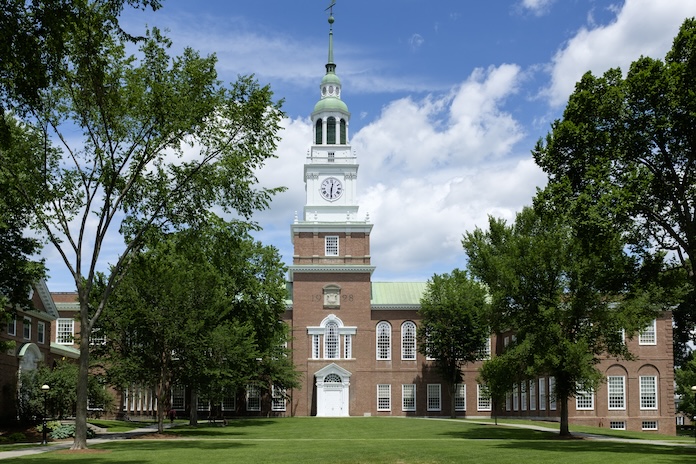
Dartmouth College, an Ivy League institution in Hanover, New Hampshire, announced its first offers of admission to the Class of 2030 on December 15, according to a university press release. In a notable departure from prior years, Dartmouth declined to release Early Decision application or admit numbers—joining a growing number of selective institutions seeking to reduce stress during the admissions cycle.
Dartmouth Early Acceptance Rate
Dean of Undergraduate Admissions Kathryn Bezella explained that the decision aligns with President Sian Leah Beilock’s emphasis on student wellness, noting that releasing mid-cycle statistics may discourage talented students from applying in the Regular Decision round. The college affirmed that application volume remains “incredibly healthy,” particularly relative to its target class size of 1,175 students.
| Class | ED Apps | ED Admits | ED Rate | Overall Rate |
| 2030 | Undisclosed | Undisclosed | TBD | TBD |
| 2029 | Undisclosed | Undisclosed | TBD | TBD |
| 2028 | 3,551 | 681 | 19.2% | 5.4% |
| 2027 | 3,009 | 600 | 19.9% | 6.2% |
| 2026 | 2,633 | 560 | 21.3% | 6.4% |
| 2025 | 2,664 | 669 | 25.1% | 6.2% |
Although Dartmouth withheld Class of 2030 information, the historical data reveals clear patterns. Early Decision applications rose 35% between the Classes of 2025 and 2028, while ED admits held steady between 560 and 681—compressing the ED acceptance rate from 25.1% to 19.2% over four cycles. Overall acceptance rates have remained in a narrow band between 5.4% and 6.4%. If these patterns hold, we expect the Class of 2030 overall rate to fall within a similar range when Regular Decision results are announced in the spring.
While specific admit numbers remain private, the academic profile of admitted students is strong. The vast majority rank within the top 10% of their graduating class, and 93% submitted standardized test scores placing them in the top 25% of test-takers at their high schools. Dartmouth reinstated mandatory SAT or ACT scores in February 2024, effective with applicants to the Class of 2029—making the Class of 2030 the second cycle under the restored requirement.
College Private Counseling
Unlock your full potential.
According to Bezella, applicants frequently cited Dartmouth’s rural setting, the emphasis on dialogue and discussion-based learning, and close faculty relationships as reasons for applying. Nearly one in five mentioned “ideas related to discourse” in their applications, underscoring the college’s commitment to fostering intellectual exchange across disciplines. Dartmouth’s admissions office describes a holistic process that seeks students who bring “a combination of qualities, experiences, and point-of-view that isn’t duplicated by any other student”—evaluating challenging coursework within the context of each applicant’s high school and valuing genuine extracurricular investment over curated profiles.
TTA Top Tip: Dartmouth’s commitment to undergraduate teaching and its 6:1 student-to-faculty ratio distinguish it from peer institutions. The college operates on a quarter system—unique among the Ivies—that enables flexible study abroad, off-campus research, and internship opportunities through its distinctive D-Plan. Students can customize their academic calendar, including taking a term off for experiential learning, without falling behind. Articulating how you’ll take advantage of these opportunities requires a deep understanding of Dartmouth’s structure and culture—the kind of institutional knowledge our counselors bring to every application.
At Top Tier Admissions, we are committed to making the college admissions process more transparent. Easy access to clear data helps families understand trends in college admissions to make more informed decisions. This year we’re once again collecting early acceptance rate data at selective schools and providing insight and analysis of our own.
Want To Read More?
Are you thinking about applying to Dartmouth College? Curious about admissions trends and strategies to improve your odds? Contact us to discuss our Application Boot Camp® or Private Counseling program—we look forward to supporting you!
- Dartmouth College Admissions
- Dartmouth vs Cornell
- Dartmouth Reinstates the SAT
- Dartmouth’s Supplemental Essay Prompts
- Dartmouth Acceptance Rate & Statistics
- Average GPA and Class Rank at Top Colleges
Want to stay in the loop? Follow us on Instagram @toptieradmissions and subscribe to our blog for expert advice and admissions insights.
Know someone else navigating the college process? Pass it along—they’ll thank you later!