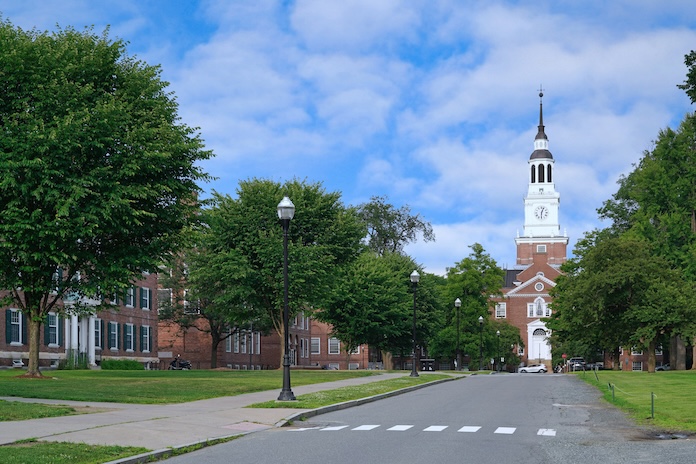
Dartmouth College, located in Hanover, New Hampshire, is a private Ivy League institution founded in 1769. It ranks #13 in a tie with Brown University, according to U.S. News & World Report 2026 Best Colleges. It’s also ranked No. #3 in Best Undergraduate Teaching.
Dartmouth Acceptance Rate
According to The Dartmouth, the College’s daily newspaper, Dartmouth invited 1,687 students to join the Class of 2030 from a pool of 28,863 applications–a reported overall acceptance rate 5.8 percent. Of these admitted applicants, Dartmouth expects to enroll 1,175 students this fall, a number that represents the second-largest in College history after that for the Class of 2028.
Applications to Dartmouth declined by 11% for the Class of 2029, the first cohort to apply after the College reinstated its standardized testing requirement, but this year applications rose by 2%. This slight increase represents Dartmouth’s continued popularity, particularly as a significant number of applicants whose scores fell below the middle-50% are now opting not to apply.
The Return of Standardized Testing
The reversal of the post-COVID-19 decision to adopt a test-optional policy for applicants to the Classes of 2025, 2026 and 2027 and a test-recommended policy for applicants to the Class of 2028 also underscores the role that standardized testing plays in selective college admissions. According to Lee Coffin, Vice President and Dean of Admissions and Financial Aid at Dartmouth, grade point averages are not sufficient data points alone to differentiate top applicants, particularly in an admission pool that contains mostly straight-A students. More data, in other words, allows the College to make more nuanced decisions.
It is important to keep in mind however, the standardized test scores are just one part of the holistic review of an application: they validate high achievement–but they are also read in the context of a student’s school. As Coffin explained, the Dartmouth admissions team looks at the college-going rates, test scores and demographics of an applicant’s high school and evaluates the applicant’s test scores in that context. This means that students excelling in less high-performing schools get a close look, even when submitted scores are low.
Geographic and International Diversity
The additional statistics Dartmouth provides for the Class of 2030 also prove informative. Dartmouth continues to prioritize a student body from a wide geographical range. For example, accepted students for the Class of 2030 hail from all 50 states, Washington, D.C. and Puerto Rico. But, for the second year in a row, the number of international countries represented hovered in the high 50s–down from 68 countries in the admitted Class of 2028 and 75 for the Class of 2027. This shift is likely a consequence of stricter policies regarding international students introduced during the Trump administration.
Also notable is the inclusion of the second class admitted since Dartmouth joined the Small Town and Rural Student (STARS) College Network—a coalition of 32 institutions dedicated to supporting rural applicants. Although Dartmouth’s official admissions release did not specify the exact number of accepted students from rural backgrounds, the institution’s ongoing dedication to broadening its economic and geographic diversity remains evident.
Rural and Low-Income Access: QuestBridge
Dartmouth’s commitment to admitting a class representing a diversity of experiences and viewpoints can also be seen in its commitment to QuestBridge, a national access program for high-achieving, low-income students. Dartmouth accepted 93 students from QuestBridge for the Class of 2030, up from 75 students in the Class of 2028. Although Dartmouth has not published how many of these accepted students will enroll, these statistics underscore what vice dean of admissions Kathryn Bezella says is “essential to the kind of intellectual community we are cultivating at Dartmouth.”
Final Thoughts
The data for the Class of 2030 makes one thing clear: Dartmouth does not rely on a single metric to define its incoming class. Instead, the reinstated testing policy, paired with strategic outreach to rural and lower-income students, represents a nuanced, data-driven approach to holistic admissions. Students enrolling at Dartmouth this fall will carry with them a wide range of lived experiences—a testament to a recruitment strategy that values both academic excellence and diverse perspectives.
Explore Additional Resources
Are you thinking about applying to Dartmouth? Curious about admissions trends and strategies to improve your odds? Contact us to discuss our Application Boot Camp® or Private Counseling program—we look forward to supporting you!
- Get Into Dartmouth
- Dartmouth vs Cornell
- What It Actually Takes to Get Into a Top College in 2026
- How to Choose a College Major
- What to Do When Your AP Scores Come Out in 2026
Stay Connected for More Expert Guidance
Want to stay in the loop? Follow us on Instagram @toptieradmissions and subscribe to our blog for expert advice and admissions insights.
Know someone else navigating the college process? Pass it along—they’ll thank you later!
She began her career at Kent School as an English teacher, coach, dormitory faculty member, and assistant athletic director, developing a deep understanding of students both inside and outside the classroom. After earning her master’s degree from Northwestern University, she joined Westminster School, where she ultimately served as Director of College Counseling, guiding students and families through academic planning and highly selective admissions.
Kate later held senior leadership roles at Pomfret School and for 12 years at The Winsor School, where she oversaw grades 5–12 academics, supervised college counseling, conducted mock interviews, and helped shape institutional strategy.
Having worked as a teacher, advisor, college counselor, academic dean, and associate head of school, Kate understands how admissions decisions are made — and how to position students thoughtfully and authentically. Today, she focuses on what she values most: partnering one-on-one with young people to help them tell their stories with confidence and purpose.
- Caltech Supplemental Essays 2026-2027 - October 19, 2026
- Test-Optional vs. Test-Blind: Decoding College Testing Policies - October 15, 2026
- NYU Supplemental Essays 2026-2027 - October 3, 2026