

Internships have exploded in popularity as job “try-outs,” allowing students to test out potential careers before going all-in on law school, for example, or the strenuous recruitment process for management consulting. But what if you could get paid to try out a career field and engage in higher-level projects to gain more valuable experience? This is the promise of co-op programs at universities like Northeastern, Drexel, and Georgia Tech, schools that have seen their application numbers rise—sometimes exponentially—as students are more aware of their ROI after graduation and drawn to more direct college-to-career opportunities.
WHAT IS A CO-OP PROGRAM?
Unlike internships, co-op programs are paid job experiences with companies like Google (Northeastern), J.P. Morgan Chase (Drexel), or Lockheed Martin (Georgia Tech) that partner with universities. Their longer duration—typically three-to-six months—mean that students are exposed to more facets of the job and are given greater responsibilities, often while earning academic credit. Students alternate traditional classroom attendance and study with co-op experience(s), which might result in a longer time to degree completion, but many students incorporate summers and graduate within four years. As a result of more face time and more opportunity to demonstrate their capabilities, over half of Northeastern grads and between 34 and 46% of Drexel and Georgia Tech students get job offers from a co-op employer, and their overall employment numbers for recent grads are over 90%.
WHO OFFERS CO-OP PROGRAMS?
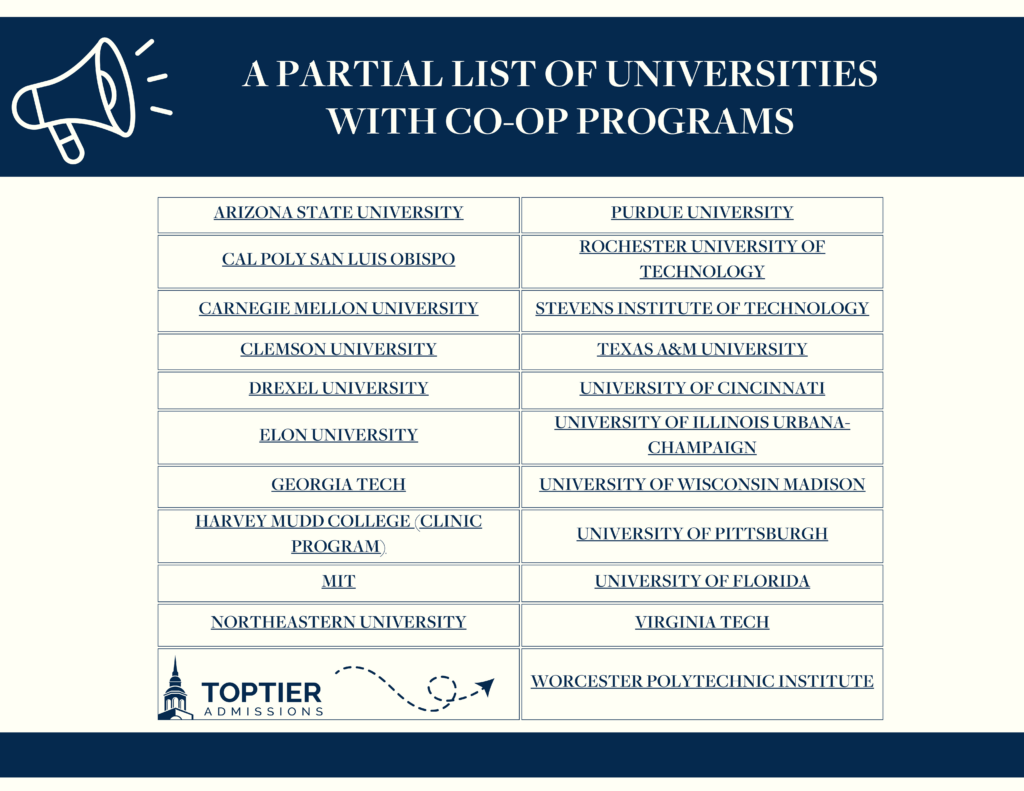
The University of Cincinnati claims to have invented cooperative education and boasts that its students earn $88 million annually working for thousands of employers. Many flagship public universities offer co-ops in STEM fields like engineering or chemical science: University of Florida, University of Illinois, University of Wisconsin, and University of Tennessee, for example. Other universities, like Rochester Institute of Technology, Worcester Polytechnic Institute, and Stevens Institute of Technology offer co-op opportunities to a wider range of STEM majors, like computer science or biology, and Elon University offers co-op experience to all students who have completed an internship. Harvey Mudd College’s twist on cooperative education is their Clinic Program, which “engages juniors and seniors in solving real-world, technical problems for companies and organizations,” such as energy storage, air quality, or AI-assisted workflow generation.
But the schools that have most successfully and fully integrated the co-op model into their curriculum are Drexel, Georgia Tech, and Northeastern. Given many students’ focus on employability and a return on their investment in college, it is no surprise that application numbers at these schools have surged over the past four years: over 28% increase in applications at Drexel and Georgia Tech, and a whopping 50% increase at Northeastern, which received 96,620 applications for Fall 2023 admission. Let’s take a closer look at what these schools have done to create such buzz.

OUR TOP THREE CO-OP PROGRAMS
DREXEL
Most majors at Drexel require a stint of co-op, and students can choose between a 5-year program with 3 co-ops or a 4-year program with 1 co-op. The typical schedule alternates six months of classes with six months of co-op. There’s even an international option with established programs in Ireland, New Zealand and Singapore. Domestic employers have included Children’s Hospital of Philadelphia, Comcast, Estée Lauder, Goldman Sachs & Co., and Johnson & Johnson.
GEORGIA TECH
With one of the oldest co-op programs in the U.S., dating back to 1912, Georgia Tech benefits from a strong state economy to provide its students with work opportunities. In fact, it boasts the largest voluntary co-op program in the country. Over a third of Georgia Tech students receive a co-op designation on their transcripts, which requires performing three work terms with a single employer, alternating these experiences with academic semesters or a summer term of study. Co-op employers include Coca-Cola, Murata Electronics, Georgia Power, and custom software developer Nead Werx.
NORTHEASTERN
The university bills cooperative education as “[t]he cornerstone of Northeastern University’s education model.” Its network of employers extends to all seven continents, across all industries, and students can choose between four and five year schedules, incorporating different numbers of experiences (study abroad, research or creative projects, classes, and professional/business co-ops). With an Experiential Network that makes it easy for students to find six-week, virtual projects with a wide range of employers, Northeastern continues to refine and expand its offerings. 96% of graduates participate in at least one co-op, while 78% participate in two or more. Sample employers include Amazon, CBS, Dana-Farber Cancer Institute, ESPN, Facebook, and Microsoft. As higher-ed continues to evolve to meet social and economic needs, co-op programs are certainly having a moment. We expect other universities may begin to incorporate elements of this model into their curriculum to provide students with additional, built-in professional experience before graduation.
Internships have exploded in popularity as job “try-outs,” allowing students to test out potential careers before going all-in on law school, for example, or the strenuous recruitment process for management consulting. But what if you could get paid to try out a career field and engage in higher-level projects to gain more valuable experience? This is the promise of co-op programs at universities like Northeastern, Drexel, and Georgia Tech, schools that have seen their application numbers rise—sometimes exponentially—as students are more aware of their ROI after graduation and drawn to more direct college-to-career opportunities.
As higher-ed continues to evolve to meet social and economic needs, co-op programs are certainly having a moment. We expect other universities may begin to incorporate elements of this model into their curriculum to provide students with additional, built-in professional experience before graduation.
If you enjoyed this post, follow us on Instagram @toptieradmissions for more tips and subscribe to our blog for expert insights & college admissions news!