At Top Tier Admissions, we take pride in our team of expert counselors who bring a wealth of experience, knowledge, and passion to guiding families through the college admissions process. In our Counselor Spotlight series, we’re excited to give you a behind-the-scenes look at the individuals who make Top Tier Admissions the most trusted name in college admissions.
Join us as we celebrate the dedication, insight, and creativity of our team, and discover how they inspire students to achieve their goals and navigate the admissions journey with confidence.
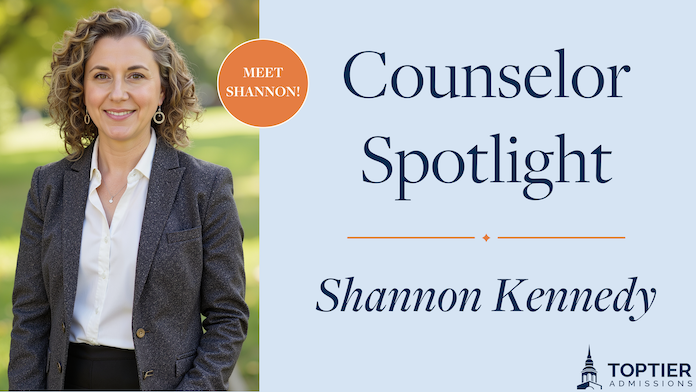
Shannon Kennedy has over 25 years of experience in the college admissions field. She has successfully advised students applying to top universities, including the Ivy League, Stanford, and MIT. Shannon previously served as Senior Assistant Director of Admission at Northwestern University and has also held leadership roles at the University of Illinois at Chicago and Chicago Waldorf School.

With over 25 years in college admissions, what inspired you to transition from university roles to private counseling, and how does this background influence your approach at Top Tier Admissions?
In my former role as a university admissions officer, I rarely had the opportunity to develop long-term connections with students. Once a class is admitted, you hand the students off to the university and you are focused on the next class. Now, I treasure the chance to work with students over time to deeply explore their interests and guide them on a journey of self-reflection as they identify colleges where they can flourish. At Top Tier, I meet regularly with students and get to know them personally as we collaborate over many years. It is a privilege to mentor students as they develop skills in research, writing and critical thinking that serve them not only in the admissions process but in college and beyond.
As a former Senior Assistant Director of Admission at Northwestern, what insights can you share about what selective colleges are looking for in applicants today?
Stellar academic qualifications are required to even be considered for admission to selective colleges. Therefore, applicants need to strive to exceed expectations in academics and other areas to shine in a competitive applicant pool. It is also very important to do extensive research beyond the surface of the admissions webpage, when drafting supplemental essays. Colleges want to feel the effort, thoughtfulness and connection in writing about why you want to be a student there so they can offer spots to those who are ready to dive into their offerings and engage in the campus community. By starting research early and reflecting on their own strengths and interests, students can be well-prepared to present an authentic and detailed application that resonates with selective colleges.
What are some of the most significant changes you’ve seen in the college admissions landscape over the years, and how do you help your students navigate these challenges?
I’m going to date myself with this one! It is really hard to believe that I used to read admissions files on paper when I first started in this field! I lugged heavy mail bins full of folders and wrote my assessment of a candidate with an actual pen. When all that paper was shuffled from applicants and high schools to college admissions offices, there was more possibility for error, and it took longer to collate. Now, things are more efficient and instant in the process and we are even seeing the introduction of AI tools that allow admissions officers to mine applications for important indicators and streamline tedious work. By staying up to date on how admissions offices are using AI tools through our personal networks, following news and attending conferences the Top Tier team is helping students maximize their applications in light of new ways they may be reviewed.
You have degrees in both Higher Education Administration and Elementary Education. How do these two fields intersect in your work with students, and how do they shape the support you offer throughout the college admissions journey?
As an elementary education major, I was exposed to a wide range of liberal arts classes to be prepared to teach literally every subject and satisfy requirements for teacher certification. This was great for me because I have always enjoyed many subjects; I had classes in material science, music history, sociology of race and culture, theater and more. My interest in a wide range of disciplines allows me to jump into a niche and go down a rabbit hole of research with all types of students which energizes me exponentially! When I pursued my masters in higher education administration, I explored my own personal niche by looking at the development of students in their critical sophomore year when big decisions are often made regarding majors and the future in general. I continue to follow higher education research and news as my personal favorite subject and get to learn about all the interesting subjects my students explore throughout our work together. It’s thrilling to work with students to advance their understanding of a subject as we learn from each other.
- Johns Hopkins Supplemental Essay 2026-2027 - October 9, 2026
- Get to Know College Admissions Expert, Kayte Hager - October 1, 2026
- U.S. News College Rankings 2027: MIT Is No. 1, Princeton Drops - September 22, 2026