

After a dizzying year, the world of college admissions continues to change as do early admissions trends. Test-optional admissions policies continue to expand and Harvard’s decision to continue with test optional admissions for the next four years will likely spur peer institutions to follow suit. Changing student demographics and greater emphasis on equity and access continue to reshape who is offered admission.
To help students and families make smart, thoughtful decisions about how to best navigate these new admission realities, we’ve mined and analyzed publicly available data and news stories about the early admission cycle for the Class of 2026 and tossed in a few interesting observations of our own.
EARLY ADMISSIONS TRENDS
Let’s start with the numbers.
EARLY APPLICATION VOLUME
At some of the nation’s uber-selective private schools (based on those who report their data), the volume of early decision or early action applications has dropped from last year’s record highs. Columbia, Dartmouth, Harvard, MIT, Penn, and Yale all noted fewer early applicants for the Class of 2026. Among the Ivies who reported early numbers, Brown and Cornell seem to be the outliers, with increases of 11 percent and five percent, respectively.
In an interview with the Brown Daily Herald, Dean Logan Powell notes the university’s virtual and in-person recruiting efforts likely contributed to this growth, alongside the national prominence of several university faculty through the pandemic, including Ashish Jha, dean of the School of Public Health, and Megan Ranney, director of the Brown-Lifespan Center for Digital Health. We’d have to agree. Who wouldn’t want to study at Brown in the company of faculty truly making an impact like Drs. Jha and Ranney? Interestingly, among the selective schools that notched the highest increases in early volume include schools like Notre Dame, UVA (early decision), and Emory, where early applications rose by 25 percent, 18 percent, and 11 percent, respectively. Watching last year’s seniors, the Class of 2026 saw that test-optional “Hail Mary” applications to the most selective schools yielded only disappointment and so likely recalibrated their focus on colleges and universities more securely in range.

DOES APPLYING EARLY STILL CONFER AN ADVANTAGE?
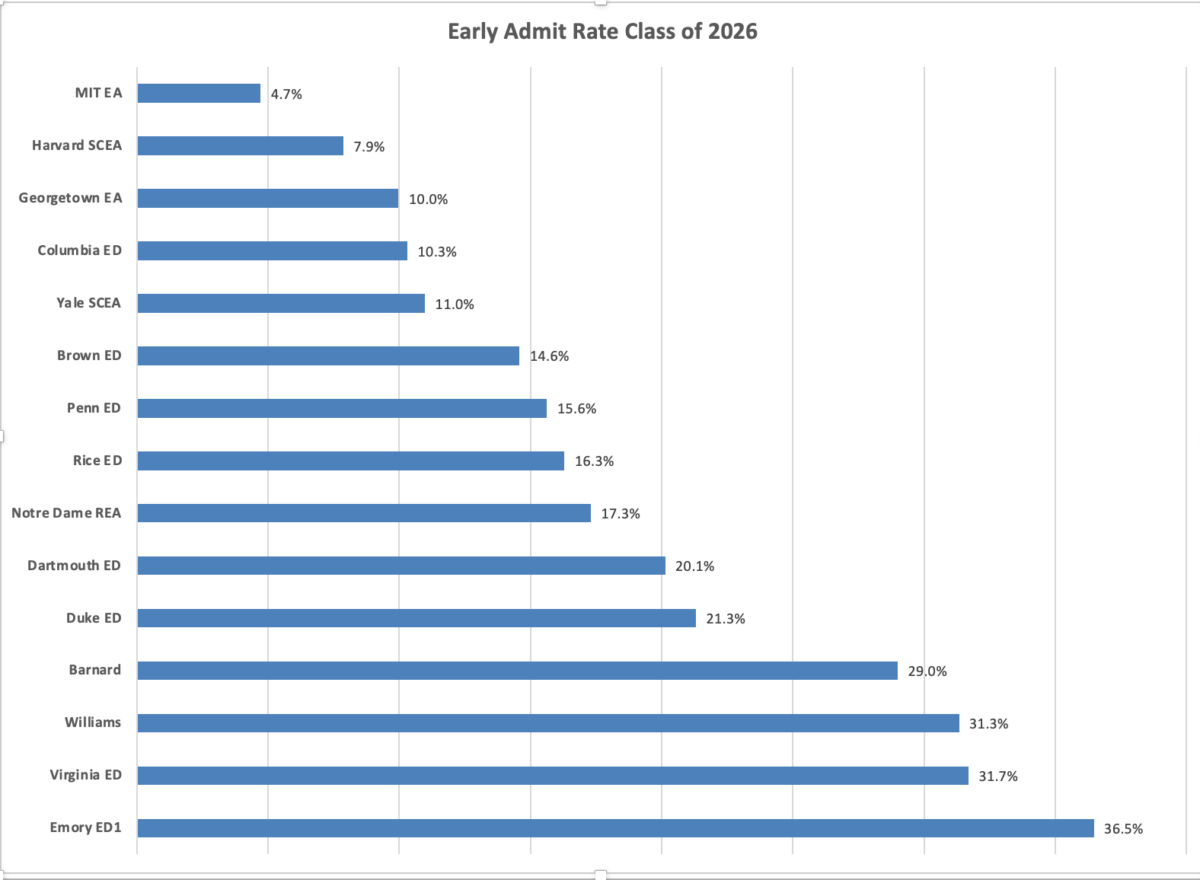
At most colleges and universities that offer an early program, the answer is a definitive yes. We won’t have comparative data on the Class of 2026 early vs. regular rates of admission, but if history is any guide, we’ll continue to see rates of admission that are two to three times greater in early than regular. There are two notable exceptions to this rule: MIT and Georgetown. Last year, MIT’s rate of admission in the early process was 4.78 percent and its overall rate of admission was 4.03 percent. (Really tough, no matter which way you look at it). Similarly, Georgetown had nearly identical rates of admission when you compare the early acceptance rate to its overall acceptance rate: 11.0 percent in early vs 11.7 percent.
WHO WAS ADMITTED
Admit rates don’t reveal the whole admissions story at top tier colleges and universities. Ultimately, the admissions process – and who gets in and why — is an expression of an institution’s values. Top colleges and universities seek to admit students who, beyond just great grades in rigorous programs, demonstrate their intellectual engagement well beyond the classroom and have made truly meaningful impacts in their schools and communities. Among those admitted early decision to Johns Hopkins this cycle are change-makers already improving society and humanity through their work – from addressing disparities in stem cell registries to developing a machine-learning algorithm that assists caregivers in preventing patients with dementia from wandering and entering unsafe spaces. They are also advocates for equity in their schools and communities.
Applicants’ creativity and compassion, especially in light of the ongoing disruption of the pandemic, were highlighted by Emory’s dean of admissions and several admissions deans as key factors in the decision process. Dean Powell at Brown University noted that successful applicants worked to build bridges and connections throughout the pandemic. “A lot of applicants spoke very candidly about how they wanted to be that individual in their community who re-established connections.” Many Brown applicants also wrote about ways to engage in civil dialogue in response to the University’s second supplemental essay topic about dealing with philosophical disagreement and civil discourse. This year’s students admitted early action to MIT include “sailors and sculptors, aviators and architects, poets and poi spinners, [all] united by a shared standard of rigorous academics, high character, and a strong match with MIT’s mission to use science, technology, and the useful arts to make the world a better place.”
Through their early programs, top colleges continue to seek ways to build a diverse foundation for their incoming classes. Case in point: the Los Angeles Times’ recent college admissions story, “The unentitled kids: California’s new generation of star college applicants.” “A new generation of students are reshaping the face of public education in California,” says author Theresa Watanabe: “young people with lower family incomes, less parental education and far more racial and ethnic diversity than college applicants of the past.” In chronicling the lives of students at Downtown Magnets, a highly diverse school in LA, whose seniors were admitted to UC Berkeley at a higher rate than elite Los Angeles private schools like Harvard-Westlake and Marlborough, the author paints a compelling picture of humble, resilient young people whose desire for education burned brightly despite struggling to overcome significant obstacles.
In the now completely test-blind world of UC admissions, these are the qualities that resonate. Rice, UVA, and Hopkins are among the schools that highlight the increasing percentages of students of color, low income, and first-generation college students amongst their early admits. The total number of first-generation college students admitted early decision to UVA increased by 68 percent over last year, from 76 to 128. Notre Dame notes double-digit growth in the number of early applicants who are students of color, international students, or first in their families to go to college. Fifty-two percent of students admitted early decision to UPenn are students of color and 14 percent are first-gen college students, both up two percentage points from last year. Similarly at Brown, 51 percent of those admitted ED are students of color, up from 48 percent last year and 44 percent the year before. In addition to highlighting the racial/ethnic diversity of its early decision admits (40 percent students of color, 17 percent first generation students), Dartmouth’s early decision admits include the largest percentage ever from public high schools (54 percent) and record-high geographic diversity, with 57 percent of admitted students hailing from the South, West, and overseas.
A few top private universities are notably silent even on high-level details about their early pools. Princeton, who reinstated its single choice early action program this year, joined Cornell and Stanford this year in not releasing admissions statistics during the early admissions cycle. Ostensibly, this is to lower the anxiety around the admissions process, but we believe a little more transparency would give students and families more tools to make better decisions. More transparency, not less, is the key to reducing anxiety.
DOES TESTING STILL MATTER
Clues abound as to the role that standardized testing still plays in the selection process (the UCs and any other colleges that are truly test-blind notwithstanding). Notre Dame reports that although only 54 percent of its REA applicants submitted test scores this year, 70 percent of REA admits had submitted test scores. Last year, 24% of those admitted ED at UPenn did not include test scores. Penn Admissions did not release the number of students who did not include test scores for the Class of 2026 but the Daily Pennsylvanian reports that of those that did submit scores, the middle 50% testing ranges were 1500-1560 on the SAT and 34-35 on the ACT.
IT AIN’T OVER TILL IT’S OVER
In the immortal words of American baseball legend Yogi Berra, we’ll watch and wait, holding off on final judgement until all the admissions results for the Class of 2026 are in hand. In the meantime, we salute our wonderful Top Tier senior class and their amazing successes in the early round!

In addition, Maria is proud of her long-term volunteer work with Opera North (Lebanon, NH) in fundraising, marketing and audience engagement. She is an avid masters rower with the Upper Valley Rowing Foundation (Hanover, NH) and also serves as a member of its board of directors.