

Stanford recently shared some admissions statistics for the Class of 2025. Big picture, Stanford received 55,471 applications for admission last year and admitted 2,190 students, a meager 3.9 percent of its applicants. Interesting to note that Stanford was not the only top school with a sub-4 percent overall admit rate last year. In fact, Columbia, with 60,551 applicants had an overall admit rate of 3.66 percent, and Harvard admitted 3.42 percent of its 57,435 applicants, making both schools harder to get into than Stanford.
STANFORD’S EYE-POPPING STATS
Stanford’s yield rate for the Class of 2025, not including the 2020 gap year students, was 80%, according to University spokesperson E.J. Miranda. Perhaps no other measure highlights a school’s desirability more than its yield rate and, on this dimension, Stanford has no peer. It’s especially notable since Stanford does not use a binding early decision program. Columbia, for comparison, had an overall yield of 67 percent but shored up its yield by admitting 41 percent of its incoming class through its binding early decision program.
Unpacking the few stats that Stanford provides, here’s what we glean:
- 12 percent of Stanford’s new class are international citizens. Those 255 students represent 72 countries, meaning that Stanford admitted only 3-4 students per country of citizenship.
- 18 percent of the new class are the first in their families to go to college.
- In the new class, women slightly outnumber men, 51 percent to 49 percent.
- 60 percent of Stanford’s new class graduated from public high schools; 27 percent from private schools; 13 percent from high schools outside the US; and 0.5 percent were homeschooled.
- The middle 50% SAT scores for the incoming class are 1470-1570; for the ACT, the middle 50% scores are 32-35. But Stanford shares no information on the percent of students admitted and enrolling who chose not to submit scores as part of the admissions process.
With top colleges working actively to enroll greater numbers of students from underrepresented backgrounds, its curious that Stanford share no data about the racial/ethnic diversity of its incoming class.
HOW TO GET INTO STANFORD
So, beyond top grades and scores – or a chest draped with Olympic medals — what does it take to be admitted to Stanford? The Olympic medals are a good clue – you need a truly distinctive set of achievements in one or more areas that help your application rise above the rest. The Stanford admissions team prioritizes academic excellence, intellectual vitality, exceptional depth of experience in your chosen extracurricular activities, and each applicant’s background, circumstances, and set of educational pathways.
Students admitted to Stanford this year show exceptional promise in their coursework in all areas of the curriculum. Look at this chart from Stanford’s Common Data Set for the Class of 2024:
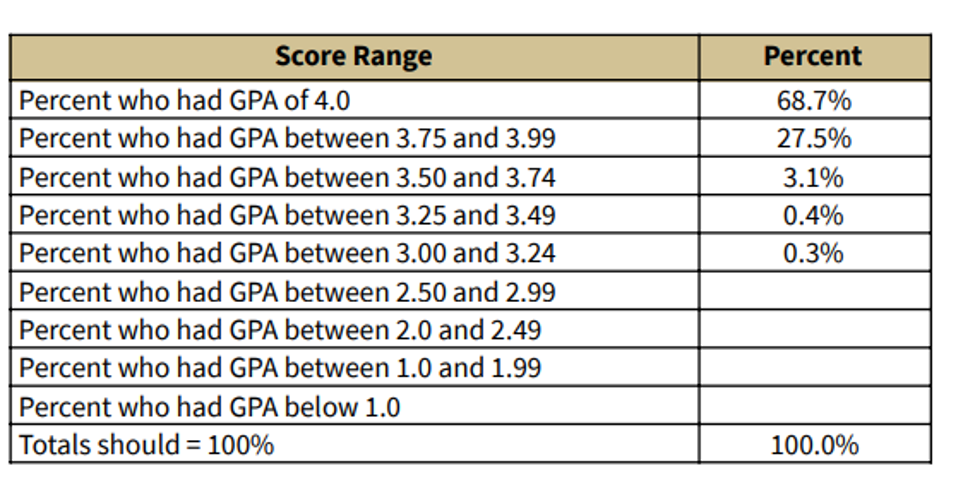
Is your unweighted GPA less than a 3.75? If so, don’t bother applying. In fact, this same report notes the average high school GPA of all applicants is a 3.96.
Stanford adopted a test-optional approach to admissions for the Class of 2025. Look at how the mid-50% range increased over the last two classes:
- Class of 2025: 1470 – 1570
- Class of 2024: 1420 – 1550
Is it now easier to get admitted to Stanford with lower scores by not reporting them? Our guess is that most students admitted without scores likely came from underrepresented and low-income backgrounds. If that’s not you, then your scores need to be top-notch.
Since the majority of Stanford students come from public high schools and we know that national AP participation rates continue to climb (38 percent of all U.S. public high school students who graduated in 2020 took at least one AP exam), it stands to reason that the majority of students admitted to Stanford will have a slew of AP exams to report. Drilling further into national AP data, we can see that nearly 39,000 students who graduated from high school in 2020 achieved the now-discontinued National AP Scholar designation, meaning scores of 4 or 5 on at least eight exams. Putting two and two together, we’d say that the Stanford pool is full of these high-scorers, and that a significant proportion of unhooked students admitted to Stanford would have eight or more strong AP scores.
INTELLECTUAL VITALITY
A top GPA in combination with top scores helps your application survive the culling that happens after the first read, but that likely won’t be enough to get you all the way to admit. Remember “intellectual vitality”? Grades and scores show achievement, but you need to demonstrate that you willingly go above and beyond what’s required of you in your classes because you have a love of learning and curiosity. Admissions officers will be looking for your academic niche: an interesting field or two; supported by courses, independent research, projects, or endeavors that you’ve dug into because you are curious. Experiment, tinker, create, explore, build—see where your curiosity takes you. Given the hyper-competitiveness of Stanford, backing up this work with distinctive awards and honors – winning the Regeneron Science Talent Search, USABO, Coolidge Scholarship, etc., or attending prestigious summer science programs like RSI or SSP or Telluride—help you rise above the pack.
Finally, the admissions review will look for alignment with Stanford’s institutional vision:
Fueled by optimism, ingenuity, and a sense of responsibility, we see to accelerate our purposeful impact in the world.
Nothing is more inspiring to an admissions officer than students who have purposely and positively impacted their communities, especially when that impact flows from their academic niche. Rather than stretching yourself thinly over a myriad of activities, identify those few areas that you truly care about and go deep. Inspired to help address water scarcity, one student researched the effectiveness of solar aquaponics in different climates and developed a mini solar aquaponics kit and accompanying curricular resources for her local schools. Stanford is also looking to create a community where people inspire each other to work and dream beyond their potential.
Let your optimism, ingenuity, and sense of responsibility to make the world a better place shine through!