
Rice University, a private research university in Houston, Texas, anchors undergraduate life in a residential college system that houses students for all four years and maintains a roughly 6-to-1 student-faculty ratio. The university admitted 2,984 of 38,603 applicants to the Class of 2030 for an overall acceptance rate of 7.7%, according to the Rice Thresher.
Rice University Acceptance Rate: Class of 2030
Rice’s acceptance rate has held within a narrow band for four straight cycles even as applications surged. Our chart shows both trends at once.
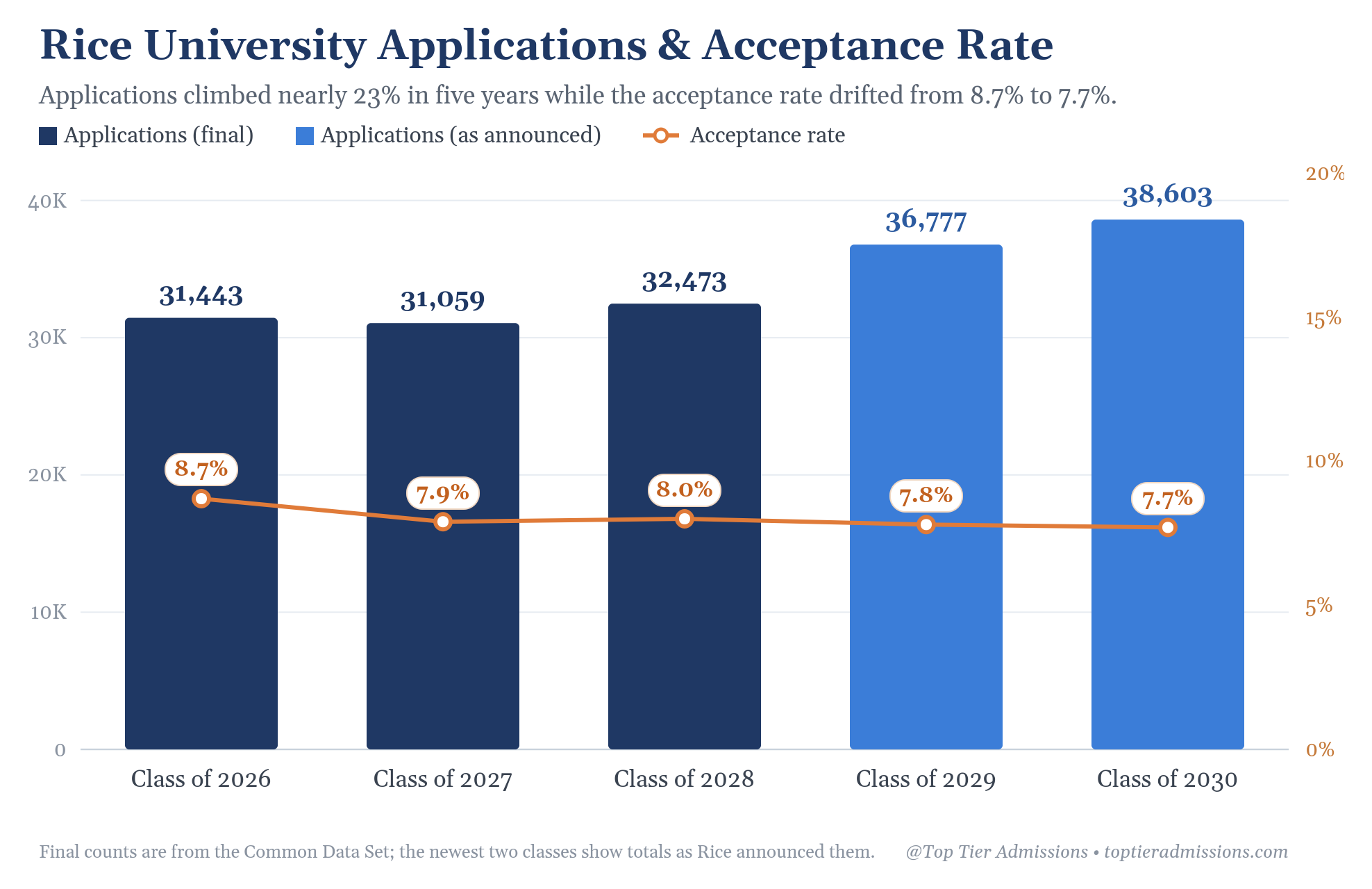
The climb has two likely sources. Part is rising demand, and part is structural: beginning with the Class of 2029, Rice added a second binding early round—Early Decision II—alongside Early Decision I, broadening the early pool.
Admits moved for a separate reason. Rice extended 2,984 offers for the Class of 2030, up from 2,730 for the Class of 2026, and that increase is by design: President Reginald DesRoches’ Momentous plan aims to grow undergraduate enrollment toward 5,200 students by 2028, with new residential college space opening in fall 2026. The rate slipped only about a point because applications still outpaced the expanding class.
Rice also shifted its testing posture this cycle. After years as a test-optional school, it now recommends that applicants submit SAT or ACT scores, while those who don’t still receive full consideration. Recommended is not required, but the signal is clear: competitive applicants with strong scores should plan to send them.
Why keep applying against those odds? Because Rice pairs the resources of a major research institution with the intimacy of a small college: undergraduates join a residential college that houses and feeds them for four years, work closely with faculty in classes that rarely balloon, and sit minutes from the Texas Medical Center, NASA, and Houston’s energy corridor for research and internships. For students who want a tight-knit community without giving up scale, the trade-off is worth applying for.
TTA Top Tip: Timing helps, but it isn’t the whole story. Early Decision I has consistently admitted in the teens—well above the roughly 8% overall rate—so if Rice is a true first choice, applying ED I is the clearest advantage you have. Don’t treat Early Decision II as the easy door, though: its inaugural round admitted below Rice’s overall rate, with no early advantage at all. What actually moves a Rice application is fit with the residential college system the university is built around. The supplement asks what perspectives you’d bring to your college, and “The Box”—Rice’s tradition of submitting a single image that represents you—rewards genuine personality over a polished résumé. Show that you’d add something to a close, collaborative community, and choose a Box image that speaks for itself.
At Top Tier Admissions, we are committed to making the college admissions process more transparent. Easy access to clear data helps families understand trends in college admissions to make more informed decisions. This year we’re once again collecting acceptance rate data at selective schools and providing insight and analysis of our own.
Explore Additional Resources
Are you thinking about applying to Rice University? Curious about admissions trends and strategies to improve your odds? Contact us to discuss our Application Boot Camp® or Private Counseling program—we look forward to supporting you!
- Get Into Rice University
- Which Colleges are Called the “Harvard of the South”?
- Rice University: Early Acceptance Rate
- How to Choose a College Major
- Average GPA and Class Rank at Top Colleges
- 2026 College Acceptance Rates: What’s Behind the Record Lows and What Families Should Know
Want to stay in the loop? Follow us on Instagram @toptieradmissions and subscribe to our blog for expert advice and admissions insights.
Know someone else navigating the college process? Pass it along—they’ll thank you later!
- Get to Know College Admissions Expert, Kayte Hager - October 1, 2026
- U.S. News College Rankings 2027: MIT Is No. 1, Princeton Drops - September 22, 2026
- Writing the College Essay: How Strong Essays Come Together - September 15, 2026