

The Medical College Admissions Test (MCAT) is not just a hill to climb for medical school applicants, it’s a gate keeper. This multiple-choice exam (a perfect score is a 528) haunts thousands of applicants from all over the world every year.
Many medical school programs choose not to disclose their average MCAT scores, but a score below 500 usually means you’re unlikely to get an interview offer (the national MCAT average is a 511 and the mean science undergrad GPA is a 3.6).
In an ideal world, more medical schools would adopt Howard University’s innovative and much-needed holistic approach to admissions. Though thousands of colleges, graduate schools and medical schools claim to have a holistic approach, Howard actually follows through. They require their admissions committees to complete unconscious bias training and do not let them see applicants’ MCATs or GPAs (and grades) until AFTER the interview. As the AAMC reported in late March, “Howard’s entrance criteria for consideration of acceptance are based on multiple factors, including MCAT score (494), undergraduate GPA, personal statements, recommendations, and life experiences.”
That said, until all medical schools adopt this unique, more inclusive approach, we are stuck with the MCAT.
MCAT SCORE: BREAK DOWN
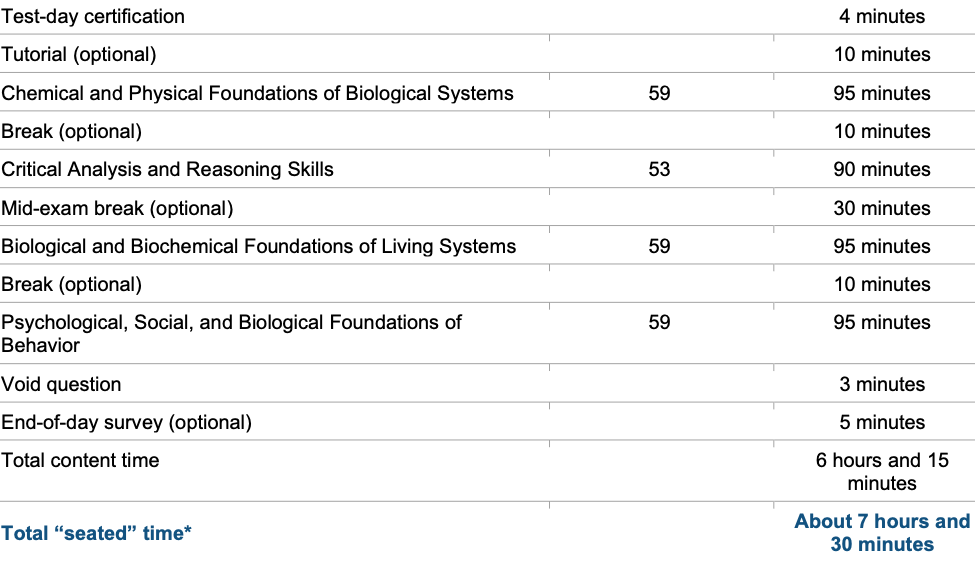
The MCAT exam has four sections:
- Chemical and Physical Foundations of Biological Systems (59 questions)
- Biological and Biochemical Foundations of Living Systems (59 questions)
- Psychological, Social, and Biological Foundations of Behavior (59 questions)
- Critical Analysis and Reasoning Skills (53 questions)
The natural and social sciences sections center around 10 foundational science concepts. MCAT content pulls from college-level course topics including general chemistry, organic chemistry, introductory physics, introductory biology and from introductory courses in biochemistry, psychology, and sociology. When medical schools tell applicants about required core pre-med coursework, it’s not just so that they can succeed in medical school. It’s also because you need those core classes to understand the basic questions on an MCAT exam.
Want proof? To give you a glimpse of what to expect on these sections, here’s a sample MCAT test question from test section # 2 above.
The radius of the aorta is about 1.0 cm, and blood passes through it at a velocity of 30 cm/s. A typical capillary has a radius of about 4 × 10⁻⁴ cm, with blood passing through at a velocity of 5 × 10⁻² cm/s. Using these data, what is the approximate number of capillaries in a human body?
A. 1×10⁴
B. 2×10⁷
C. 4×10⁹
D. 7×10¹²
The correct answer is C.
See? We told you. The AAMC doesn’t mess around with this test. It’s a double layered question. You need to know both the principles of blood flow characteristics in the human body, and how to successfully apply a mathematical model to arrive at the answer. And this is why we encourage MCAT prep, tutoring and strategic admissions guidance.

Grad School Analysis & Guidance Program
Craft your grad school strategy and sharpen your applications and essays.
THE MCAT TEST
Interested in potentially taking the MCAT? You can dive in now and begin exploring the free AAMC information online, review the content on the exam, the sections you will need to complete, and even the amount of time you’ll be sitting in the room.
Here’s how your MCAT test day really goes:
ACTIVITY/SECTION # QUESTIONS # MINUTES
MCAT SCORES: WHAT TO AIM FOR
So now that you know what you’re in for, let’s assess the scores to aim for. Note the following from AAMC for 2021-2022.
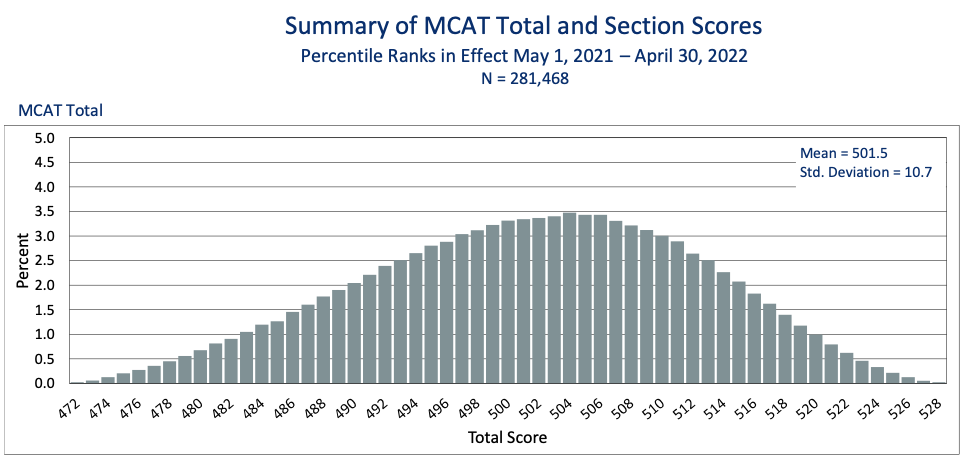
MCAT test takers who get a 515 hit the 90th percentile, and yet a 510 is 78th percentile.
To put this into context, here are some recent median MCAT scores for ten top medical schools as reported in March 2022 by U.S. News & World Report:
- Dartmouth College (Geisel): 514
- Tufts University: 514
- University of Miami (Miller): 514
- Boston University: 517
- University of California (Keck): 517
- Duke University: 518
- Northwestern University: 520
- Vanderbilt University: 520
- New York University (Grossman): 522
- University of Pennsylvania (Perelman): 522
Not all medical schools, however, require that you break 515. Temple University’s Lewis Katz School of Medicine has an average MCAT of 512. Virginia Tech’s Carilion School of Medicine’s Class of 2025’s mean MCAT was a 512 and the average undergrad GPA was a 3.6. Still, climbing into Virginia Tech’s admit pool is not a walk in the park, as they only accepted 49 applicants.
THE KEY TO A GREAT MCAT SCORE: PLAN AHEAD
The key to getting a great MCAT score and breaking into the 90th percentile is planning ahead. Here’s how:
- Know the ins and outs of the exam.
- Take plenty of full-length practice exams under test simulated conditions.
- Secure a one-on-one tutor whose approach resonates with you.
- Employ study strategies and a study schedule that aligns with the way you prefer to learn.
- Don’t be afraid to retake the test.
- Apply to medical schools where you meet or exceed their average GPA and MCAT scores.
I’d love to help you get a plan in place and map out your reach, in range, and backup medical schools. Finally, remember that the MCAT is not the only piece in medical school admissions. Don’t let your laser-focus on this exam outshine needed prep for the other pieces in your application. If you’d like to learn more, I’d love to help!