This year’s high school seniors navigated an admissions season bookended by the Supreme Court’s decision to overturn affirmative action and a fiasco with the federal financial aid form (FAFSA) that has left half a million students and their families without vital information on college costs and financial aid awards. In between, we saw campuses beset by protests in the aftermath of Hamas’ attack on Israel and the launch of the war in Gaza, the ouster of two Ivy League presidents, in part, after withering criticism from lawmakers for allowing anti-Semitism to fester on campus, and protests against the war in Gaza intensifying during April revisit days and college graduation season.
With the May 1st candidates’ reply date in the rearview mirror, let’s reflect on the admissions cycle that we just experienced.
CLASS OF 2028 ADMISSIONS: MOST UP, SOME DOWN
Last month, many university and college press releases breathlessly proclaimed record-breaking volume and lowest admit rates in their history. Here are some highlights:
- Duke received a record 54,191 applications, bringing the University’s overall acceptance rate this year to 5.1%, a record low.
- A record number of high school students applied to Lehigh to be part of its Class of 2028, up 11% from the previous year. It also marks a nearly 35% increase in applications from two years ago, when applications numbered 15,160.
- Northeastern received a record 98,373 applications for fall 2024, leading to an admit rate of 5%. Northeastern’s applications have jumped 53% in just five years.
- Penn received a record number of applications for the Class of 2028 despite campus leadership transitions and concerns over antisemitism and Islamophobia. The Class of 2028 received 65,230 applications, up more than 10% from the previous year.
- Rice saw its applicant pool grow to 32,459 applicants. With a 7.5% admit rate, this is the third consecutive year of record-low acceptance rates.
- Nearly 73,000 students applied to UT Austin – a new record. As required by state law, the top 6% of all Texas high school students are offered automatic entry to the university — making up 75% of UT’s incoming class. The remaining 25% of the class are chosen from a holistic review process, and this year that group had an acceptance rate of 11%.
- UVA had another record-breaking year for applications, with 58,995 students applying to attend. Last year, 56,538 applied. In 2022, 50,942 students submitted applications.
- Williams College received 15,411 applications for the Class of 2028, leading to an admit rate of 7.5% — down 2.3 percentage points since last year — marking the lowest rate on record.
- Applications to Yale surged to 57,465, a 10 percentage point increase over last year’s application totals, and leading to its most competitive year ever. Just 3.7% of applicants were offered admission, its lowest admit rate ever, down from 4.5% last year.
A few colleges and universities saw small downturns in application volume this year. Most notably:
- Brown’s applications dropped 5% this year.
- Harvard saw its applications drop by over 5% from last year (after seeing a dramatic 17% drop in early applications). These admissions numbers seem to reflect the impact of a year of campus controversy and turmoil. But, even with a slight increase in Harvard’s admit rate from 3.34% last year to 3.59% this year, admissions is still incredibly competitive.
- Applications to Northwestern dropped by 4% this year.
- As compared to last year, first-year applications to UC Berkeley dropped a modest 1.3% and were essentially flat at UCLA.
THREE YEARS OF APPLICATION GROWTH + THE HIGHLY REJECTIVE ERA
For those interested in comparative data, here’s a look at how applications at top universities have changed over the last three years:
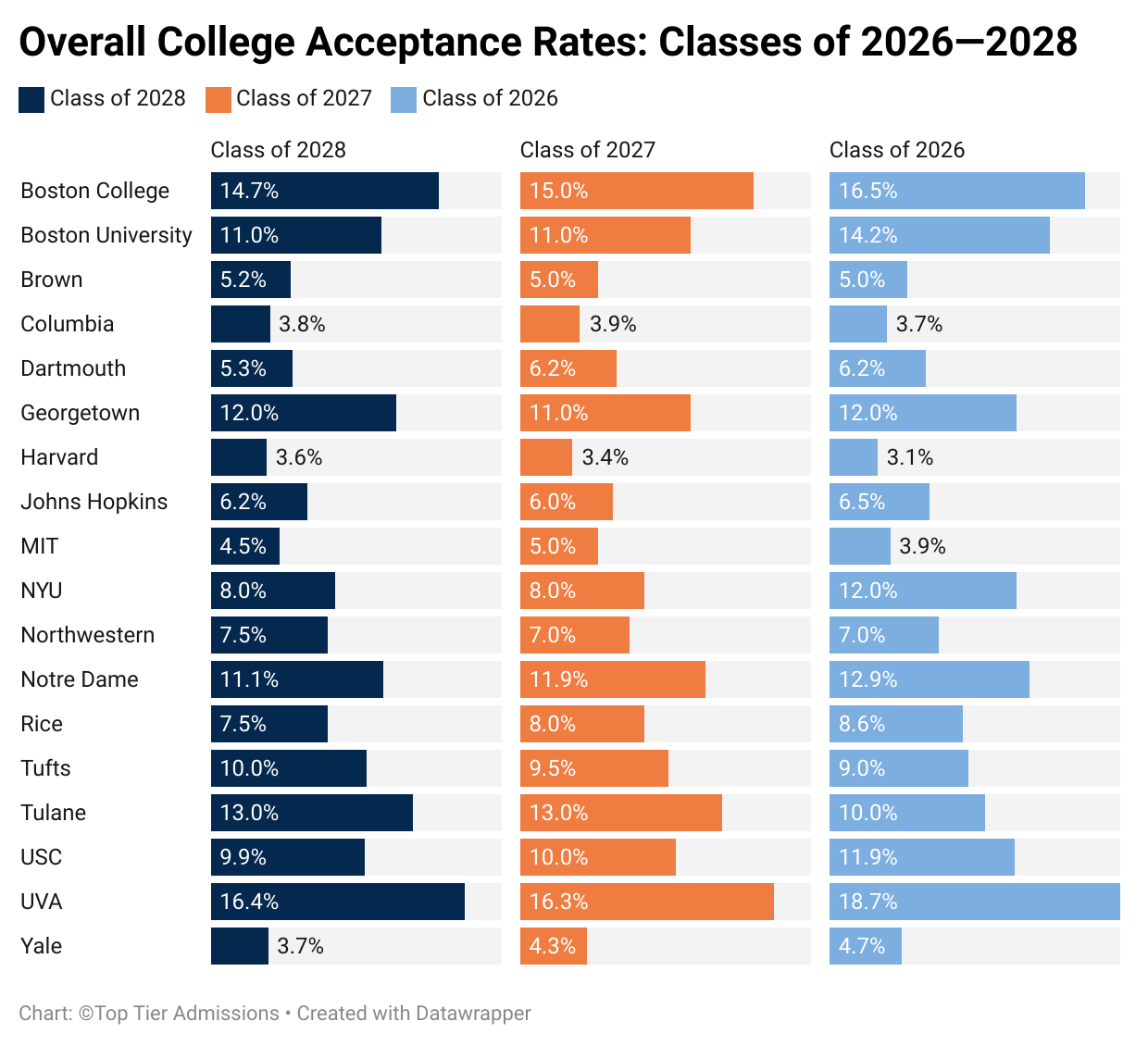
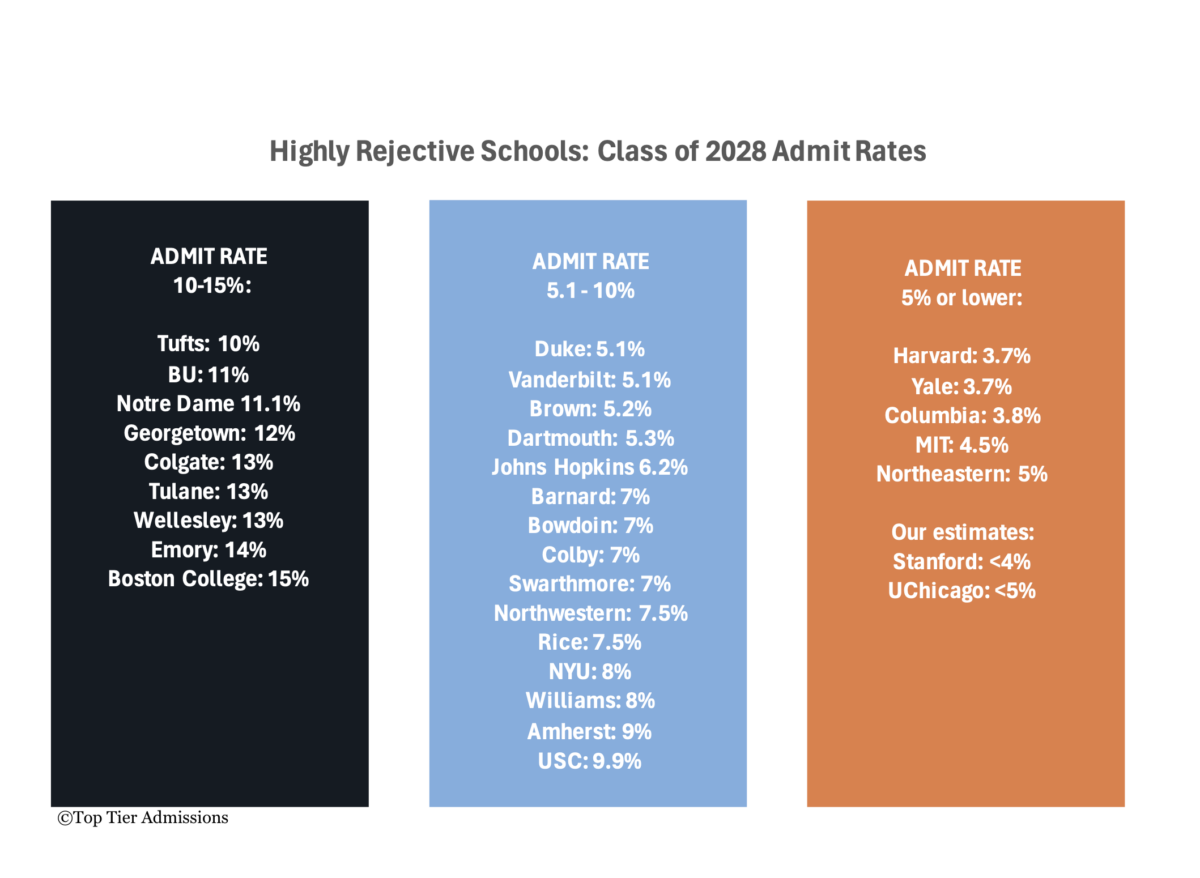
Many now refer to top colleges with admit rates of less than 15% as “highly rejective” rather than “highly selective.” Along with pandemic-era test-optional admissions policies, other factors driving up application volume and pushing down admit rates include the aggressive use of non-binding EA programs to generate thousands of new applications, squeezing the available RD places by admitting a higher percentage of students in ED1 and ED2 rounds (which draw a smaller fraction of applicants), and enhancements to financial aid initiatives aimed at lowering the cost of attendance.
Boston College, which saw its applicant pool shrink by 3% nonetheless saw its overall admit rate nudge down 0.3% to below 15%. How did that happen? Easy. By admitting more students in the ED1 and ED2 rounds, BC reduced the number of seats available for RD applicants and pushed its admit rate lower.
Duke, for instance, attributed a good portion of the growth in its ED pool to applicants from North and South Carolina enticed by its new Carolinas Financial Aid Initiative which provides full tuition grants for undergraduates from North Carolina and South Carolina with family incomes of $150,000 or less. Students admitted to NYU’s Class of 2028 will be the first to reap the benefits of the NYU Promise, an initiative which will make tuition free for families with an annual household income under $100,000.
CLASS OF 2028: HIGHLY REJECTIVE SCHOOLS
Among the schools who’ve reported their admissions data for the Class of 2028, here’s who falls into the “highly rejective” category:
THE EARLY DECISION ADVANTAGE IS CLEAR
Speaking of early decision, this year’s admissions data continue to point to significantly higher rates in the early round (especially for binding ED programs) as compared to the regular decision round. Even taking into account the various caveats that some schools – Ivies, in particular – use up ED spots for institutional priorities like recruited athletes, legacy applicants, and development cases, it is still the case that high-achieving students face much better odds in the early round. Students admitted in the early round through the Questbridge match program don’t apply via the Common Application and so they aren’t typically included in ED applicant data
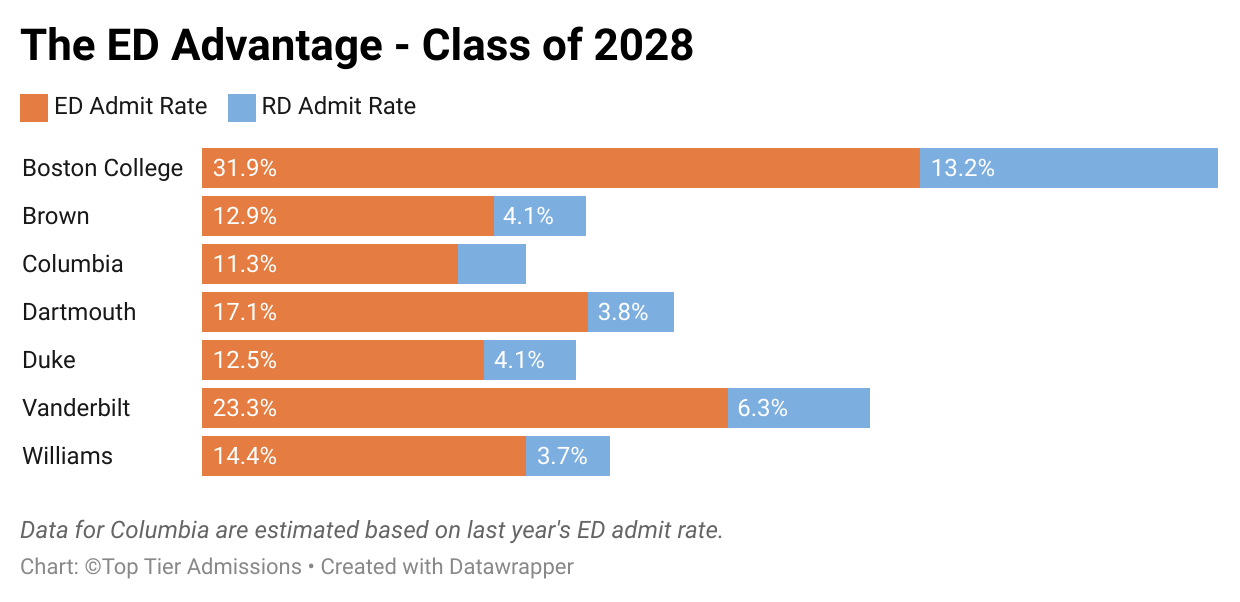
From the chart above, you can see that ED applicants continue to have a significant advantage over those who wait to the regular round. At Dartmouth, Duke, and BC, for instance, the admit rate in ED was over four times greater than the RD admit rate. ED applicants at Brown, Vanderbilt, and Williams had an admit rate that was over three times greater than the RD rate, and Columbia’s ED applicants were admitted at more than 2.5 times the RD rate.
Although many top schools aren’t fully transparent around their ED and RD admit rates, we’re certain the picture will be similar across all schools with a binding ED program.
WHAT’S AHEAD FOR THE CLASS OF 2025?
As current juniors head into the application season this fall, here are a few of the things we’ll be keeping an eye on:
- Standardized testing requirements have been reinstated for the coming application cycle by a handful of top universities, including Brown, Cornell, Dartmouth, Harvard, and Yale. These schools join Georgetown, MIT, and the University of Florida (among others) that currently require testing. With four Ivies asking for testing, you can be sure that all Ivies and other top colleges will see a higher number of applicants submitting scores. With grade inflation in high schools rampant, strong scores will be points of differentiation.
- Applications to early decision/early action programs, which have swelled by more than one million applications in the last five years (a 60% increase) will continue to grow unabated. Time and time again, we see a distinct advantage for students who apply in binding ED programs. Non-binding early action programs, however, don’t confer the same advantage to applicants. Instead, they’re increasingly a tool used by universities to burnish their admissions metrics.
- Use of AI tools to assess applicants, most especially at large schools. Take a look at the number of colleges that now require applicants to recreate their transcript – course by course and grade by grade – in the Common App’s Self-Reported Academic Record (SRAR) form or their own version of an SRAR. Capturing this academic data in a consistent format makes automated transcript evaluations much easier.
- Campus climate and fit. From campus protests in the wake of the Israel-Hamas war to states with abortion bans , it remains to be seen how much our political divisions spill over into students’ college choices. Despite the recent exhortation by Wesleyan President Michael Roth that the best college for you is one where you don’t fit in, most students are likely to not want to swim against the current.
- Soaring costs at some private colleges and universities like Vanderbilt are approaching $100,000 a year. Generous need-based aid policies will help families whose incomes are below $125,000 but what about those families that don’t qualify for need-based or merit aid and don’t have the means to pay full price? Vanderbilt, for instance, projects that only 35% of its students will pay the full list price. Will this new financial threshold lead more students and families to decide that in-state schools are a much better option, all things considered?
As the new admissions cycle gets underway, we’ll be watching and reporting back to you!
TOP TIER’S CLASS OF 2024 DEFIES THE ODDS
In spite of these tough odds, Top Tier’s Class of 2024 did exceptionally well this year and we’re extraordinarily proud of our seniors. Their resilience inspired us as they dove into high school in the throes of remote and hybrid schooling. They embodied academic success in rigorous courses, demonstrated genuine intellectual engagement as they stretched and challenged themselves beyond the classroom, and made meaningful personal contributions to their schools and communities.
Our results? We’re thrilled to share that:
- 72% of our seniors who applied in the early round were admitted.
- Our seniors applying to Ivies were admitted at a rate that is ten times higher than the average Ivy applicant.
- In recognition of their academic and personal accomplishments, our seniors received over $4 million in merit aid.
Congratulations to our amazing Class of 2024!!

In addition, Maria is proud of her long-term volunteer work with Opera North (Lebanon, NH) in fundraising, marketing and audience engagement. She is an avid masters rower with the Upper Valley Rowing Foundation (Hanover, NH) and also serves as a member of its board of directors.