
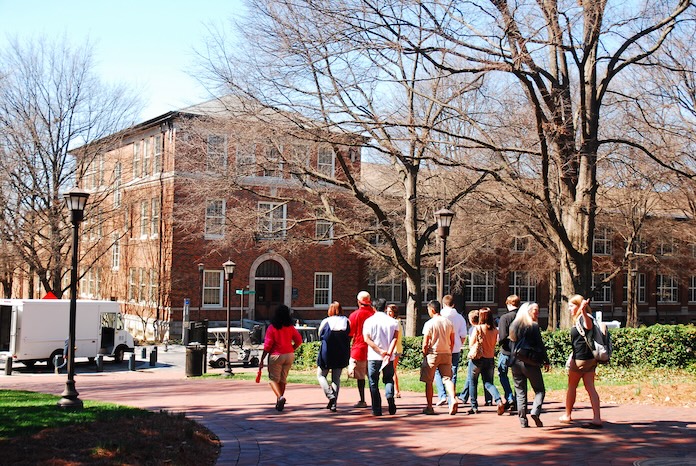
Every summer, prospective students descend upon college campuses, eager to learn more about academic opportunities and get a taste of campus life. Prospective families are armed with the same advice: “meet your admissions officer,” “eat a meal in the dining hall,” “visit a class.” While there is some value in this, it can still be hard to get a “feel” for what it would be like to be a student on campus. As you plan your visits, incorporate this novel approach to gain a greater sense of the student experience.
RETHINKING COLLEGE VISITS: TOP TIPS
Pick Your Tour Guide
When one of my former admissions colleagues took his daughter on her first college visit, he told her beforehand that the tour guide didn’t matter. However, fifteen minutes into the tour, he was pulling her towards the car saying, “You’re not going here.” Prospective families tend to think the tour guide is just there to give you facts about the school. Yet, the tour guide plays a vital role in how that information is delivered. As a former Associate Director of Admissions at Brown University, I was tasked with hiring tour guides, and we painstakingly tried to find tour guides that had different personalities. One of my colleagues always joked that we were looking for “cheerleaders” and “philosophers.” The “cheerleaders” were upbeat and energetic, and they connected with prospective students looking for someone to “cheer” on the school. The “philosophers,” on the other hand brought in the more cerebral, quiet kids. While our tour guides didn’t always fit neatly in these two categories, the takeaway is that you will not connect with every tour guide. At visits where there are multiple tour guides, listen closely to their introductions and choose your tour guide wisely. The person leading the tour doesn’t necessarily have to be like you, but you should be able to imagine being friends with them because you will view the university through their lens while on the tour.
Application Boot Camp®
Need strategic guidance from start to finish? Try Application Boot Camp®.
Visit the “Main Drag”
My dad’s favorite thing to do after a college tour was hop in the car and announce, “Let’s go check out the main drag!” He said the line so often that it became something my brothers and I repeatedly teased him about. My dad was onto something though. He knew that students didn’t just spend time on campus, and he felt it was important to check out the surrounding area. This helped us “place” each school within its wider context, we could imagine what our lives might be like beyond campus, and we usually had a nice lunch! Now, every time I visit a college, I venture off campus to find out what the town, city, or surrounding area is like. Taking time to explore the adorable town of Orange, CA (home to Chapman University), the bustling Greenwich Village Neighborhood of Manhattan where NYU is located, or the bucolic charm of Gambier, OH and Kenyon College, will give you a greater sense of the wider community you are about to join.
Visit the Buildings You Will Spend Time In
The traditional college tour takes you to many of the same places at each school: the library (did you know they all get quieter as you move to higher floors?), the dining hall, a random classroom, the student center, and a dorm room. This gives you an overall sense of the campus- the idea is that the tour takes students to places where every student goes. But where will you spend your time? Do you enjoy working out? Are you interested in the engineering labs? Do you want to pursue internships while on campus? Once you have figured out where you would be spending time on campus, do some research and find out where those spots are on each campus. Visit the gym if you are a fitness buff, venture into the STEM labs if you plan to study those fields (you may even meet a professor or student who can show you something interesting!), and hit up the career center for information about internships if that is important to you. Go off the beaten path and discover the places that the tour doesn’t take you to. You’ll have a more personalized experience, and you’ll have a better sense of how you will navigate each college.
College Private Counseling
Develop an organized and effective application strategy that leverages your academic and extracurricular experience to stand out.
Don’t Ask For Facts, Ask For Anecdotes
As an admissions officer, I often fielded factual questions like “What are your most popular majors?” or “What research opportunities do you offer?” While there is a need to gather information on a visit, most of these questions were answered on our website. Prospective students shouldn’t be asking for facts, they should be asking for anecdotes. In fact, when we trained our tour guides, we told them to tell stories of their experiences or their friends’ experiences because it allows families to make connections and imagine what their student might get involved in on campus. Instead of asking what research opportunities are available, ask “What research have you or your friends done with faculty?” This allows the tour guide to give you a more detailed description of academic and campus life! Other great questions are “What did you do last weekend?”, “What are meetings with your advisor like?”, or “Where is your favorite place to hang out on campus and why?” These questions drive to the heart of the student experience and give a clearer picture to prospective students rather than just statistics.
COLLEGE VISITS: FINAL THOUGHTS
To get the most out of your college visits, think outside of the box! Tours and information sessions tend to feel similar and highlight the same characteristics at each college. To understand the student experience and campus culture, go beyond the facts. These four tips will allow you to imagine yourself as a student at each school.
If you enjoyed this post, follow us on Instagram @toptieradmissions for more tips and subscribe to our blog for expert insights & college admissions news!