
In college admissions, the term “grade inflation” is frequently used. It refers to the trend of teachers awarding higher grades for the same level of work over time. As a result, grades become less meaningful, making it harder for colleges to determine what truly constitutes A-level work.
THE RISE OF THE HIGH SCHOOL GPA
Colleges can easily notice school-specific grade inflation by looking at the school’s yearly college profile. Many schools provide the colleges with a breakdown of GPAs or a grade distribution chart, like the ones below. In the first example, 73% of the graduating class at this school has over a 3.5 GPA, which translates to an A-/B+ average. In the second example, A grades (not even A-) are the most common grades given at the school in every subject.
Example 1:
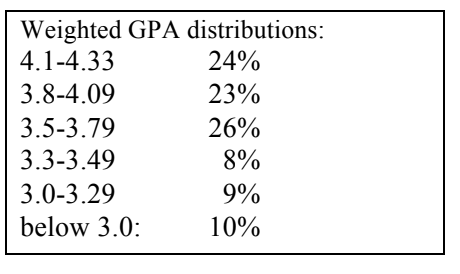
Example 2:

While grade inflation is seen in specific schools, it has also become a nationwide trend. In August 2023, ACT released their findings from a twelve year study (2010-2022), concluding that average grades for U.S. students had risen in every subject, and most notably, in math. This occurred even though ACT subject tests remained relatively stagnant. In fact, ACT scores even dropped a bit in some areas. The tables below show this phenomenon.

CAUSES OF GRADE INFLATION
While there is no definitive study on the causes of grade inflation, several cultural changes around school achievement can be considered. External pressures from rankings such as Niche and U.S News & World Report, and nearly every local paper consistently rank high schools. Yes, they use testing, but not every student takes the SAT or ACT in the recent test optional landscape, so graduation rates and sometimes GPA is also included. If funding is attached to these rankings, there is even more impetus for a school administration to encourage raising GPAs.
Additionally, as highly selective colleges become even more competitive, there is pressure from students and parents to raise grades. High-performing students seek perfect GPAs, and teachers are under more pressure to offer retakes, extra credit, and flexible deadlines, which lowers student accountability.
GRADE INFLATION: HOW COLLEGES ARE RESPONDING
As evidenced by the school profiles listed at the top of this post, colleges are aware of rampant grade inflation both in individual schools and across the country. With GPAs telling colleges less information about a student’s ability than they used to, colleges have begun to focus on other measures of achievement to supplement the GPA. For example, universities, especially those who are highly selective, will take a close look at the rigor of a student’s courseload. Is the student taking the most challenging curriculum at their school (IB, AP, Honors, Dual Enrollment, etc.) and receiving all As or are they taking an average courseload with the same grade results. Because of the increasing selectivity among the top schools in the country, it is no longer acceptable just to achieve all As. A student must also be enrolled in a challenging curriculum across all subjects.
In recent years, many of the most selective colleges have returned to relying on standardized testing. After the mass exodus from testing due to lack of access during the pandemic, colleges like MIT, Georgetown, Brown, Cornell, Harvard, and Dartmouth, among others, have reinstated the requirement for SAT or ACT testing, arguing that testing is a more consistent predictor of college success that helps admissions offices evaluate an applicant in context.

AP Exam Tutoring
Our tutors offer customized tutoring designed to fit the needs of each student.
Similarly, AP exam scores have gained importance as a standardized measure of academic ability. Unlike GPAs, which vary widely across schools, AP scores provide colleges with a uniform benchmark to assess students’ mastery of college-level material. High scores on AP exams demonstrate not only subject proficiency but also the ability to handle rigorous coursework, reinforcing a student’s academic strengths. As a result, students aiming for top-tier schools are increasingly prioritizing strong AP exam performances to differentiate themselves in an applicant pool where inflated grades are common.
Finally, highly selective colleges have reiterated the value of a holistic review. This review goes beyond just GPA and test scores, considering essays, extra-curricular activities, and letters of recommendation, among other things, as admissions offices consider a student’s candidacy. GPA is only one factor in the selection process, and even a high GPA can be outweighed by weaker performance in other areas.
HOW STUDENTS CAN STAND OUT
As grade inflation continues to shape high school academics, students need to focus on genuine learning, course rigor, standardized test scores, and outside achievements. Colleges now expect high classroom performance. They want students who challenge themselves and contribute meaningfully to their communities. Students should concentrate on enrolling in the most challenging courses available, achieving high scores on standardized tests (including APs, when possible), excelling academically to secure strong letters of recommendation, and cultivating a compelling portfolio of extracurriculars, leadership roles, and authentic accomplishments.
If you enjoyed this post, follow us on Instagram @toptieradmissions for more tips and subscribe to our blog for expert insights & college admissions news!

- College Admissions Timeline - May 6, 2025
- Grade Inflation and the Changing Landscape of College Admissions - March 18, 2025
- When to Start Thinking About College: A Guide for Middle School Families - February 25, 2025