

Many students, whether still in high school or post-grad, come to Top Tier Admissions with the goal of attending medical school. Each year, over 50,000 students apply, yet only around 40% are accepted. The key to getting into medical school starts with the AMCAS (American Medical College Application Service), a centralized application system managed by the AAMC (American Association of Medical Colleges).
The AMCAS application is the central application platform for medical schools across the U.S. It requires you to submit essential components such as your academic records, MCAT scores, a list of activities and extracurriculars, personal statements, and letters of recommendation.
Familiarizing yourself early with the application process can give you a valuable head start, especially if medical school is part of your future plan.
Grad School Analysis & Guidance Program
Craft your grad school strategy and sharpen your applications and essays.
THE 2024-2025 AMCAS: WHAT YOU NEED TO KNOW
The AMCAS is the MD equivalent of the Common Application for U.S. medical schools.
Keep in mind, MD programs at public medical schools in Texas opt out of AMCAS for better or for worse.
- Just like some universities use their own application system for undergraduate admissions, public medical schools in Texas use the Texas Medical and Dental Schools Application Service, or TMDSAS. If you have schools like the University of Houston or UT Austin on your list, this affects you.
Medical school is pricey, this includes the application fees.
The 2025 processing fee for the AMCAS is $175 and that includes ONE school.
- Our TTA medical school applicants often apply to over 20 medical schools. Additional medical school applications (or “designations” as the application calls them) are $46 per school. This is after you’ve just paid $335 or $375 (depending on how early you register) for the MCAT. It adds up.
The AAMC makes money in other ways too.
Medical school applicants can also purchase a subscription to the MSAR (Medical School Admissions Requirements database). This is worth your money, as it’s an online database that allows you to browse, search, sort, and compare information based on your personal requirements for every MD-granting, LCME-accredited medical school in the U.S. and Canada.
- The list of what’s included in a paid AAMC MSAR subscription is actually pretty impressive. Check it out!
Career Planning and Academic Advising
Clear, informed career planning and academic / extracurricular advising.
The AAMC knows their application is a bit confusing.
When it comes to the Common App, we create a “Mysteries of the Common App Guide” for our TTA students. In that same spirit, the AAMC publishes an AAMC Applicant Guide annually. Here’s the 2025 version.
The medical school admissions application is divided into two key parts.
There’s a primary application and then a secondary application or, “the primary app” and then “secondaries.”
- The Primary App wants: demographic info, coursework info, letter of rec writer info, significant hardship essay (if applicable), personal statement, and activities section.
- The Secondaries are supplemental essays which can typically be broken down into 4 types of prompts:
- Gap Year Explanation Essay
- Adversity or Overcoming Obstacles Essay
- Diversity or Personal Identity Essays
- Why Essays (and there’s a catch too, the Secondaries have added fees school by school.)
You get to list 15 activities (work and extracurriculars).
If med school is in your future, start tracking these as early as possible.
- I like Johns Hopkins University’s free Pre Professional Experiences Tracking Template for health professions students; you don’t need to be a JHU student to use it.
The AMCAS expects you to be honest.
Interestingly, they’ve recently updated their 2025 application and they acknowledge that medical students are using AI as they prepare their materials. At the end of your primary application, you must state (page 6):
I certify that all my writing, including personal comments, essays for MD-PhD applicants, and descriptions of work/activities, is my own. Although I may utilize mentors, peers, advisors, and/or AI tools for brainstorming, proofreading, or editing, my final submission is a true reflection of my own work and represents my experiences. I acknowledge that no changes can be made after submission and will thoroughly proofread my work. Quotations are allowed if I cite the source.
Note that I’ve bolded the AI reference as they do allow applicants to use “AI tools for brainstorming, proofreading or editing.”That’s new.Way to be hip, AMCAS.This is a recent 2025 change so it’s an incredibly slippery (and risky) slope when it comes to AI and medical school essays.
Submit early!
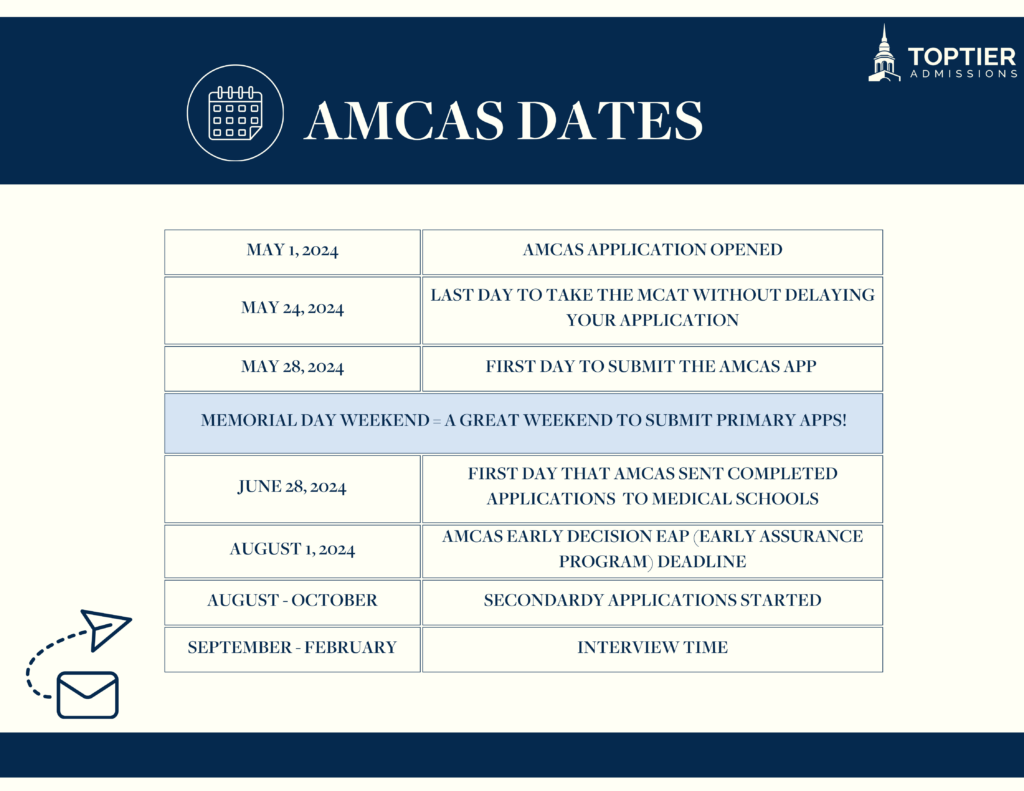
Let’s take a peek at the spring 2024 AMCAS dates so you can plan for 2025 and be in the know on just how fast the AMCAS application timeline goes.
YOUR PATH TO MEDICAL SCHOOL
The AMCAS is not a breeze to complete, but then again, it shouldn’t be too easy considering the end goal. There’s a reason that roughly 100,000 AMCAS applications are started each year, but only 51,000 on average are completed, or more specifically, 52,577 in 2024. We’d love to help you chart out your medical school timeline, pathways, primary application materials, and secondaries.
Contact us for more information on our Top Tier Admissions consulting program options for medical school applicants whether you’re planning for medical school as a high schooler, college student or working professional.