

Gender disparities in college admissions have made headlines in recent years, with women now outnumbering men on many campuses. In 2023, the NY Times highlighted Tulane’s incoming freshman class, which was nearly 64% women. Similarly, wide disparities exist on the campuses of the University of Arizona-Phoenix (68% women), Liberty University (59%), and Miami Dade College (57%). While some frame this as a recent shift and sources are reporting on this trend as if it were unprecedented (a “wake-up call” for men), the reality is that women have outpaced men in higher education for over 40 years. However, not all institutions experience this imbalance equally—while open-enrollment colleges often see more female students, elite universities have historically tilted male. Understanding these trends can help students better navigate the admissions landscape.
GENDER GAP IN COLLEGE ADMISSIONS: HISTORICAL PRECEDENCE
There are concurrent historical stories to tell when it comes to understanding gender and college admissions. The first, which has been in the news frequently over the past few years, is the domination of women across college campuses. Incoming freshman classes are disproportionately gendered female. Across the country, a higher percentage of women who finish high school are entering college than their male counterparts (65.3% vs 57.6%) and more women are finishing college than men (67.9 compared with 61.3, in 2022).
Women first earned more than 50% of the bachelor’s degrees awarded in 1982. (Considering that almost 50% of American colleges didn’t go coeducational until the middle of the twentieth century, this was rapid progress!) By 1992, they accounted for more than 53% of college students, and by 2023 that number was 58%.
Breaking down these statistics by college category and prestige reveals a different story: while there have long been more women in higher education across the board, the disparity has historically been exacerbated at open enrollment institutions like non-selective and community colleges. In contrast, until very recently women were slightly underrepresented at Ivy league and equivalent institutions, with Yale, MIT, and Stanford all admitting more men than women as late as 2015 (although the overall share of women in higher education reached 57% that year).
GENDER AND ADMISSIONS
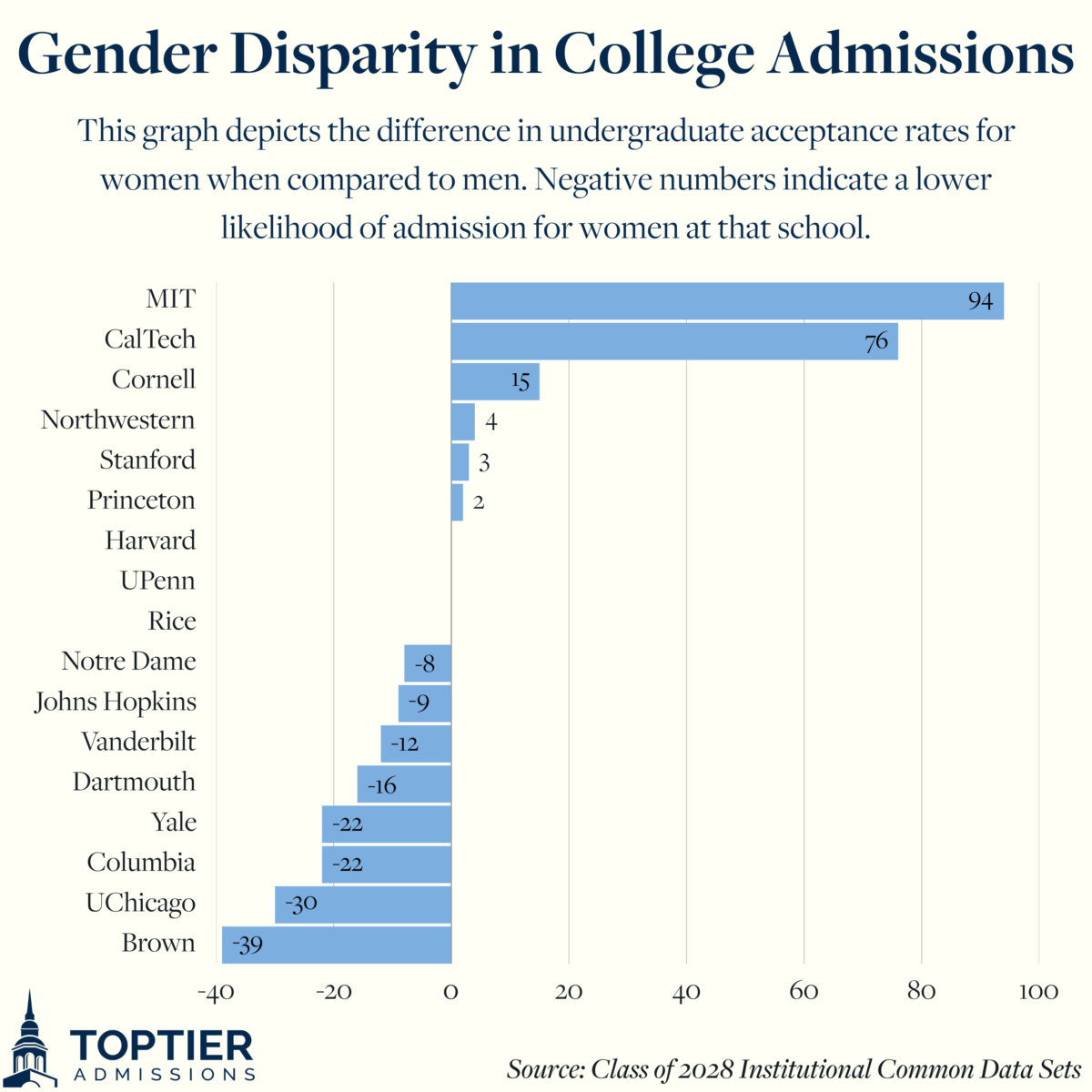
The impact that these historical statistics exert on admissions is uneven: Tulane, for example, has a slightly higher admissions rate for women than men (15% versus 13%) despite receiving 1.7x the number of applications from women than men. Other schools’ statistics tell a more proactive story of seeking to balance incoming classes. Title IX prohibits discrimination on the basis of gender in admissions; but, as the head of enrollment at Trinity College told the NY Times in 2020, “I can’t come up with a class of 20% men – that’s just not a good campus.” Small adjustments, like upping sports recruitment for football teams and prioritizing standardized test results (which tend to be slightly higher for men) can tip the scales towards increasing male enrollment. At Brown University, about 12,000 more women than men applied for admission in 2023, but 14 more men than women were admitted. The same year, the University of Chicago received almost 4,000 more applications from women, but admitted 150 more men. Then there are the schools that struggle to recruit women applicants, and thus tend to overcorrect the other way. Elite, STEM-focused institutions like MIT, Caltech, and Stanford have slightly higher acceptance rates for women since they historically have attracted more male candidates. Last year, MIT received half the number of applications from women as they did men, but admitted a near-even class in terms of gender. Maria Laskaris, Top Tier Admissions Senior Private Counselor and former Dartmouth College Dean of Admission & Financial Aid, recently spoke with BestColleges about gender inequity in selective college admissions. She notes that, “at some institutions, there’s no admissions advantage based on gender. Schools such as Harvard University, the University of Pennsylvania, and Rice University reflect similar acceptance rates for men and women.” In the chart below, we’ve graphed the schools with the largest acceptance gaps between men and women.
NON-BINARY APPLICANTS
Colleges have only recently begun tracking the number of applicants and admitted students that don’t identify as one of the binary genders, and admissions statistics are still too small in numbers to say anything definitive about opportunities and obstacles for these candidates. For example, NYU reported receiving four gender-non-binary applications in 2023, and admitted all four. Conversely, the University of Chicago did not accept any of the 9 applicants who declined to list a gender. MIT received more than 1,100 applications marked “another gender” and accepted about 4% of those 1,100 applicants; what is interesting to note is that this is the same rate of acceptance for male-identifying applicants (also 4%) and much lower than the rate for female-identifying applicants (7%; see MIT’s leading spot in the chart above).

College Private Counseling
Develop an organized and effective application strategy that leverages your academic and extracurricular experience to stand out.
WHAT DOES THIS MEAN FOR YOUR COLLEGE APPLICATIONS?
The takeaway is that gender imbalances have long existed on college campuses. Some institutions, namely those depicted in the chart above, seek to overcorrect one way or another for historical disparities. However, when you apply to most institutions, the gender that you mark on your application will have little to no effect on your chance of acceptance—so we urge college applicants to focus their strategizing on a strong academic record, impactful extracurriculars, and compelling main essays!
If you enjoyed this post, follow us on Instagram @toptieradmissions for more tips and subscribe to our blog for expert insights & college admissions news!

- The Gender Gap in College Admissions - March 13, 2025
- The Best Schools for Transferring - February 13, 2025