
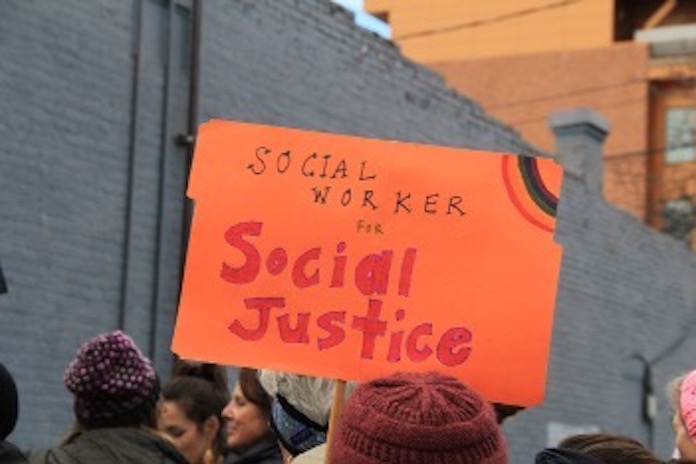
For students who have devoted their time and energy to civic engagement and social justice action in high school, college is a great time to advance these skills and continue making an impact. Now, more than ever, there are opportunities to turn your advocacy into a career path by pursuing jobs at an NGO, as a community organizer, or in the political realm after graduation. Almost every college offers opportunities for community engagement in some capacity but, in recent years, some schools have also developed specific academic programs, majors, and minors to support students with a commitment to social activism, both in and out of the classroom.
SAMPLING OF SCHOOLS WITH STRONG SOCIAL JUSTICE PROGRAMS
To learn more about academic programs in social justice, check out these 10 schools:
Bucknell University
Bucknell’s interdisciplinary minor in Social Justice includes a core curriculum that introduces key concepts like oppression and privilege. Through a wide range of courses including “Environmental Injustice,” “Social and Political Philosophy,” and “Sex and Social Order,” students can explore the interconnected nature of social justice from a theoretical and practical perspective. Electives are divided into five categories: 1. Gender & Sexuality, 2. Race & Ethnicity, 3. Poverty, Inequality, & Class, 4. Environmental Justice, and 5. Law, Religion, & Human Rights. Bucknell also offers a Poverty Studies Concentration, which culminates with an internship offered through the Shepherd Consortium.
Brandeis University
At Brandeis University, students can pursue a minor in social justice and social policy (SJSP) as part of an interdepartmental program that draws on faculty expertise from the School of Arts and Sciences and the Heller School for Social Policy and Management. To complete the minor, students are required to do a “Social Justice, Social Policy Internship” and take core courses, including “Protest, Politics, and Change: Social Movements.” Recent internship placements include the Immigrant Legal Resource Center, the Progressive Change Campaign Committee, and the NAACP’s Washington Bureau. Students are also encouraged to focus on specific policy areas that affect a certain demographic (children, women, the elderly) or engage with a particular theme (health care, housing, etc.). As stated on the program’s website, the goal of the minor is to help students understand how to: 1. Rigorously engage with core questions of liberty, equality, and justice 2. Recognize and locate major philosophical, legal, and analytic conceptions of liberty, equality, and justice 3. Relate frameworks from multiple disciplines to pressing social, economic, philosophical, legal, and political issues and policies 4. Identify how policy approaches are shaped by and bear upon racial, gender, ethnic, religious, cultural, and political difference 5. Locate and classify the points of intersection between social values and practical policies.

Common App 911/UC App 911
Step-by-step strategic support.
Smith College
Smith has a long reputation of being on the forefront when it comes to diversity, inclusion, and social justice—both through its course offerings and campus policies. Although there is no social justice major or minor offered, the Program for the Study of Women and Gender is one of the strongest such departments in the country and places a heavy emphasis on intersectional feminism and social justice. As stated on the department website, the program “examines gender, race, class and sexuality as important and simultaneous aspects of social worlds and human lives.” Courses include “Gender, Law and Policy,” “White Supremacy in the Age of Trump,” and “Collective Organizing.” Beyond the classroom, the Social Justice & Equity Committee is comprised of representatives who complete training to serve as educators, allies, and advocates for social justice issues on campus. They also educate their peers through programming and dialogue around issues such a privilege, oppression, and identity.
Lake Forest College
The Social Justice minor at Lake Forest includes core courses such as “Social Justice and Human Rights,” “Identities, Rights, Social Justice,” and “Topics in Social Justice” in addition to a wide range of electives from different departments and programs such as African American Studies, Business, Chemistry, Communication, Economics, Religion, and Sociology. The department notes that, although “Social justice is often perceived as a ‘liberal’ notion…the issues transcend partisan political classifications. The Social Justice minor at Lake Forest College does not shrink from the serious, fundamental questions, e.g., of the tension between demands for individual liberty and the calls for social equity. We face the complicated tasks of comparing competing strategies and conclusions about how to achieve a better world. Our investigations and efforts will proceed in the Socratic method of encouraging conscientious dialogue among those with different beliefs, and with the Socratic goal of seeking the truth on matters of justice. And we will recognize Socrates’ claim that we will never reach final answers. Our task is to continue the process, to do our best to determine what would constitute a better world and how to achieve it.” Lake Forest also offers a number of off-campus social justice opportunities so students can engage in their communities. For instance, students who want to immerse themselves in Latin American culture can study and volunteer abroad in Chile while taking courses such as “Political and Social Change in Chile & Latin America,” “Globalization and Social Justice,” and “Latin American Gender Studies.”
Tufts University
At Tufts, the program in Civic Studies also offers a minor in Peace and Justice Studies. Interested students can take courses in the following five categories: Education for Public Inquiry and International Citizenship (peace and justice), Thinking about Justice (political theory, philosophy, or social theory), Social Conflict and Violence (the historical, political, and social origins of conflict and violence), Civic Action and Social Movements (the historical, ethical, and social origins of organized movements for social change), and Civic Skills (civic practices like conflict-mediation, community-based research, and financing social enterprises).
George Washington University
George Washington University offers a unique Human Services and Social Justice major within the Columbia College of Arts and Sciences that combines psychology, education, counseling, and sociology to help students become leaders and professionals in nonprofit organizations, educational institutions and government and private agencies. Students may also pursue this program as a minor or combined degree (BA/MPA) in partnership with the Columbian College’s Trachtenberg School of Public Policy and Public Administration. Courses are combined with research and service-learning opportunities as students work to fight injustice, discrimination and poverty alongside nonprofits and government agencies in Washington, D.C.
Wesleyan University
Wesleyan University offers a Philosophy degree with a social justice track so that students can apply philosophical methods of analysis to real-world scenarios. Students who pursue this track often focus on one area of social justice, such as human rights, social responsibility, or environmental justice, based on their interests and then craft an interdisciplinary concentration around this theme. Courses include “Human Rights Across Cultures,” “Reasoning About Justice,” and “The Moral Basis of Politics.”

Essay Guidance
Get our expert guidance on your college essays.
University of North Carolina, Chapel Hill
UNC Chapel Hill offers a minor in social and economic justice that aims to teach students how to engage with a range of topics including human rights; racial, ethnic, and gender equality; economic justice; democratic participation; sustainable development; diversity; and peace. Students who pursue this minor are prepared to work in advocacy roles after graduation, especially in nonprofit organizations, in local communities, or in governmental organizations. Courses are grouped into three categories: “Understanding Justice,” “Justice in Action,” and The Context of Justice.” These include classes like “Gender, Class, Race, and Mass Media,” “Hate Speech,” “Labor Economics,” “Medicine, Politics, and Justin,” and “Comparative Queer Politics.” This minor also includes a mandatory service-learning component.
University of Connecticut
UConn’s minor in Social Justice Organizing provides students with practical skills in community organizing through a supervised internship to complement classroom instruction. Courses are organized into three categories: “Identities, Intersections, and Categories of Analysis,” State Structures and Systems of Inequality and Control,” and “Creative Social Justice, Equity and Freedom.” Students may explore a wide range of topics from “Refugees and Humanitarianism” to “Indigenous Rights and Aboriginal Australia.” During the required service-learning seminar, students work with local activists and UConn instructors to become more familiar with the theories and practice of community organizing, especially when it comes to immigration, environmental, reproductive, and racial justice.
Baylor University
In 2012, the Baylor Interdisciplinary Poverty Initiative introduced an interdisciplinary minor in Poverty Studies and Social Justice. Students must complete three required courses, plus 9 hours of electives as they learn about ways to effect social change and advocate for vulnerable populations. The required courses are “Introduction of the Economics of Poverty and Discrimination,” “Social Policy for Social Work Practice,” and “Foundations of Social Justice.” Students often pair this minor with a major in Social Work, Economics, Child and Family Studies, Political Science, or Psychology.
LET US HELP
Do these programs resonate with you and your post-grad aspirations? Not sure how to show demonstrated interest in a particular school or craft a compelling application? Contact us today and learn how we can help you on your admissions journey through private counseling, test prep, or essay guidance.