
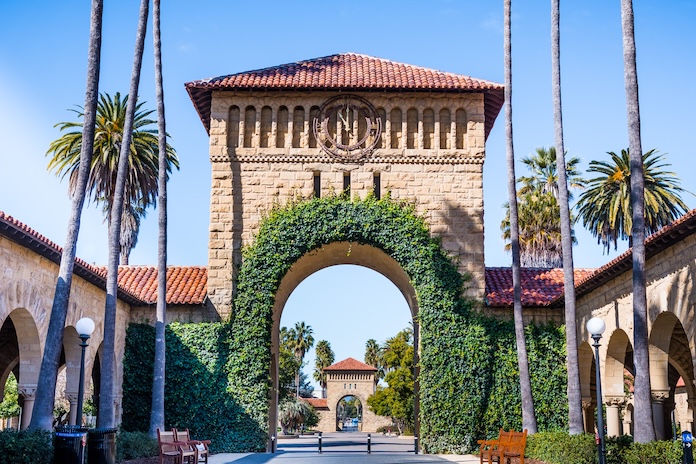
As a Senior Private Counselor and former Seasonal Reader in the Stanford Undergraduate Admissions Office, I was thrilled to host our recent live webinar, “Is Your Student Stanford Ready?” We had an excellent turnout and an incredibly engaged audience who asked thoughtful, insightful questions throughout the session about many important topics, including course selection, the importance of student research, and legacy status in admissions, to name a few.
Our session covered key factors related to the selective admissions process, starting with a look at the current admissions climate, then narrowing our focus to discuss what Stanford in particular values in applicants.
Here’s a recap of what we discussed:
THE SELECTIVE ADMISSIONS LANDSCAPE
Standardized Testing: Standardized testing policies have fluctuated at top colleges over the last few years. In 2025, an increasing number of colleges have reinstated standardized testing requirements that were removed during the pandemic, though many do still remain test-optional or test-flexible. Stanford requires students submit ACT or SAT scores.
Legacy: The practice of giving preference to legacy candidates in the admissions process is currently under scrutiny at both the state and federal level. Notably, Stanford is opting out of state financial aid funding in order to continue considering legacy in evaluating candidates.
Yield: Admissions officers have struggled in recent years to reliably predict yield. What this means for students is that colleges are using the waitlist more heavily, putting more students on the list to allow flexibility later in the process to adjust the freshman class size over the summer. Stanford extended its waitlist by about a month in 2025 to maintain flexibility to make offers through the summer.
International Students: International students are typically full-pay students, making them a major source of revenue for U.S. colleges. These funds offset the costs for domestic students as well as contribute to financial aid programs and other university offerings. Currently, policy-related discussions and political uncertainties have left both universities and students struggling to know how to navigate and predict the future.
WHAT MATTERS TO STANFORD?
Like many highly selective colleges in the U.S., Stanford practices holistic review. Quantitative measures like grades and standardized test scores are carefully reviewed, as well as qualitative measures like personal qualities and a student’s impact. At Stanford, the most important factors are those that reflect a student’s academic abilities and potential. Now that submitting standardized testing is again required, it is safe to assume it will be a very important component of the review process, as it was prior to the pandemic.
In an effort to create a well-balanced class, Stanford admits students with exceptional talents and qualities across a range of areas. The most important non-academic factors are extracurricular activities and one’s talent in these activities, as well as a student’s character and personal qualities.
With an admit rate hovering just over three and a half percent, it’s a given that all students who are viable candidates for admission to Stanford have strong academic records. At schools like Stanford, admissions officers want to see students earning A grades in the most rigorous courses available to them. Students should aim to take classes in all five core fields—English, history, math, science, and world language—throughout all four years of high school, which often means going above and beyond their high school’s graduation requirements.
CONTEXT MATTERS
In many admissions offices, individual staff members are responsible for managing a geographic territory. It is the job of these individuals to become experts in the high schools and opportunities available in that region. One of the ways that they do this is through review of the school profile. This document, compiled by a student’s high school, typically includes a list of available courses (and any restrictions they may place on what a student can take), the average GPA and standardized testing of the most recently graduated class, the colleges that students have matriculated to over the last few years, as well as any special features or programs offered by the school.
If a student is looking to stand out in comparison to other students at their high school and be competitive for a university like Stanford, they should maximize the rigor of their courses, earn a GPA in at least the top 10% as compared to peers, and generally take full advantage of the opportunities available within their school context. In addition, they may even be going above and beyond what is offered at their high school in search of extra challenge.
INTELLECTUAL VITALITY
Stanford is eager to understand the impact a student has already had as a deep thinker and intellectual, as well as to envision how they might contribute their curiosity and enthusiasm on campus and in the world beyond college. Taking courses beyond one’s standard high school classes can provide evidence of this potential. These might be college classes at a nearby university, credit-bearing summer programs, online classes, or independent study programs.
In terms of showcasing interests, students can consider participating in relevant academic contests, attending conferences in their field of interest, or submitting work to journals for publication. Some students also choose to self-study for AP exams, which can be an excellent way to demonstrate initiative and willingness to tackle challenges.
Finally, pursuing research helps Stanford to understand a student’s scholarly capacity. Research demonstrates that a student has engaged their curiosity at a higher level, as well as gives colleges a glimpse of how they may contribute to the culture of investigation and inquiry that exists on campus. Research should be framed through a lens of personal interest and growth.
College Essay Guidance
Experience personalized, expert guidance to elevate your college essays and secure your spot at top universities.
Another excellent place to showcase intellectual vitality is in the Common App personal statement. Students should view this essay as a space to highlight the impact they could make on a college campus. Grades indicate academic strength, but not intellectual vitality—that’s where the essay comes in. The essay is a great place to show admissions readers the very specific way(s) in which a student will contribute to the university.
Supplemental essay prompts typically signal a school’s values and institutional mission, and they’re used by admissions officers to find students they believe will be an especially strong fit for the culture of their school. With this in mind, it’s a good idea for students to review the mission statement of all of the colleges to which they apply.
College Private Counseling
Unlock your full potential.
ADDITIONAL FACTORS
The most competitive candidates for Stanford have excellent grades and academic rigor, and have demonstrated intellectual vitality as well as significant potential to contribute. This potential can also be seen in a student’s high school activities. There is no specific number or set of activities that colleges hope to see, however colleges like Stanford are looking for depth of commitment to the activities students pursue.
It’s also important for colleges like Stanford to understand the role a student has played in their school and local community. For our private counseling students at Top Tier, we work closely with students to design civic engagement opportunities that center around the causes they are naturally interested in. The goal with these sorts of projects is to showcase impact, leadership, and initiative.
PLAN YOUR APPLICATION STRATEGY
So how does an individual student maximize their chances of success in the college admissions process? The key is to put together a thoughtful, carefully balanced college list that includes colleges of a range of selectivity. Every college on a student’s list should be somewhere they would genuinely be excited to attend, and their essays should reflect that.
As students explore colleges, they should identify the attributes that appeal to them about colleges – unique programs, geographic location, urban/suburban/rural setting, social opportunities, curricular flexibility – rather than focusing primarily on college names. Ultimately, students should be able to articulate the specific qualities that appeal to them about each school on their list, from the most selective down to the one with the most generous admit rate.
Finally, we recommend that students strongly consider applying Early. The biggest admissions advantage is conferred to students who apply Early Decision, however not every school offers Early Decision. At Top Tier, we work closely with our private counseling students to create an application strategy that includes Early applications.
CLOSING THOUGHTS
Thank you to all the students and parents who attended our webinar, and for the many excellent questions they posed about Stanford and admission to highly selective colleges. For over twenty years, Top Tier has guided families through the selective admissions process, and we look forward to helping your family, too! Please reach out to learn more about the many programs we offer to support your journey.
Want to stay in the loop? Follow us on Instagram @toptieradmissions and subscribe to our blog for expert advice and admissions insights.
Know someone else navigating the college process? Pass it along — they’ll thank you later!

- How Many Extracurriculars Do Colleges Really Want? - September 4, 2026
- Yale Ends Test-Flexible Policy: What Changed, and Why - July 13, 2026
- Colleges Are Changing How They Read Essays Because of AI. Here’s What That Means - June 2, 2026