

With the launch of the digital SAT in March 2024 and the more recent updates to the ACT in April 2025 (both of which introduced significant changes to test formats) the standardized testing landscape is more uncertain than ever. At Top Tier Admissions, we’ve received a steady stream of questions about these shifts, so we’re sharing some of the most frequently asked questions along with our expert insights. With registration now open for both the SAT and ACT for the 2025–2026 admissions cycle, it’s essential to stay informed about these key components of the college application process.
WHEN CAN I TAKE THE SAT OR ACT?
SAT: Test dates for this academic year are August 23, September 13, October 4, November 8, December 6, March 14, May 2, and June 6. Note that the September test date is a new offering this year, for a total of 8 potential dates.
ACT: The ACT’s National Test Dates Schedule in 2025-2026 is September 6, October 18, December 13, February 14, April 11, June 13, and July 11; a total of 7 exam dates.
Students usually take the exam for the first time in the fall or spring of their junior year. In senior year, the October dates are the last ones for consideration in Early Action or Early Decision 1. The December dates are the final ones for consideration in Early Decision 2 and the Regular Decision rounds.
SAT Tutoring
Expert one-on-one guidance to boost your score.
HOW DO I REGISTER FOR THE EXAMS?
Registration is done online by setting up an account, choosing your date and location, and paying the fee.
SAT: Register through the College Board website. Regular registration for the SAT is 3 weeks in advance of the test date.
ACT: Register through the official ACT website. Regular registration for the ACT is 5 weeks in advance of the test date.
Both exams also offer late registration deadlines, but note that many test centers fill early, especially in popular areas of California and New York.
WHY SHOULD I TAKE THE SAT OR ACT IF MOST SCHOOLS ARE TEST OPTIONAL?
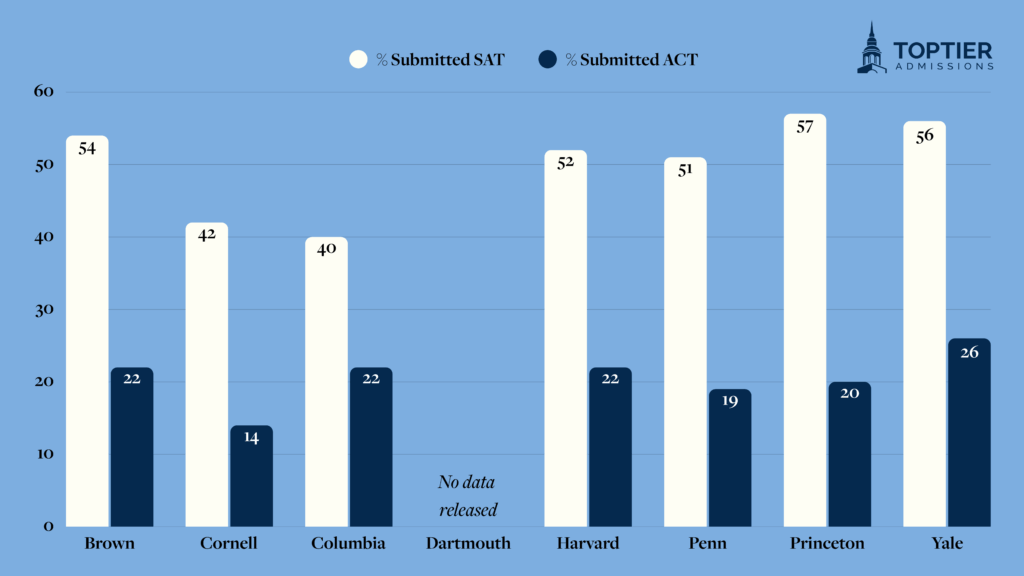
Until 2020, roughly 2 million students took the SAT and another 2 million took the ACT for college admissions purposes. During the pandemic and the implementation of test-optional policies, there was a steep but short-lived drop in the total number of test takers. Numbers have now returned to pre-pandemic levels with 1.97 million students taking the SAT in 2024, reflecting the continued importance of these exams in college admissions. In 2025, all Ivies except for Columbia and Princeton again require standardized test scores (Yale applicants can submit AP or IB results instead of the ACT or SAT). Colleges that are “test optional” in policy are often “test preferred” in practice. For example, based on Common Data Sets for the Class of 2027, most students applying to the Ivies in a test-optional environment still submitted scores, knowing that they are “considered” or “very important” in admissions evaluations.
HOW ARE THE SAT AND ACT SCORED, AND HOW DOES SUPERSCORING WORK?
SAT: The SAT is broken into two sections – Mathematics, and Reading and Writing (RW). The SAT is scored on a scale of 400 to 1600, with separate scores (200–800) for the two subsections. The additional Essay section is only available in states where it is required as part of SAT School Day administrations.
Colleges that superscore the SAT use your best section-level scores, even if they are from different test dates, so that you can combine a Math score from one date with an RW score from another for a higher total. For example, if a student scores 600 in RW and 700 in Math in November, and then scores 700 in RW and 650 in Math in December, the superscore would be 1400 (700 in Reading and 700 in Math), versus a score of 1300 in November or 1350 in December. Superscores are often higher than the composite score from any single test date. This is different from the College Board’s Score Choice™, which allows students to select which score reports, by test date, to send to each college. Score Choice is no longer an especially valuable feature since many schools now allow students to self-report their scores selectively.
ACT: The new Enhanced (vs Legacy) ACT has sections on English, Math, and Reading, with an optional Science section. ACT scores range from 1-36 on each section. There is also an optional Writing (Essay) section that is scored 2-12. Based on an average of the three core sections, students receive a composite score, rounded to the nearest whole number. The Science section is averaged with the Math score for an ACT STEM score. The Writing section is reported separately.
Given the two optional sections of the new Enhanced ACT, there is significant variation in how colleges are handling superscoring and scoring across the two versions. Most colleges see the highest composite score from a single sitting, but will also look at the highest subsection scores across dates.
ACT Tutoring
Hit your target score with our renowned ACT tutors.
WHEN AND HOW TO SUBMIT SCORES?
When registering for the SAT or ACT, you can choose up to four colleges to send your scores to for free. After the test, you can send an official score report to any schools for a fee. Most students prefer to wait to see their scores before sending them to schools. Instead of requiring official score reports, many schools now allow students to self-report scores either on the Common App or on their school-specific portals. This saves students the cost of sending official scores to multiple schools at application time, as they can send those official scores for verification only at the one school where they matriculate.
SAT: On the Common App, the questions for self-reporting the SAT in the last cycle were:
- In addition to sending official score reports as required by colleges, do you wish to self-report scores or future test dates for any of the following standardized tests: ACT, SAT/SAT Subject, AP, IB, Cambridge, TOEFL, PTE Academic, IELTS, and Duolingo English Test?
- Number of past SAT scores you wish to report:
- Would you like to report an SAT essay score?
- Number of future SAT sittings you expect
- Highest evidence-based reading and writing score/date
- Highest math score/date
ACT: On the Common App, the questions for self-reporting the ACT in the last cycle were:
- In addition to sending official score reports as required by colleges, do you wish to self-report scores or future test dates for any of the following standardized tests: ACT, SAT/SAT Subject, AP, IB, Cambridge, TOEFL, PTE Academic, IELTS, and Duolingo English Test?
- Number of past ACT scores you wish to report:
- Would you like to report an ACT Plus Writing score?
- Number of future ACT sittings you expect:
- Highest composite score/date
- Highest English score/date
- Highest Math score/date
- Highest Reading score/date
- Highest Science score/date (*this will necessarily change to reflect optional reporting when the Common App is refreshed for the new cycle on August 1, 2025)
Note that students who take the ACT must report their highest composite from a single date, whereas students who take the SAT do not, and only report the two subsections separately, which can be from different dates (i.e., superscoring). Importantly, also note that the Common App no longer asks students for the total number of times they have taken the exam, only how many scores they wish to report. This means that students are not disadvantaged by taking the exam multiple times, except at schools that require all test results (see below); most students do score higher on a second or later attempt.
WHICH SCHOOLS REQUIRE ALL TESTS?
There are only a few schools that require all test sittings to be reported. Among selective U.S. schools, Georgetown is the only one that requires all test results, although several others including MIT, Rice, and the University of Washington “suggest” or “recommend” sending all scores. If these schools are at the top of your list, you should prep extensively and only sit for a real test when your practice scores are consistently in range of your target score.
Outside of the U.S., the University of Cambridge and University of Toronto Engineering require applicants to disclose SAT scores from all test administrations. University of Cambridge’s language on this is the most stringent: “You are required to inform us in your application of all tests taken and scores achieved (including retakes). If you do not tell us about any of the tests you have taken or your scores, this may disadvantage your application. The Cambridge Colleges reserve the right to contact College Board or your school to confirm your results.”
SHOULD I TAKE THE SAT OR ACT?
Both the SAT and ACT are college entrance exams. These two exams are now similar in length and interchangeable in the eyes of admissions officers, so it makes sense to take the exam that you will likely do better on. They are different in terms of pacing, problem style, and content, and students usually have a preference. Students can take a full-length practice exam of each to determine their “better exam,” or take TTA’s diagnostic quiz for a quicker assessment of their English, Reading, Math, and Science/Data knowledge as related to the SAT and ACT (you will receive feedback on your areas of strengths, areas you need to work on, and which test might be most suitable for you).
Key differences between the exams:
TIMING
SAT: The total time for the digital SAT is 2 hours and 14 minutes for 98 questions. The test consists of:
- Reading and Writing: 64-minute section with 54 questions (1 minute 11 seconds per question)
- Math: 70-minute section with 44 questions (1 minute 35 seconds per question)
There is a 10-minute break between the Reading and Writing section and the Math section.
ACT: The three core sections of the ACT English, Math, and Reading sections total two hours five minutes for 121 questions–
- 35 minutes for 50 English questions
- 50 minutes for 45 Math questions, and
- 40 minutes for 36 Reading questions.
- The optional Science section is 40 minutes with 40 questions.
There is a ten-minute break between the Math and Reading sections.
The Enhanced ACT has about 20% more time per question than the previous Legacy ACT, but the exam still maintains a faster pace than the SAT. This advantages students who are faster workers or who have extra time through accommodations.
FORMAT
SAT: The SAT is now fully digital and is taken on the College Board’s Bluebook testing app. The SAT is also adaptive. The first module of each SAT section (Reading and Writing, Math) contains a broad mix of easy, medium, and hard questions. Depending on how you answer the questions in the first module, you are routed to a second module of questions either of higher difficulty or of lower difficulty than in the first module.
ACT: The ACT is offered in both digital and paper-based formats. Students who have a strong preference for a paper-based format should opt for the ACT. The ACT is not adaptive.
Both are administered only at proctored testing centers.
CONTENT
SAT: The SAT focuses on reasoning, problem-solving, and reading comprehension across all sections. The math section (50% of score) prioritizes algebra and word-based math problems. Most questions are multiple-choice but the math section has student-produced response questions where students must input their answers in “grid-ins.” The SAT is great for students who like to think through longer, more abstract, or multi-step problems, and for those who excel at in-depth algebra and logical reading.
ACT: The ACT is more of a knowledge-based test that covers specific content. The math content (33% of composite score) covers a broader range of topics including trigonometry and matrices, and favors students confident in direct recall of math concepts. The ACT is entirely multiple-choice with the exception of the optional writing section. The ACT is great for fast workers and those who prefer straightforward questions across a wide range of knowledge.
CALCULATOR
SAT: The SAT allows use of an on-screen Desmos calculator for math questions but also has a No-Calculator Math section. In May 2025, the College Board noted, “Effective for the August 2025 SAT Weekend administration and the October 2025 in-school SAT and PSAT-related assessments testing window, calculators with CAS functionality will no longer be allowed for tests within the SAT Suite of Assessments.”
ACT: You can use an approved calculator on the Math section of the ACT, but you cannot use it on the Science section.
CAN I CANCEL MY SCORES?
SAT: Students can cancel online within one week of taking the test. You cannot cancel your scores after receiving them.
ACT: Students can cancel by requesting to “cancel scores for a particular test date. Contact us online and we will provide you a form to complete and return to us. We will then permanently cancel that score record for the indicated test date and send cancellation notices to any score recipients.” The ability to cancel an ACT test after receiving results was previously an advantage of the ACT but is no longer especially valuable given the increasing ability to self-report scores selectively.
SAT vs ACT: WHICH IS YOUR BETTER TEST?
Now that you have all the key information about these important exams for college admissions, determining whether the SAT or ACT is best for you (SAT vs. ACT: Which is Your Better Test?) is the next step in establishing a successful test-prep plan that will allow you to reach your college goals. Let TTA’s expert tutors help you improve your scores efficiently!
Want to stay in the loop? Follow us on Instagram @toptieradmissions and subscribe to our blog for expert advice and admissions insights.
Know someone else navigating the college process? Pass it along — they’ll thank you later!

After attending Castilleja School in Palo Alto, California, Heidi graduated cum laude with an Honors thesis from Dartmouth College as a double major in Classical Archaeology and Comparative Literature. At the University of Pennsylvania, Heidi was a Williams Fellow in the graduate program of Art and Archaeology of the Mediterranean World. She has conducted archaeological field work in Sardinia, Cyprus, Greece, and Turkey.