The choice to attend college at the University of California, Los Angeles has defined my life in many ways, not least of which being that I met my lovely wife (and the mother of our child) at UCLA. In this post, I aim to give you the history of this proud institution, and reflect on the strengths and unique qualities of UCLA.
UCLA: HISTORY
UC Los Angeles was founded in 1882 as the Los Angeles Branch State Normal School. Ironically, like its fellow Southern California landmark, Disneyland, the school was erected on the site of an orange grove. In 1919 the school was re-designated as the southern branch of the University of California (a.k.a UC Berkeley) and by 1927 had not only graduated its first class of students, but changed names again to The University of California at Los Angeles (the “at” was replaced with a comma in 1958).
Today, UCLA boasts one of the biggest student populations in the UC system (with 32,400 undergraduates) but it is also the second smallest of the UC campuses by area (squeezed on to 419 acres, representing a mere 10% of the biggest UC campus, at Davis). In addition to its extreme population density, the school is known for its famous alumni (Jackie Robinson, Francis Ford Coppola, Gabrielle Union, Jack Black, etc. etc.) and for being a filming location for many well-known movies and shows, including Legally Blonde, Buffy the Vampire Slayer and – most recently – Oppenheimer. Perhaps not surprising, considering its location in the entertainment capital of the U.S., the school plays host to several big concerts every year (students can get discounted tickets!) and for all my hoopheads out there, UCLA is the #1 spot for visiting NBA teams to practice before playing the Lakers or Clippers. If you ever get to stay for a summer, don’t be surprised to see pro players in the student gym, getting some run in to prepare for the regular season. And sometimes, randomly, Adam Sandler will be on the court too.
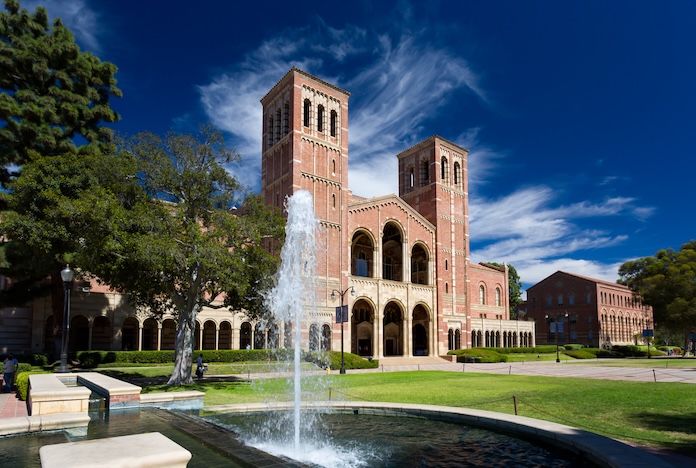
Looking at the campus, it’s not hard to see why UCLA attracts all this attention. The grounds are stunning, with vast green lawns, rolling hills and Italian-style brick buildings, a visual aesthetic celebrated most abundantly at Royce Quad. On one side of this iconic courtyard, which lies on the academic side of campus (the dorms lie on a hill on the opposite side), you have the picturesque Royce Hall, modeled after the San Ambrogio Church in Milan. The inside of this building is used as a lecture space, but it is also where the school hosts some of its bigger concerts (I won’t age myself by sharing who I saw play here). On the other side of the quad, you will find the campus’ most popular study spot, Powell Library, with its signature bell tower chiming out show tunes and theme songs every hour, on the hour.

Common App 911/UC App 911
Step-by-step strategic support.
WHY UCLA
This question is tricky because you could ask 100 UCLA students why they chose UCLA, or why they are happy to be there, and you would get 100 drastically different answers. The school has so many academic and extracurricular options to explore, and no two Bruins will experience UCLA the same way. For me, the majority of my time at UCLA was committed to the Greek system (I was a member of the Zeta Beta Tau fraternity and published a Greek-life newspaper in my senior year) as well as my classes in History and Geography. But I have advised students who attended UCLA and experienced almost no overlap with the pathways I chose: students who went into UCLA’s ROTC program, who were active in student government, striving to center the voices of women of color, who joined the surf club or found their community in their dance electives or even served a short stint as Josephine Bruin (one of our two school mascots).
Generally, UCLA stands out amongst the other UCs for its incredible location (nestled between Hollywood and the Pacific Ocean, just a 20-minute drive from the Santa Monica beach and about an hour from both Disneyland and Universal Studios), as well as its rah-rah sports culture (more D1 NCAA championships than any other college in the country and a storied rivalry with crosstown nemesis USC) and its work hard, play hard culture. But as I said, these are just the general features. What pulls people into UCLA are all the unique paths you can walk as a student there, and that diversity of experience is what I love about the school.
I also find it interesting that the things I remember most fondly about UCLA have little to do with my “niche” of Greek life and History courses. Instead, I am most drawn to the experiences that fell outside of my “norm”, the times I stepped outside my comfort zone and took advantage of the unfamiliar offerings my school presented: the Italian cooking class from my sophomore year; my job as groundskeeper for the UCLA baseball team; and let’s not forget my brief stint as DJ Beathoven, a 90s hip-hop DJ for the student-run radio station. The beauty of the UCLA experience is that I got to try all of these things, and that each new avenue I explored brought a new group of friends into my life: people who were exploring the same budding interests or well-developed passions as myself.
UCLA: DIVERSITY OF EXPERIENCE
UCLA is a wonderful school because of this rich academic and extracurricular ecosystem. The school’s reputation in academics also carries UCLA grads far. According to the San Francisco Chronicle, the return on investment for a UCLA degree is $211,000, more than USC or any other UC outside of Berkeley. Even more relevant to the student experience is the fact that UCLA has excellent teachers. During my time there I was lucky enough to study under Teofilo Ruiz (recipient of the National Humanities Medal) but the faculty is also comprised of Nobel Prize Laureates (like Dr. Andrea Ghez, Ph.D.), Pulitzer Prize winners (like Dr. Jared Diamond, Ph.D., author of Guns, Germs and Steel), and National Academy of Engineering members (like earthquake engineer, Dr. Jonathan Stewart, Ph.D., P.E.).
The school is particularly strong in engineering, business, music and film, though a word to the wise: these programs are extremely competitive, some only accepting a few dozen students each year. And don’t try to apply to UCLA as a less competitive major, with plans of transferring into a more competitive major down the road. While this may work at some smaller institutions, it is an impossible feat at UCLA, where these competitive programs are capped and the large student population creates a situation where academic exploration is not widely encouraged. UCLA likes to get students into their majors early and keep them there until they graduate, though there is a little bit of wiggle room to switch majors early in your career, especially if they are majors within the same college or at the same level of “competitiveness”.
AFTER UCLA
As a graduate of UCLA, you will enjoy access to a massive alumni network spread across a wide range of industries. There are so many UCLA grads out in the wilds of the professional world, especially if you see yourself settling down in California. Another word to the wise: the best time to tap into this alumni network is before you graduate from UCLA. Please learn from my mistakes and spend some time accessing the resources at the UCLA Career Center before you graduate. That office provides some wonderful services, including practice interviews, resume support, and connecting students with alumni in relevant industries to conduct informational interviews, shadow sessions, and more. Use your resources well, my friends! UCLA has a lot of them, but nobody is going to track you down and make you use them. You must seek these things out yourself.
Stay tuned for Part 2 in July, where I will share some specific tips for applying to UCLA (and the UC system in general) since it has become one of the most competitive – and selective – colleges in the U.S.
If you enjoyed this post, follow us on Instagram @toptieradmissions for more tips and subscribe to our blog for expert insights & college admissions news!