

As a young teen, I often went on family outings to the now nonexistent bookstore, Borders. While my siblings wandered off to peruse the fiction and sports sections, I usually found myself wandering in the direction of the college guidebooks and U.S. News & World Report college rankings list (perhaps I was always headed in this career direction!). The list fascinated me, not only for its representation of the wide range of options available in academia, but for the subtle differences in schools based on various seemingly-important criteria.
More than 25 years later, I now have the privilege of working with families navigating the college search and application process as a Senior Private Counselor at Top Tier Admissions. In speaking with students and parents I am often reminded of the allure of these lists, but as a seasoned professional, I am also aware of the dangers of overreliance on rankings as a tool in the college search.
U.S. News & World Report – The Original Rankings List
First published in 1983, U.S. News’ list of best colleges was originally based entirely on a school’s reputation as perceived by its peer institutions. Over time, the methodology has evolved, now grounding the rankings in less subjective factors. Although “peer assessment” still plays a significant role in theirrankings, other factors—such as selectivity, graduation rates, student retention, and student debt— now play a role as well.
In spite of these methodological changes, criticisms of U.S. News’ rankings list abound. Objections range from the arbitrary nature of weight given to different variables to the impact that the rankings very existence has on institutional priorities (colleges may make strategic choices to bump themselves up on the list), and even the accuracy of the quantitative data considered.
In recent years, many alternative rankings lists have emerged, utilizing a range of different metrics and seeking to provide consumers of higher education with a more balanced, objective take on the colleges they consider. As TTA CEO Dr. Liz Doe Stone shares in her recent Forbes piece, families gravitate towards rankings for the seeming certainty they provide amidst a process that can feel anything but.
The latest addition to the rankings game? TIME magazine.
College Private Counseling
Unlock your full potential.
How TIME Calculates Its Rankings
TIME magazine’s list seeks to evaluate colleges on the basis of student outcomes, as measured by three key factors:
- Academic Capacity & Performance (60% of final score): This metric considers the resources expenditure per student, research funding per faculty member, student to faculty ratio and student to staff ratio.
- Innovation and Economic Impact (30% of final score): This metric refers to a university’s impact on technological advances, the value and reach of its intellectual property, and its influence on the economy through professional roles held by its graduates.
- Global Engagement (10% of final score): This measures the international appeal of a university, including the interest of international students in attending the school, the proportion of international undergraduates, and the proportion of international faculty members.
Comparing U.S. News and Time Rankings
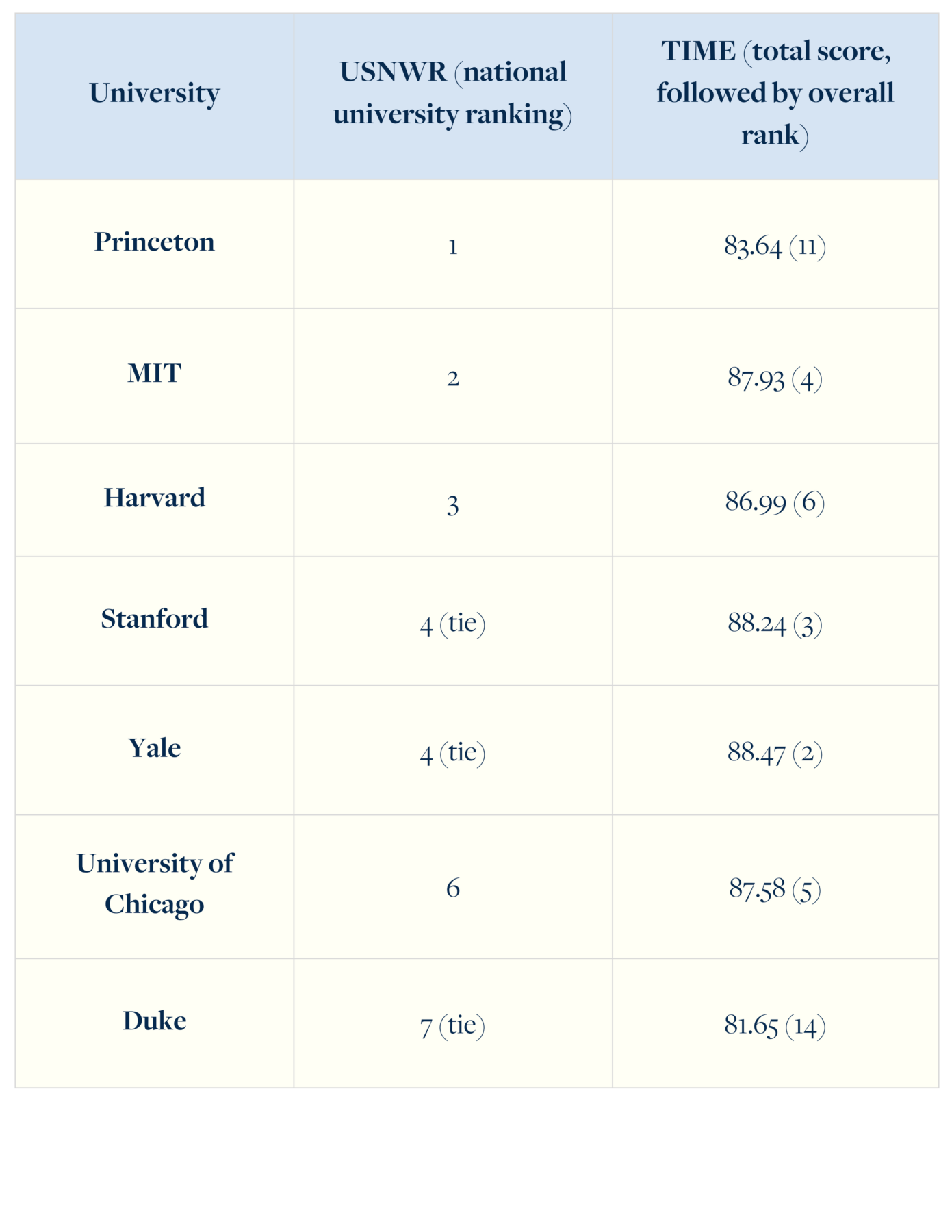
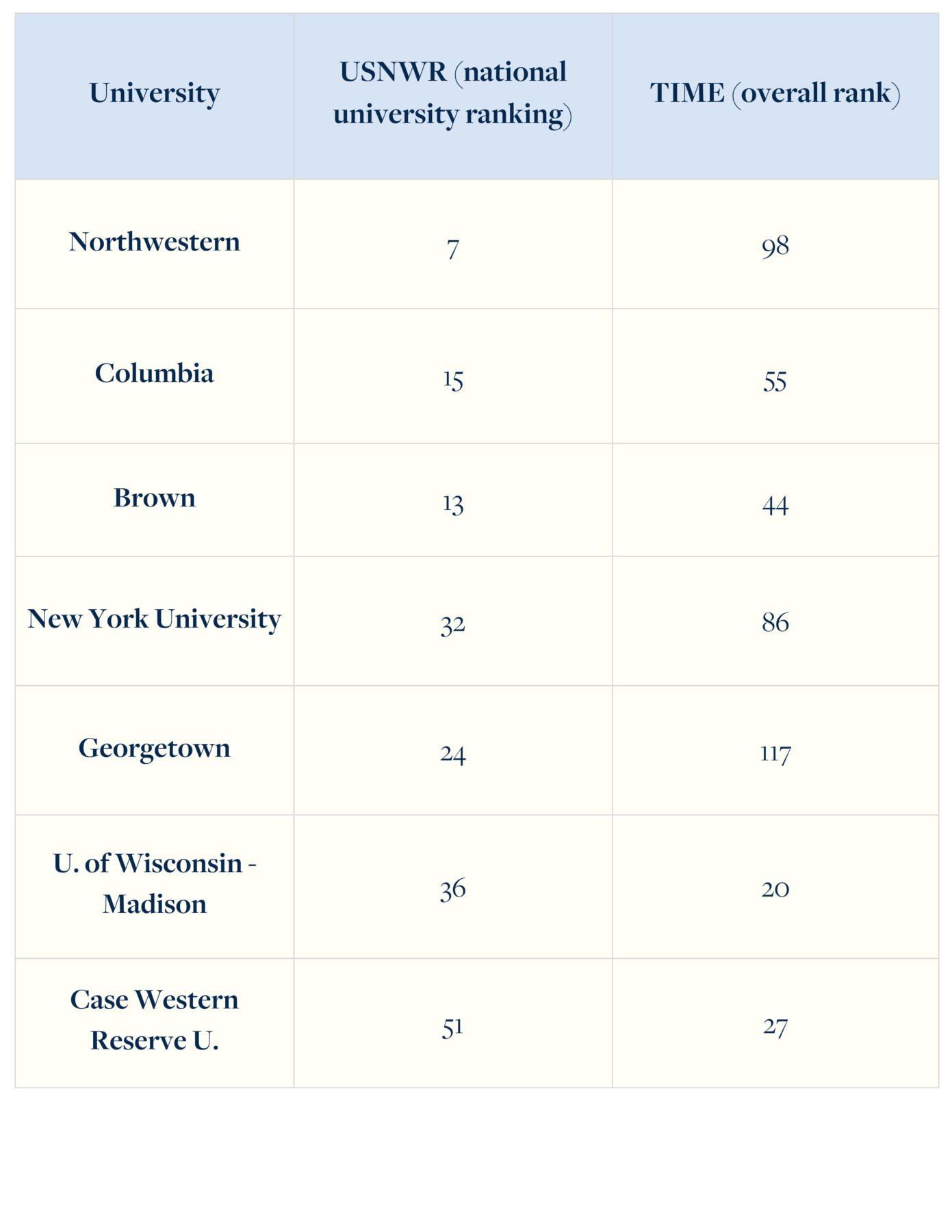
A key difference between the two lists is TIME’s inclusion of universities outside the United States. The University of Oxford in the United Kingdom takes the top spot on the list with a total score of 90.11. Still, many of U.S. News & World Report’s top 10 are reflected on TIME’s list as well.Notable differences in U.S. News’ top 10 as compared to TIME’s listare a few schools among the favorites of TTA applicants:
Ranking the Rankings
As is evident from the tables above, rankings systems vary. So, what makes a college or university a “top” school? The best colleges are not those that fall into the top 20 of any particular ranking list. Rather, they are the ones that offer the best fit for an individual student. A “must have” criterion for one student may be a dealbreaker for another. Sometimes, “best” just comes down to a school’s vibe. Rankings lists can serve as a good starting point, but they provide just a tiny snapshot of a much larger picture. At Top Tier Admissions, we help students to deeply explore their interests, goals, and needs, then craft a college list that includes schools reflecting these priorities.
Want to stay in the loop? Follow us on Instagram @toptieradmissions and subscribe to our blog for expert advice and admissions insights.
Know someone else navigating the college process? Pass it along—they’ll thank you later!

- College Rankings Explained: U.S. News vs. Time - March 4, 2026
- Behind the Scenes of College Admissions: What Happens After You Click “Submit” - January 6, 2026
- Is Your Student Stanford Ready? - October 28, 2025